Most Popular Architect CEU Topics
Architects have to keep pace with changing codes, new project delivery methods, sustainability goals, and shifting client expectations. Continuing education gives licensed professionals a practical way to keep their knowledge current while meeting renewal requirements.
The most popular architect CEU topics tend to reflect the work architects are already doing every day. Design teams need better ways to reduce energy use, improve safety, coordinate with engineers, and create healthier buildings. The right continuing education courses can help design professionals strengthen those skills while staying organized for license renewal.
PDH-Pro supports professional architects with flexible online learning, state-specific continuing education resources, expert-developed courses, and instant access to certificates after passing the exam. For engineers who work closely with architecture teams, facility managers, consultants, and state boards, that mix of convenience and reliable documentation can make renewal planning for architecture teams much easier.
Current Architect CEU Topics Shaping Professional Practice
Popular CEU subjects usually follow the same pressures shaping the built environment. Architects are being asked to design buildings that use less energy, meet stricter codes, support occupant wellness, and adapt to new technology. Continuing education helps turn those broad goals into practical project decisions.
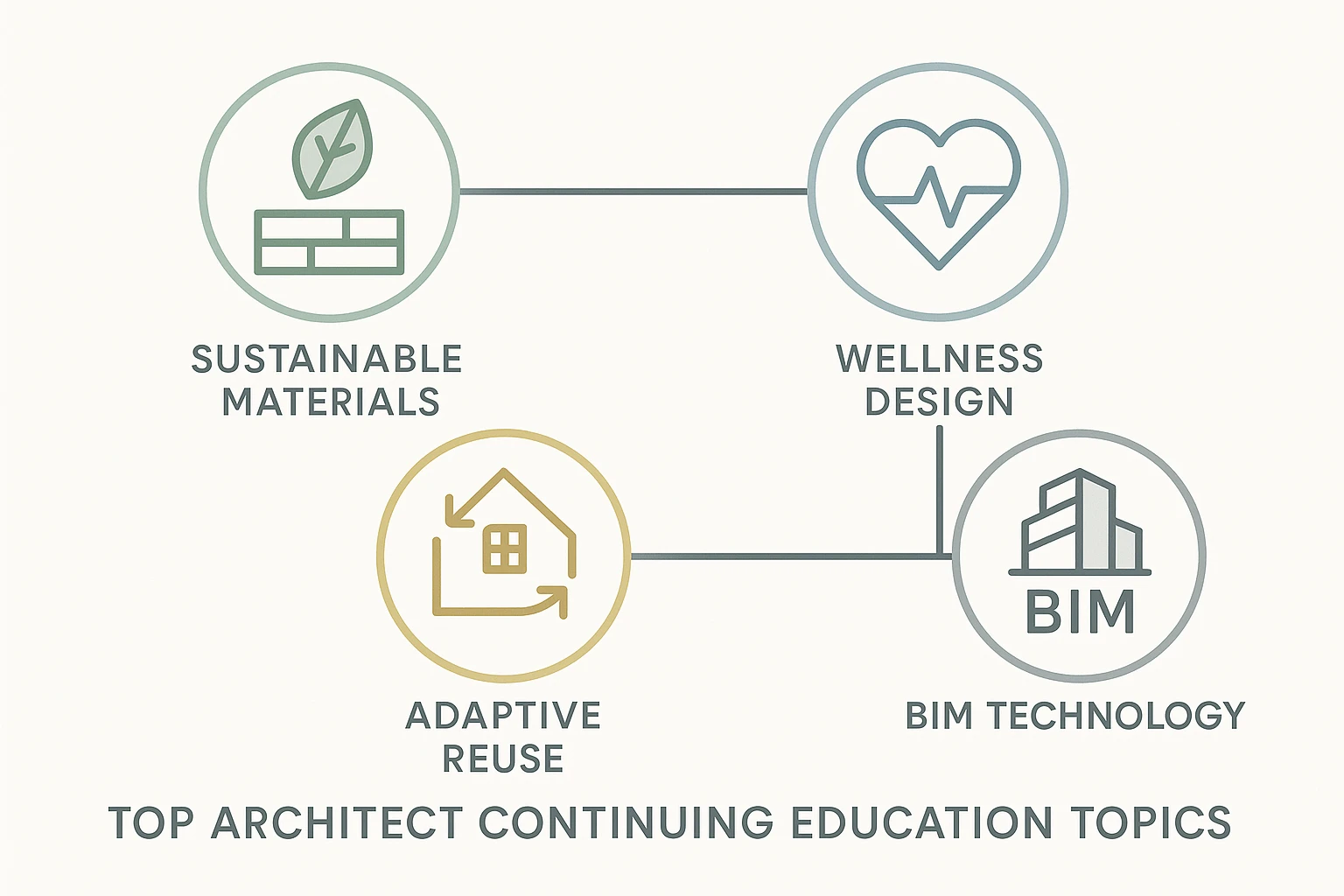
Several topic areas appear again and again in architect continuing education because they connect directly to daily practice:
- Sustainable design, energy performance, and carbon reduction
- Building codes, accessibility, fire safety, and life safety
- Adaptive reuse, existing building upgrades, and resilient design
- Building systems coordination, including HVAC, lighting, plumbing, and electrical integration
- Digital tools, BIM workflows, construction documentation, and project delivery
- Ethics, professional responsibility, risk management, and state-specific rules
Architects also need to understand how CEUs, PDH credits, learning units, and continuing education hours apply to their own license. The terminology can vary by board, organization, and state. Before selecting courses, professionals should check their renewal rules and confirm which course types count toward their required credits.
AIA continuing education often plays a major role in professional development, especially for architects who track learning units through AIA programs. State licensing boards may have their own requirements as well, including health, safety, and welfare content, accessibility training, ethics, or rules specific to the state. That is why course planning works best when it starts with compliance, then moves into professional goals.
PDH-Pro’s online format supports architects who need a practical way to manage PDH credits, state requirements, and renewal documentation. Self-directed courses and webinars make it easier for busy professionals to fit learning around deadlines, site visits, client meetings, and renewal dates. Instead of setting aside a full travel day for an event, architects and related licensed professionals can focus on courses that match their practice area and documentation needs.
Designing for Net-Zero Energy, Carbon, and Sustainable Buildings
Sustainable design remains one of the strongest areas of interest in architect CEUs. Net-zero energy goals, carbon reduction, high-performance envelopes, and climate-responsive design now influence early planning, specifications, and consultant coordination. Clients want lower operating costs, communities want better environmental outcomes, and code requirements continue to move toward better performance.
Courses in this area often help architects connect design intent with measurable results. That can include passive design strategies, envelope detailing, daylighting, material selection, water efficiency, renewable energy coordination, and life cycle thinking. The value comes from learning how each decision affects the final building, not simply knowing the vocabulary.
Carbon-focused training has also become a major part of continuing education. Operational carbon looks at the energy used by a building after occupancy. Embodied carbon looks at the impact of materials, manufacturing, transport, construction, maintenance, and end-of-life decisions. Architects who understand both can make better choices during design development and specifications.
| CEU Topic | Why Architects Choose It | Practical Project Application |
| Net-Zero Energy Design | Supports energy targets and high-performance project goals | Building orientation, envelope design, energy modeling coordination, and renewable energy planning |
| Carbon Reduction | Helps teams compare material and system impacts | Lower-carbon concrete, steel, insulation, finishes, and life cycle assessment discussions |
| Sustainable Materials | Supports healthier, lower-impact design decisions | Product research, specifications, durability planning, and indoor environmental quality |
| Resilient Design | Prepares projects for climate, weather, and operational disruption | Flood-resistant strategies, heat mitigation, backup systems, and site planning |
| Building Systems Coordination | Improves collaboration with engineering consultants | Earlier HVAC, lighting, controls, plumbing, and electrical coordination |
Sustainability training also supports better communication. Architects often serve as the connector between client goals, engineering recommendations, budget limits, and code requirements. A course that explains energy modeling, envelope performance, or carbon metrics in plain terms can help an architect lead those conversations with more confidence.
PDH-Pro’s subject matter expert course approach fits architects who want practical technical content designed around NCEES standards and state engineering board requirements. The strongest courses do not treat sustainability as a trend. They show how architects and engineering partners can apply better design choices on real projects.
Building Codes, Safety, and Vertical Transportation
Code-related courses remain highly popular because they affect nearly every project. Architects need to understand how design decisions relate to occupancy classifications, means of egress, fire protection, accessibility, structural coordination, and public safety. A missed code issue can delay approvals, increase costs, or force redesign late in the process.
Safety topics also support better coordination with consultants and authorities having jurisdiction. Architects do not need to perform every technical calculation themselves, but they do need to understand how building layout, systems, and documentation affect compliance. Continuing education can sharpen that judgment.
Elevators and vertical transportation deserve special attention in modern buildings. Taller structures, mixed-use projects, healthcare facilities, multifamily developments, and office towers all depend on reliable movement through the building. Elevator planning affects space allocation, circulation, accessibility, emergency response, fire service access, and user experience.
Training on elevators often covers system types, traffic management, safety requirements, machine room planning, controls, maintenance access, and coordination with structural and electrical systems. For architects, that knowledge can improve early design decisions. Shaft sizes, core planning, lobby layouts, waiting areas, and emergency features all become easier to coordinate when the architect understands how the system works.
Vertical transportation also connects with accessibility. Architects must consider users with mobility needs, service access, stretcher requirements in certain occupancies, and clear wayfinding. Continuing education on this topic helps teams design buildings that move people safely and efficiently.
A strong code and safety education plan may include courses on fire-resistive construction, accessibility updates, existing building codes, fall protection, emergency systems, and construction phase risk. These topics may feel technical, but they directly support better design work and smoother approvals.
Interior Spaces, Building Systems, and Technical Training
Interior environments are where building performance becomes personal. Occupants experience the quality of a space through air, light, sound, comfort, layout, and accessibility. That is why interior-focused architect continuing education remains popular across commercial, institutional, healthcare, education, and workplace projects.
Training in interior spaces may cover programming, space planning, accessibility, acoustics, lighting design, indoor air quality, materials, fire ratings, and code coordination. These subjects help architects create spaces that look good, work well, and support the people who use them.
Building systems training is just as valuable. Mechanical, electrical, plumbing, fire protection, and control systems can shape ceiling heights, room layouts, wall assemblies, roof planning, equipment access, and operating costs. Architects who understand system basics can coordinate earlier and reduce conflicts.
Useful technical courses often address:
- HVAC layout principles, ventilation, humidity control, and equipment coordination
- Lighting quality, daylighting, controls, glare, and energy code alignment
- Acoustics for offices, classrooms, healthcare spaces, housing, and public buildings
- Plumbing coordination, water efficiency, fixture planning, and maintenance access
- Electrical rooms, panel locations, backup power, charging needs, and smart building controls
These courses are especially helpful for architects who manage multidisciplinary teams. Early coordination can prevent ceiling conflicts, awkward soffits, poor equipment access, and expensive redesigns. Better technical understanding also improves communication with clients, contractors, and engineers.
Digital tools add another layer. BIM, model coordination, clash detection, digital documentation, and project delivery platforms have changed how teams work. Architect CEUs that address software and workflow changes can help professionals use technology to reduce errors, improve coordination, and manage project information with greater discipline.
PDH-Pro’s online learning model is useful for architects who want to build technical knowledge one course at a time while meeting PDH renewal requirements. A busy architect may not be able to attend a full conference, but a targeted online course on lighting, safety, systems coordination, or professional practice can fit into a normal workweek.
Choosing Online CEU Courses for License Renewal
The best CEU plan starts with the rules that apply to your license. Architect continuing education requirements can vary by state, renewal cycle, accepted provider, subject matter, and documentation standard. AIA membership requirements may not be identical to state board requirements, so architects should review both when needed.
Online courses can make renewal planning easier, especially for professionals licensed in multiple states or working under tight deadlines. The convenience matters, but documentation matters just as much. Certificates, course descriptions, completion dates, and credit hours should be easy to access in case of an audit.
When comparing CEU courses, architects should look for clear course information before enrolling. The course title, provider details, credit value, subject area, format, completion requirements, and certificate process should all be easy to understand. For architect continuing education courses online, architects should confirm whether the provider meets their state board rules, AIA learning needs, and documentation requirements before enrolling.
State-specific planning can prevent renewal stress, especially for professional engineers managing architecture board requirements across one or more states. Some boards require certain topics, such as ethics, accessibility, laws and rules, or health, safety, and welfare content. Other boards focus on a total number of hours within the renewal period. Professionals should keep records even when a provider offers instant certificates or online tracking.
PDH-Pro is built around flexible course access, expert-developed engineering training, state-specific architecture packages, board approval information, and immediate certificate access after passing the exam. That structure is helpful for licensed professionals who want a simpler way to manage continuing education without losing sight of compliance.
Architects who work closely with engineers may also find value in technical courses that overlap with building performance, systems, sustainability, safety, and infrastructure. Many design challenges sit between architecture and engineering. Learning across those boundaries can improve coordination and project outcomes.
A practical renewal plan might include one code or safety course, one sustainability course, one technical systems course, and one professional practice or ethics topic. From there, architects can add specialized training based on their project type, state rules, and career goals.