
Written by: Jordan Ellis
Published: Oct 1, 2026
 Pennsylvania PE continuing education carryover lets you move up to 12 eligible PDH earned beyond the 24-PDH biennial requirement into the next renewal period. You cannot carry more than 12 or count the same PDH toward two renewal periods. For the broader rules, see Pennsylvania PE continuing education requirements.
The carryover rule applies to professional development activity completed by the licensee, not to a general account balance or unused course purchase.
How many professional development hours can Pennsylvania PEs carry forward?
Table of Contents
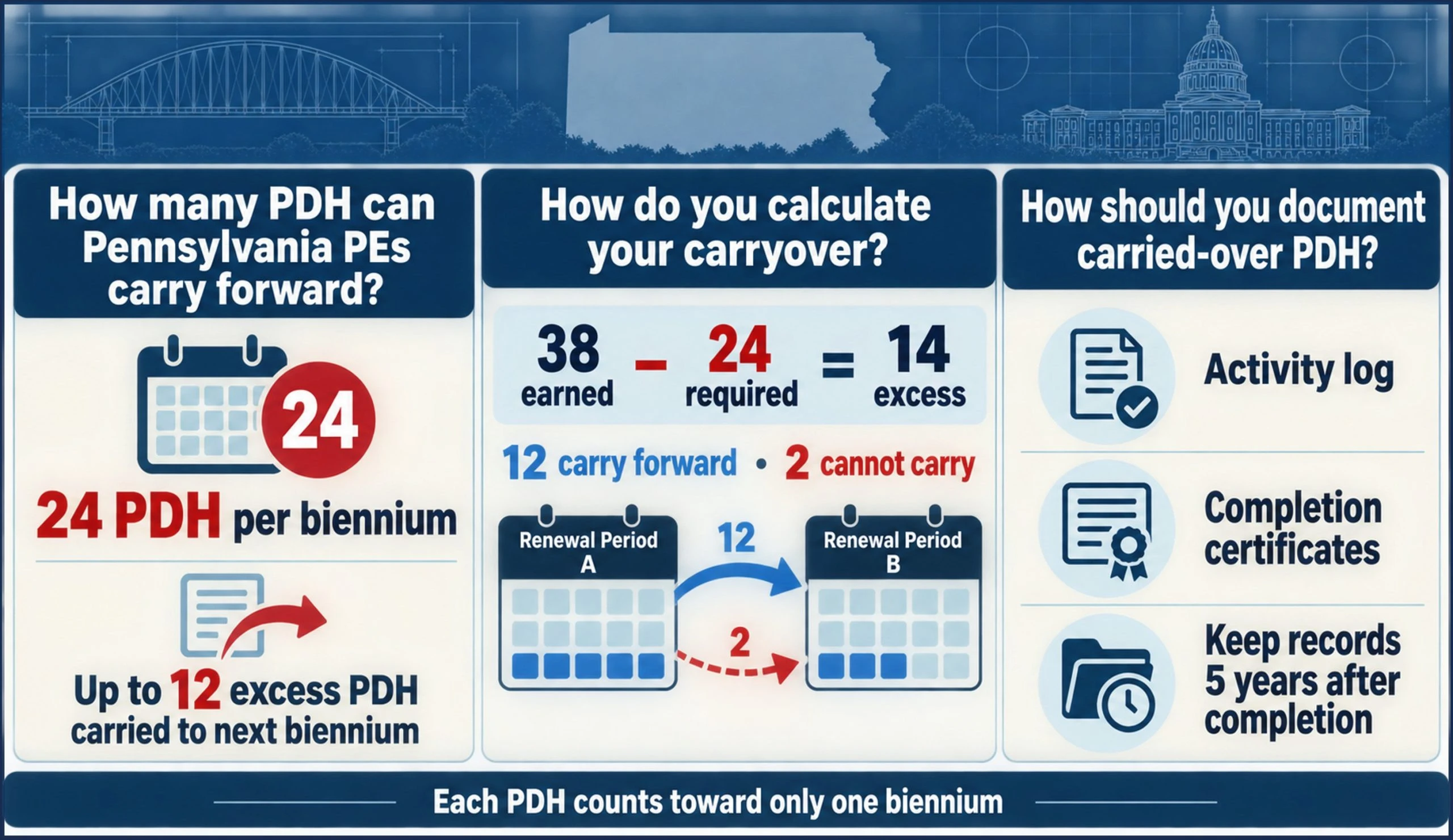
Pennsylvania requires 24 professional development hours (PDH) during each two-year renewal period. If you earn more than 24 qualifying PDH, the law permits you to carry up to 12 excess hours into the subsequent period. The limit applies to hours you actually earned and can document. Each PDH unit should be tied to a specific activity, completion date, and renewal period so the engineer can show how the credit was earned and where it was applied.
The Pennsylvania board’s renewal page says licenses expire September 30 in odd-numbered years. As of this article’s verification date, the next regular expiration is September 30, 2027. Check your own license status before planning around that date.
If you carry the full 12 PDH into the next biennium, you need 12 additional qualifying PDH to reach its 24-PDH requirement. Carrying six leaves 18 to earn. Carryover changes how you meet the next period’s requirement; it does not change the 24-PDH minimum.
| Carryover From Prior Period | Additional PDH Needed This Period | Total Toward 24-PDH Requirement |
|---|---|---|
| 0 PDH | 24 PDH | 24 PDH |
| 6 PDH | 18 PDH | 24 PDH |
| 12 PDH | 12 PDH | 24 PDH |
Which continuing education and professional development hours qualify for carryover?
 Only qualifying excess hours can carry forward. Pennsylvania recognizes activities relevant to professional practice, including college and continuing education courses, correspondence and recorded courses, tutorials, seminars, employer-sponsored courses, technical presentations, teaching, publications, and patents. Courses in practice building or office management receive no credit.
The professional development activity should reduce technical, ethical, or regulatory risk in the engineer’s practice by maintaining or improving knowledge used in professional services.
For the role of professional conduct instruction in your course plan, see Pennsylvania PE continuing education ethics requirement.
Pennsylvania measures credit in PDH. Under the registration law, one continuing education unit (CEU) equals ten PDH, while one hour of qualifying course work generally equals one PDH. Convert credits shown in other units before calculating your excess.
A continuing education unit is a different measurement unit, so convert the unit before deciding whether any excess credit remains for carryover.
The board says it does not preapprove continuing professional competency activities, courses, or providers. It retains final authority over course eligibility and credit value. Check a course’s subject, duration, completion evidence, and relevance to your engineering practice before relying on it for renewal or carryover.
| Activity Type | Carryover Treatment |
|---|---|
| Relevant engineering course completed in the current biennium | May qualify if documented and unused after the 24-PDH requirement is met |
| Course purchased but not completed | Should not be counted as earned PDH |
| Practice building or office management course | Not eligible for Pennsylvania PE credit |
| Old carryover from a prior biennium | Cannot be rolled forward again as newly earned excess |
If some of your excess hours come from coursework, Pennsylvania PE college course credits explains how to assess and convert that credit.
Hours earned during the current renewal period and assigned PDH units
Assign each activity to the biennium in which you completed it. First identify the hours satisfying that period’s requirement. You can then designate up to 12 otherwise unused, qualifying hours for the immediately following biennium. A purchase receipt alone does not establish when you completed a course.
For a written course with a quiz or an on-demand webinar, keep the completion record showing when you earned the credit. Pennsylvania law identifies correspondence, videotaped, and other relevant short courses or tutorials as potentially eligible, subject to the board’s determination.
Why the same PDH cannot count in multiple periods
Pennsylvania’s regulation states that a PDH unit cannot satisfy the continuing education requirement for more than one biennium. An excess hour carried forward is assigned to the next period; it is not also one of the hours used to meet the first period’s 24-PDH requirement. That same hour cannot keep rolling into a third period. The regulation also bars credit for more than one presentation of a particular course or activity within a single renewal period.
If your current total includes hours carried in from an earlier biennium, separate those from activities newly completed this biennium. An old carryover hour does not become a newly earned excess hour just because your current total exceeds 24. This is especially important when a licensee completes professional development early in the renewal cycle and later adds more courses near the deadline.
How do you calculate carryover and risk of overclaiming credit?
Start with qualifying PDH completed in the current biennium. Account separately for any valid hours carried into it. Once you have established how you met the current 24-PDH requirement, identify any newly earned, unused hours you can assign to the following period, up to the 12-PDH limit. Keep that allocation with your activity records.
Example: earning 38 PDH in one biennium
Suppose you start with no carryover and complete 38 qualifying PDH in one biennium:
| Calculation | PDH | Treatment |
| Qualifying hours completed | 38 | Confirm completion dates and records |
| Hours applied to this period | 24 | Meets the biennial requirement |
| Newly earned excess | 14 | 38 minus 24 |
| Maximum carried to the next period | 12 | Pennsylvania’s statutory limit |
| Excess that cannot be carried | 2 | Cannot be claimed in a later period |
| Additional hours needed next period | 12 | Assumes all 12 carried hours qualify |
If you completed 29 qualifying PDH instead, you could carry five. These examples apply the statutory 24-PDH requirement and 12-PDH carryover cap; the regulation prevents reuse of a PDH across biennia.
If you hold licenses in several states, check each jurisdiction separately. Pennsylvania can accept credit earned in another jurisdiction when the activity otherwise complies with its rules. That does not establish how another state will treat the activity or Pennsylvania’s carryover allocation. Keep a separate renewal calculation for each license. The safest approach is to maintain a separate calculation for each state license instead of assuming one continuing education rule applies across all jurisdictions.
How should you document carried-over PDH?
Pennsylvania makes licensees responsible for records supporting claimed credit. The law calls for an activity log showing the type of activity, sponsor, location, duration, instructor or speaker, and PDH earned, plus certificates or other proof of attendance. For an hour you carry forward, also record its completion date, earning biennium, and the later biennium to which you assigned it. Those additional allocation notes are a practical way to make your calculation understandable during an audit.
A clear record should show the original PDH unit, the activity provider, the completion evidence, the carryover amount, and the renewal period where the credit was used.
Certificates, activity records, audit risk, and five-year retention
Keep records verifying completion for five years after each activity. The board may audit licensees and requires a full response within 30 days of its request, unless the request specifies another time. Retain the original certificate and your carryover calculation together.
Before renewing:
- Confirm your license status and renewal deadline.
- Reconcile newly completed PDH and any valid carryover from the previous biennium.
- Set aside no more than 12 newly earned, unused PDH for the next biennium.
- Save certificates, course information, the activity log, and your allocation calculation.
- Review the rules for every other state in which you hold a license.
The credit and recordkeeping requirements come from Pennsylvania law and regulation; this sequence is practical guidance for applying them. Ask the Pennsylvania licensing board about an unusual activity, exemption, or disputed credit before relying on it.