
Written by: Jordan Ellis
Published: Oct 5, 2026
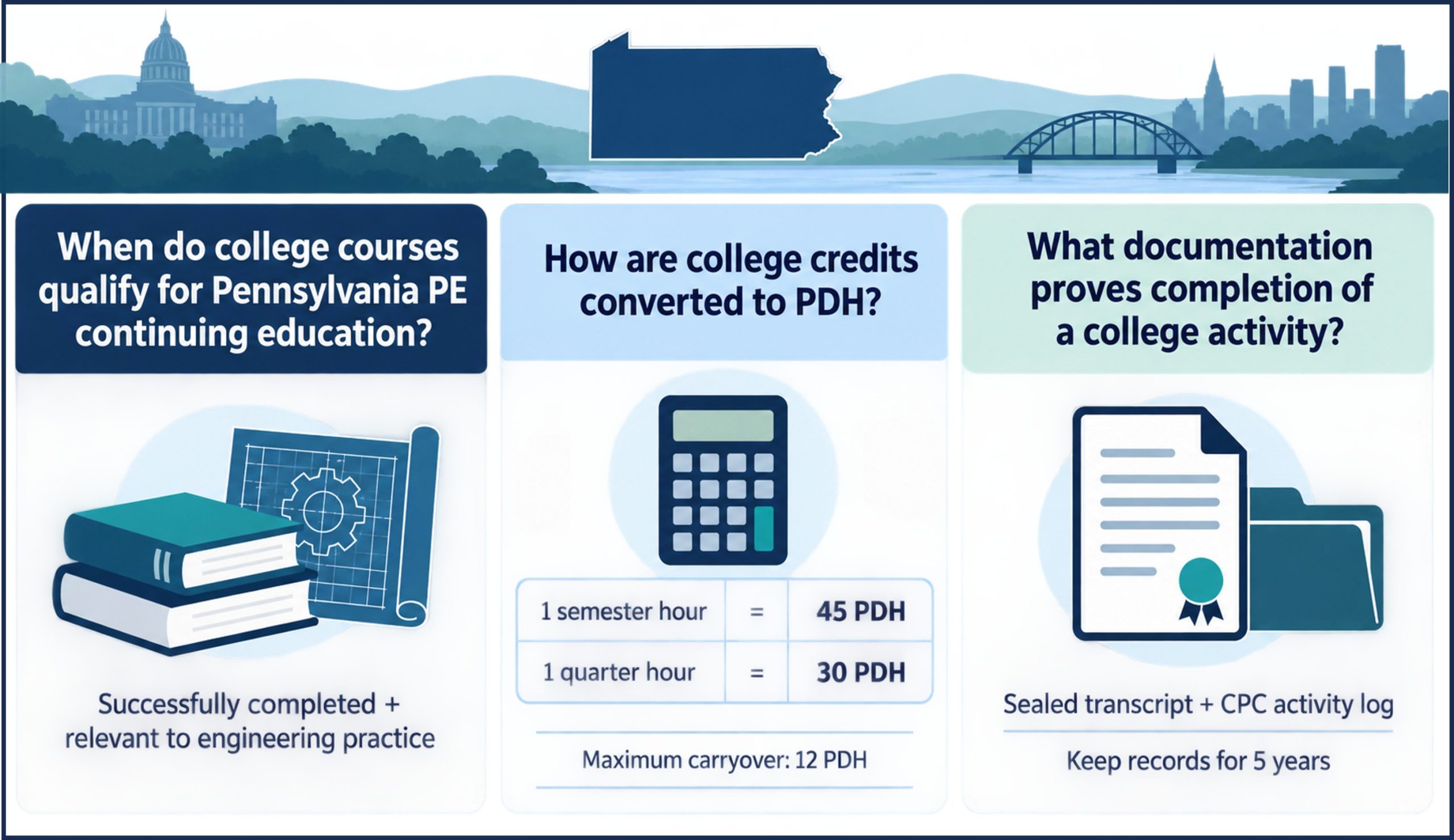
 Pennsylvania PEs can earn continuing education credit for successfully completing a college course relevant to their professional practice. One semester hour converts to 45 PDH, and one quarter hour converts to 30 PDH, both more than the state’s 24-PDH biennial renewal requirement. The conversion does not make every class eligible: the coursework must qualify, and the board’s guidance calls for a sealed transcript to support the claim. For the full renewal rules, see continuing education requirements for Pennsylvania engineers.
When do college courses qualify for Pennsylvania PE continuing education?
Table of Contents
Pennsylvania’s engineering registration law recognizes the successful completion of college courses relevant to professional practice as a way to earn professional development hours. The course needs a clear educational purpose that maintains, improves, or expands knowledge relevant to your work as an engineer. Enrollment alone is insufficient: the law specifies completion.
That distinction is useful if you are studying for a graduate degree, taking one university class while working, or returning to school for a technical subject outside your original discipline. A course can be valuable to your career and still require a separate judgment about whether it supports a Pennsylvania CPC claim. Evaluate the course content against the engineering services you perform or reasonably expect to perform.
Pennsylvania uses continuing professional competency (CPC) for its renewal program and professional development hours (PDH) to measure the requirement. Academic semester or quarter hours are converted into PDH under the law. They are not the same unit as a continuing education unit (CEU), which has its own conversion rule.
Relevance to professional practice, student records, and successful completion
A course in hydraulic modeling could be relevant to an engineer who designs water infrastructure. Advanced statistics might support an engineer’s work in reliability analysis, environmental data interpretation, or quality control. A course in control systems could be pertinent to someone responsible for process equipment. These are illustrations, not a board-approved catalog. The connection depends on the content and the licensee’s practice.
Relevant research methods, advanced technical studies, design preparation, or clinical engineering topics may support a PDH claim when they connect directly to the engineer’s professional practice.
The statute defines college semester and quarter hours with reference to courses in qualifying programs or other related college courses. It also describes a qualifying course as one with a clear purpose and objective that develops knowledge relevant to professional practice. The key question is therefore more specific than “Was this offered by a college?” Ask what the class taught and how that knowledge relates to your engineering responsibilities.
Before registering primarily for PDH, check the syllabus or official course description. Identify the technical topics, learning objectives, academic credit unit, and method of documenting completion. Keep a copy of that description as useful context. The board’s specified evidence for a completed college course is a sealed transcript; a syllabus by itself does not establish that you completed the class.
For a student completing college-level study, the syllabus, university catalog, or graduate catalog can help document what the course covered, but the transcript remains the primary record showing successful completion and academic credit.
Pennsylvania’s statute does not specify a particular grade in the provisions reviewed here. Avoid assuming that merely attending classes or enrolling for an audit satisfies “successful completion.” If a grading arrangement, pass/fail designation, or noncredit enrollment makes completion unclear, seek clarification from the board before relying on the activity for renewal. That is a practical recommendation arising from the statutory completion requirement, not a new grade threshold.
Coursework, health, and fitness classes that usually do not support an engineering PDH claim
 A college’s involvement does not override Pennsylvania’s subject-matter rules. The law expressly denies credit for a course in practice building or office management. A class focused on attracting clients or administering an office should not be claimed simply because it appears on a university transcript.
For a course outside your usual engineering discipline, examine its actual content before excluding or claiming it. For example, data analysis may have a sound connection to technical work, while a general-interest class may have none. Write down the professional connection in one or two plain sentences and retain the description that supports it. This note helps explain your reasoning if the board later asks about the course; it does not replace the required completion evidence.
Do not import rules from other professions. An Act 48 course for Pennsylvania educators, a health education class, or a college physical education requirement is not automatically PE continuing education. The question for this article is whether the particular college course satisfies the engineering law’s relevance and completion requirements. Likewise, courses designed mainly for teacher certification, educator preparation, student wellness, campus recreation, fitness, or physical education should not be treated as engineering PDH unless the licensee can clearly document a professional engineering connection.
How are college credits converted to PDH?
Pennsylvania’s law sets the following conversions for qualifying academic coursework. The values apply to the academic units shown on the transcript, subject to the course meeting the CPC requirements.
| Documented academic unit | Pennsylvania conversion | Illustrative calculation |
| 1 semester hour | 45 PDH | 1 × 45 = 45 PDH |
| 1 quarter hour | 30 PDH | 1 × 30 = 30 PDH |
| 1 CEU | 10 PDH | 1 × 10 = 10 PDH |
A CEU is included to prevent confusion between different units; it is not a semester or quarter hour. Read the transcript or completion document rather than estimating credit from the number of weeks the class ran. A three-semester-hour class, for example, converts mathematically to 135 PDH if the coursework qualifies. That figure does not mean you need 135 hours for renewal or may transfer all unused hours indefinitely.
If a separate course certificate reports CEUs rather than college credits, how many hours does 1 CEU equal explains that conversion.
Semester hours, quarter hours, and the 24-PDH requirement
A Pennsylvania PE ordinarily needs 24 PDH during each biennial renewal period. The statute allows no more than 12 excess PDH to carry into the subsequent period. Thus, one qualifying one-semester-hour course can exceed the current period’s 24-PDH requirement, but its 45-PDH conversion does not permit all 21 excess hours to carry forward. The maximum carryover is 12.
Here is a simplified example. An engineer completes a qualifying one-semester-hour college course during a renewal period and has no other PDH. The course converts to 45 PDH. Of those hours, 24 satisfy that period’s requirement; up to 12 may be carried into the next period under the statutory limit. The remaining excess does not increase the carryover allowance. This example assumes the engineer is subject to the ordinary requirement and that the activity is accepted as qualifying.
Record the course completion date and the period to which you apply the hours. Pennsylvania’s regulation generally applies continuing education to the biennium in which it was completed, subject to its stated carryover and other exceptions. It also prohibits using a PDH unit to satisfy requirements for more than one biennium. A clean calculation should show which hours satisfied the current renewal and which, if any, are carried into the next.
The board’s renewal information states that licenses expire September 30 of each odd-numbered year. As of the verification date for this article, the next regular expiration is September 30, 2027. The board also states that a licensee need not complete continuing education during the biennium in which the person is first licensed.
What documentation proves completion of a college activity, catalog listing, or transcript record?
Pennsylvania places responsibility for supporting claimed CPC on the licensee. Its law requires an activity log and records verifying the education claimed. For college coursework specifically, the board’s published PDH breakdown instructs a licensee to submit a sealed transcript from the college or university showing the course title, course number, and semester or quarter hours earned.
A transcript is different from a registration confirmation, tuition receipt, or course catalog page. Those materials may identify what was offered or paid for, but they do not establish successful completion and earned academic hours. The board’s general audit guidance says it does not accept payment receipts, registration notices, brochures, course literature, or sign-in sheets as substitutes for completion evidence.
If multiple colleges offer similar courses, compare the course number, catalog description, credit hours, and completion record rather than relying only on the course title.
Transcript requirements, course number, and CPC activity log
Use the board’s continuing professional competency activity log to record the academic activity. The form includes a college-course area for details such as the date, course title, institution, instructor, and PDH. The governing law calls for a log that identifies the type of activity, sponsor, location, duration, instructor or speaker, and PDH claimed.
The activity log should identify the student or licensee, the college or university, the course number, the instructor when available, the academic term, and the number of PDH claimed.
Keep the following together:
- The transcript showing the completed course and academic hours earned.
- Your completed CPC log and PDH conversion calculation.
- The syllabus or official description, if it helps establish relevance to your engineering practice.
- Any correspondence clarifying an unusual credit unit or course-completion designation.
The transcript and log support the core claim. The syllabus and correspondence provide context; they are not alternatives to a sealed transcript when the board requests the college-course documentation described in its guidance. Arrange for a sealed transcript in the manner the board specifies if you are audited.
Pennsylvania requires records verifying continuing education to be retained for five years after the activity is completed. The board audits licensees, and an audited engineer must respond fully within 30 days of a request unless the request gives another deadline. Missing required records can lead the board to infer that the claimed education was not completed.
Requesting or locating a transcript soon after the course ends is a sensible precaution, especially if an institution later changes its records system. The board says it will not review unsolicited documentation in advance to determine whether a course qualifies, and it does not maintain an ongoing record of each licensee’s completed activities. Maintain your own complete file.
Can college coursework satisfy more than one license renewal?
The same qualifying coursework can have implications for more than one license, but each licensing jurisdiction sets its own requirements. Pennsylvania’s regulation says a person who holds more than one class of license from its engineering, surveying, and geology board must meet the continuing education requirement for each. An activity applicable to more than one class may be applied to each license for which it is applicable.
For licenses issued by different states, Pennsylvania’s rules cannot establish what the other state will accept. Pennsylvania’s statute says it will accept credit earned in another jurisdiction if the activity otherwise complies with its requirements. That does not mean another state automatically accepts Pennsylvania’s academic conversion, relevance judgment, carryover calculation, or documentation. Check each board separately before making a multistate claim.
If qualifying coursework leaves you with excess hours, Pennsylvania PE continuing education carryover explains how many you may assign to the next biennium.
Pennsylvania carryover and licenses in other states
Carryover is limited to 12 PDH into the subsequent Pennsylvania renewal period, even when an eligible college course converts to many more hours. Track the amount used in the period of completion and the amount carried forward. Do not apply the same PDH units repeatedly across renewal periods.
If another state requires a specific topic, such as ethics, or treats academic coursework differently, satisfying Pennsylvania’s general total will not necessarily satisfy that state. A practical multistate worksheet should list each jurisdiction’s renewal period, accepted activities, subject requirements, conversions, carryover rule, and records required. That worksheet is an organizational recommendation, not a Pennsylvania board form.
A qualifying college course is only one route to Pennsylvania’s 24 PDH. If you have fewer hours than you need after applying coursework and allowable carryover, other relevant continuing education activities may fill the gap. PDH Pro’s Pennsylvania PE requirements guide provides a starting point for checking the broader renewal rules. Select any additional course for its relevance to your practice and retain proof of completion.
Frequently asked questions about college coursework
Do nondegree courses, certification courses, or college-level study count?
A course does not have to be part of a degree you are pursuing solely to be worth evaluating, but its college-credit status, successful completion, and relevance must be supportable. Pennsylvania’s law recognizes related college courses and separately recognizes relevant continuing education and short courses. If an offering awards no semester or quarter hours, do not apply the academic 45- or 30-PDH conversion to it. Evaluate whether it qualifies under another activity category and how its completion will be documented.
A nondegree student may still earn credit for a qualifying college course, but the course must produce a transcript or other acceptable completion record showing the academic hours earned.
Can teaching a college course earn PDH?
Yes, teaching, presenting, or instructing qualifying activities is recognized by the statute. The law generally awards double the applicable PDH for teaching, but it excludes teaching credit for full-time faculty members performing duties at their employing institutions. The board’s guidance calls for documentation identifying the instructor, including a sponsor or provider letter where needed. Review those conditions before treating an academic teaching assignment as a renewal claim.
Does the board preapprove a college course?
No. The Pennsylvania board states that it does not preapprove CPC activities, courses, or providers. The law gives the board final authority over whether credit and the claimed PDH value are acceptable. A university’s award of academic credit establishes the academic unit; it does not guarantee that the class is relevant to your professional engineering practice.
Before renewing, verify the course’s completion date, confirm its semester or quarter hours on the transcript, calculate the PDH, and document why its content relates to your practice. Apply no more than 12 excess PDH to the next Pennsylvania biennium. For an unusual course or transcript designation, ask the board about the specific issue before relying on it.