
Written by: Jordan Ellis
Published: Oct 3, 2026
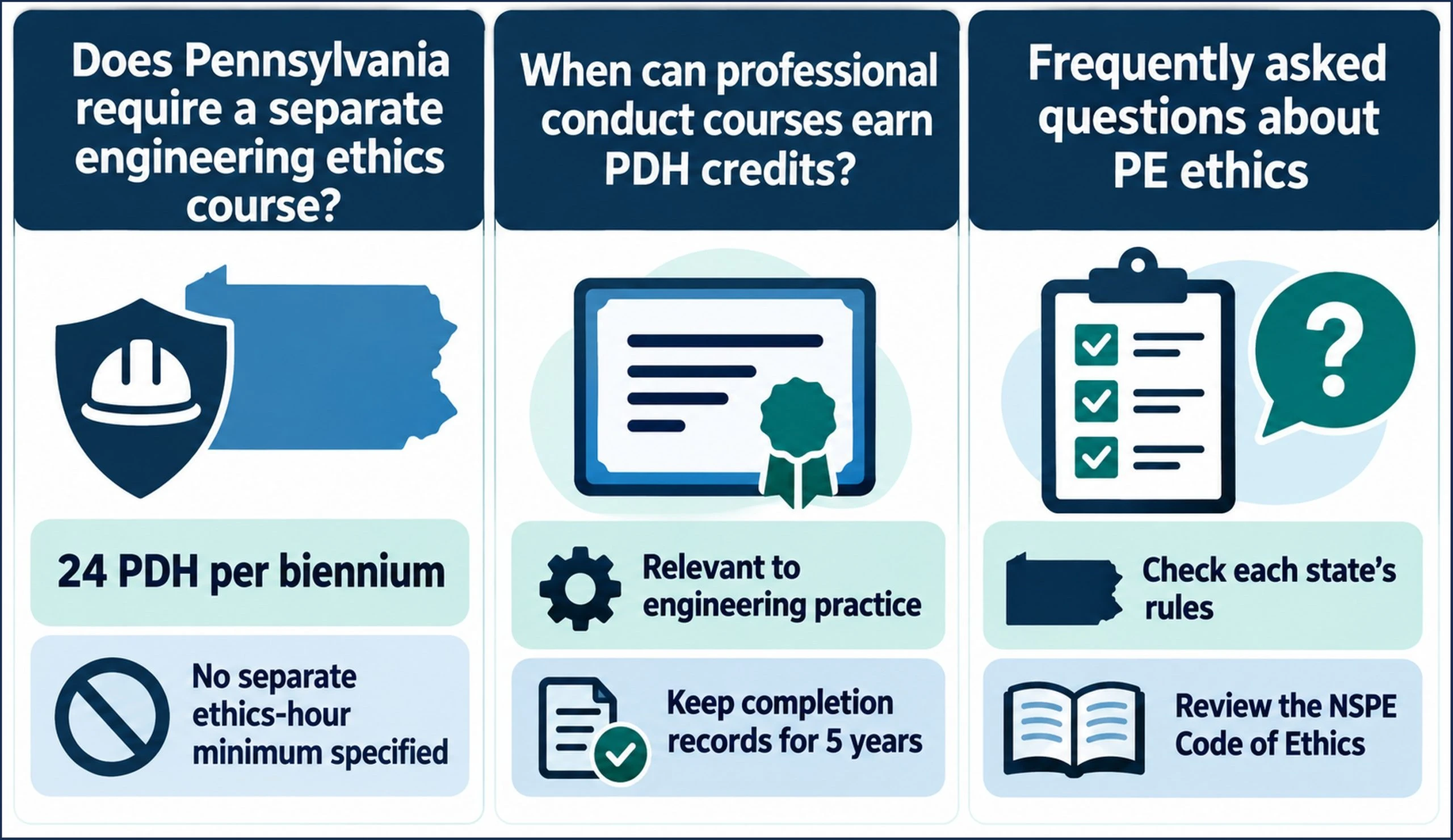
 Pennsylvania does not specify a separate ethics-course or ethics-hour minimum for PE renewal in the engineering law and board rules reviewed for this article. A PE ordinarily needs 24 PDH during each biennial renewal period. The law says qualifying professional development should maintain or expand relevant knowledge, including law and ethics applicable to engineering, but it does not reserve a stated portion of the 24 PDH for ethics. For the broader renewal rules, see continuing education requirements for Pennsylvania engineers.
Does Pennsylvania require a separate engineering ethics course?
Table of Contents
The Pennsylvania engineer registration law requires 24 PDH in a biennial period and describes the professional knowledge that continuing education should maintain, improve, or expand. It expressly mentions law and ethics applicable to the profession. Neither that provision nor the board’s continuing education regulation sets out a separate one-hour, two-hour, or other numerical ethics requirement for PEs.
This distinction affects how you plan renewal. An ethics course can be a sensible and potentially qualifying choice. You should not, however, tell a Pennsylvania engineer that a designated ethics course is compulsory under the current rule solely because the statute mentions ethics. Likewise, the absence of a separate course minimum does not diminish an engineer’s obligation to practice ethically.
| Question | Pennsylvania rule or guidance |
| Total continuing professional competency | 24 PDH per biennial renewal period |
| Separately specified ethics PDH | No numerical minimum identified in the reviewed engineering law or board regulation |
| Relevant ethics education | The law includes applicable law and ethics among knowledge that CPC should maintain or develop |
| Course preapproval | The board says it does not preapprove CPC activities, courses, or providers |
The first three rows reflect the engineering law and regulation; the last reflects the board’s renewal guidance. Eligibility of a particular course remains subject to the board’s final authority over credit.
What the 24-PDH rule says about law and ethics
 Pennsylvania measures its PE renewal requirement in professional development hours (PDH) and refers to the program as continuing professional competency (CPC). The registration law recognizes several ways to earn hours, including relevant continuing education courses, short courses, seminars, workshops, and professional or technical presentations. It excludes courses in practice building or office management.
A course examining an engineer’s duty to the public, conflicts of interest, responsible charge, or truthful technical reporting may have a clear connection to professional practice. A course on the ethical rules for an unrelated occupation requires closer scrutiny. Its label alone does not establish that it develops knowledge applicable to engineering. The board’s guidance says an activity that meets the statutory conditions, relates to professional practice, and avoids the excluded subjects is likely to be acceptable; the board retains final authority.
Licenses expire September 30 of odd-numbered years. As of the verification date, the next regular expiration is September 30, 2027. The board’s PE licensure snapshot says an engineer need not complete continuing education during the biennium in which the engineer is first licensed. A PE subject to the ordinary requirement should finish qualifying activities during the applicable period and retain the supporting records.
Ethics education versus ethical duties in practice
The renewal-course question is separate from conduct in engineering practice. Pennsylvania’s regulations address misconduct, including misleading or fraudulent representations and improperly delegating responsible charge to someone known or reasonably believed to lack the qualifications for the work. A PE can face professional consequences for misconduct regardless of whether an ethics class appears on a renewal log.
An ethics course is therefore useful for more than filling a PDH total. A scenario about pressure to sign a design outside your competence, for example, can prompt a practical discussion about technical review, responsible charge, and protecting the public. This is an illustrative reason to study ethics, not a claim that Pennsylvania mandates a course on that particular scenario.
The NSPE Code of Ethics for Engineers is a helpful professional reference. It discusses duties to the public, clients, employers, and the profession. Treat it as NSPE’s code, while consulting Pennsylvania’s statutes and regulations for binding state licensure requirements. A course may draw on both, but one document should not be mislabeled as the other.
When can professional conduct courses earn PDH credits?
An ethics or professional conduct course may contribute to Pennsylvania’s 24 PDH when its subject is relevant to the licensee’s professional practice and the activity meets the law’s requirements. The board does not provide advance approval for individual CPC activities or providers. The course sponsor can describe its offering and issue proof of completion, but its marketing claim does not bind the board to award a particular amount of credit.
Think about the actual instruction. A PE designing treatment systems might benefit from case studies about reporting uncertain performance data, protecting health, and communicating limitations to a client. A structural engineer might choose a case concerning independent review and public safety. Both subjects have plausible professional connections, but the engineer should assess the specific course before claiming it.
If you take that instruction at a professional meeting, Pennsylvania PE conference credit rules explain how to assess and document the session.
The law also permits a maximum of 12 excess PDH to carry into the next renewal period. That general carryover rule does not create a separate ethics category. Pennsylvania’s regulation prohibits claiming more than one presentation of a particular course or specific activity during a renewal period, so repeating the same ethics course in that period is not a way to earn additional credit.
Choosing relevant instruction and keeping completion records
When selecting a course, use this short check:
- Does the content address ethical decisions, laws, or professional duties relevant to your engineering work?
- Does the provider identify the learning objective, duration, and instructor?
- Will you receive a completion record with enough information to support the PDH claimed?
- Have you already claimed the same course or specific activity during this renewal period?
These are practical screening questions based on the state’s subject, documentation, and repeat-activity rules. They are not a board-issued application form. If qualifying courses leave you with excess hours, Pennsylvania PE continuing education carryover explains the limit on hours you may use in the next biennium.
Pennsylvania requires licensees to maintain a CPC activity log and attendance verification. The board’s guidance says an acceptable certificate should identify the learner, sponsor, date, location, duration, instructor or speaker, and PDH earned. It also says a registration notice or payment receipt does not substitute for completion evidence in an audit.
Keep records for five years after completing each activity. The board audits licensees and requires a full response to an information request within 30 days unless the request specifies another period. Saving the certificate and entering the course on your log immediately after completion is a practical way to avoid reconstructing details years later.
Board approval and the engineer’s responsibility
The Pennsylvania board states that it does not preapprove courses, providers, or other CPC activities. The registration law gives it final authority over course acceptability and PDH value. Your responsibility is to select relevant education, claim a supportable amount, and preserve the records required for review.
Format is a separate consideration from content. Pennsylvania’s law recognizes correspondence, televised, videotaped, and other short courses or tutorials relevant to practice. This supports consideration of appropriate remote or self-paced instruction, but it does not automatically approve every online ethics product. Check completion requirements and documentation for the particular offering.
If you hold licenses in multiple states, do not use Pennsylvania’s absence of a separate ethics minimum as the rule for every license. Another board may specify ethics hours, an approved provider, a particular subject, or a different reporting period. Compare each jurisdiction’s current rules before choosing one course to satisfy several licenses.
For Pennsylvania planning, start with the PDH Pro guide to PE continuing education requirements and the board’s renewal information. If you choose an ethics course, select one relevant to your practice and retain its completion certificate. An unusual course or licensing circumstance warrants a specific question to the board.
Frequently asked questions about PE ethics
What are a professional engineer’s ethical responsibilities?
A PE’s responsibilities include competent, truthful professional practice and attention to public safety. Pennsylvania’s regulation identifies misconduct such as misleading representations and improper delegation of responsible charge. The NSPE Code offers broader professional guidance, including duties concerning public welfare, competence, and honest communication. Consult the applicable Pennsylvania law and regulations when determining a legal duty in a specific situation.
Are there seven principles of engineering ethics?
There is no single universal list of “seven principles” that establishes Pennsylvania’s PE renewal requirement. The NSPE Code is organized around six Fundamental Canons, followed by Rules of Practice and Professional Obligations. Other teaching materials may group ethical ideas differently. Neither such a list nor the number of canons changes Pennsylvania’s 24-PDH renewal rule.
Where can I find the NSPE Code of Ethics PDF?
NSPE provides a downloadable PDF from its official Code of Ethics page. It is a useful reference for studying professional decisions. For Pennsylvania-specific licensing obligations, also consult the state registration law and board regulations.
Can an ethics course count for licenses in other states?
Possibly, but acceptance depends on each licensing board’s rules. A course relevant to Pennsylvania practice may also meet another state’s criteria, yet completing Pennsylvania’s total does not automatically satisfy that state’s ethics-hour, provider, timing, or documentation requirements. Check the current rules for every license before relying on a single course.