Engineering work affects public safety, property, infrastructure, environmental quality, and the trust communities place in licensed professionals. Because of that responsibility, engineers need to recognize ethical risks before they become project failures, public hazards, disciplinary problems, or damage to a company’s reputation.
A practical way to answer the question, what are common engineering ethics issues, is to look at the situations engineers face in everyday practice. These often include conflicts of interest, safety negligence, poor documentation, pressure to approve incomplete work, environmental concerns, product safety questions, misuse of confidential information, and failure to follow professional codes.
Ethics education helps engineers identify these situations, apply sound judgment, and respond in a way that protects the public. PDH-Pro supports that goal with online engineering ethics courses and PDH training built around real-world examples, case studies, professional standards, and license renewal needs.
Conflict of Interest in Engineering Decisions
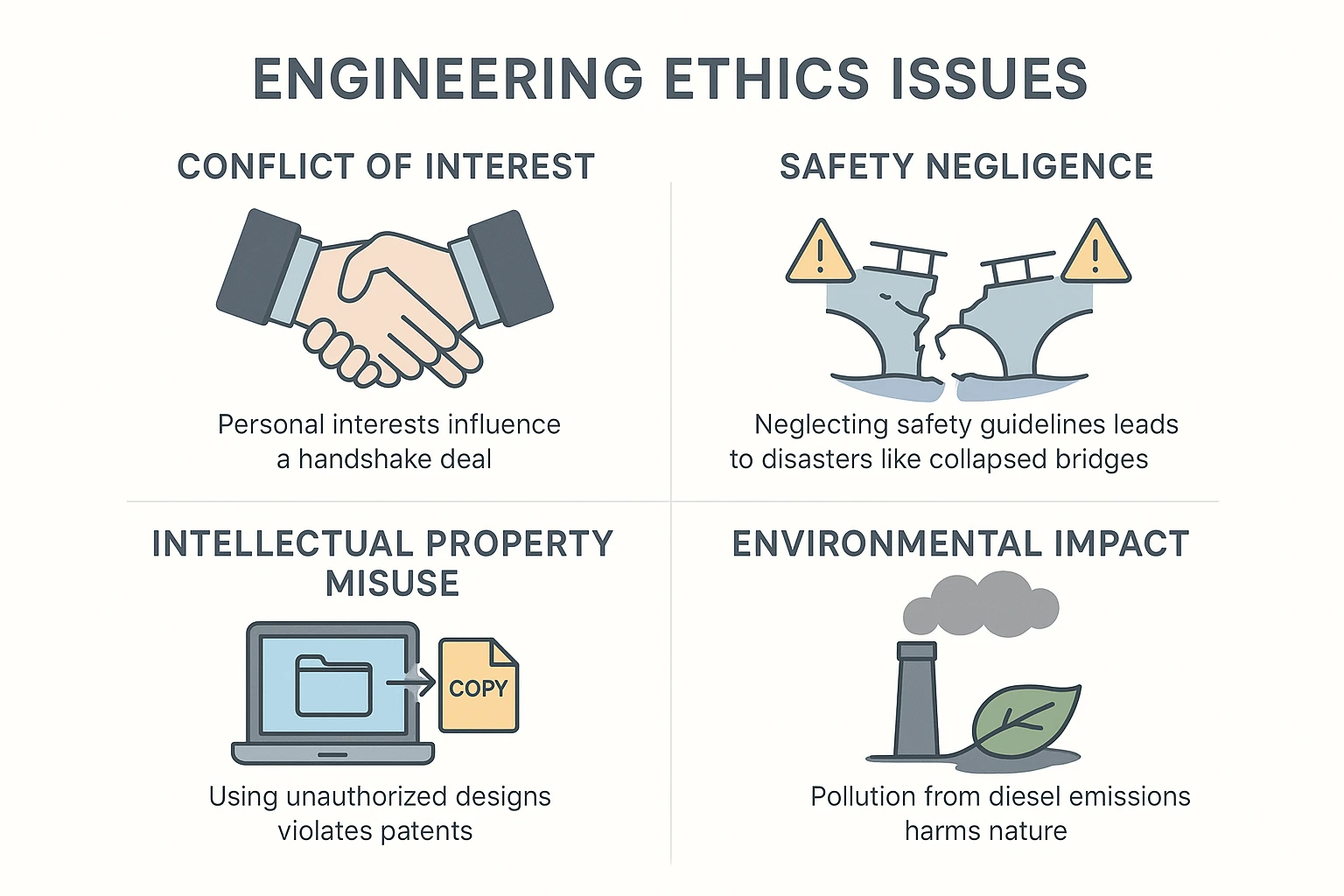
A conflict of interest happens when an engineer’s personal, financial, business, or professional relationship could affect independent judgment. It may be obvious, such as owning part of a company, being considered for a project. It may also be subtle, such as reviewing work by a close friend, recommending a vendor with a personal connection, or accepting gifts from a contractor.
Conflicts become ethical issues when they are hidden or allowed to influence decisions. An engineer may believe they can remain objective, but public trust depends on transparency. Clients, employers, agencies, and the public need to know when outside interests may affect professional judgment.
Common conflict situations include:
- Recommending a supplier or contractor because of a personal relationship.
- Reviewing a design prepared by a business partner.
- Accepting gifts or incentives tied to project approval.
- Failing to disclose financial interests in a project outcome.
- Letting company loyalty override public welfare.
- Working for two parties with competing interests.
- Using confidential client information for personal gain.
The right response usually starts with disclosure. Engineers should notify the proper parties, document the concern, and step away from decisions where impartiality could reasonably be questioned. Professional codes often stress honesty, objectivity, and public welfare because trust is central to engineering practice.
PDH-Pro ethics courses use practical examples to help engineers recognize conflicts early and handle them through clear communication, documentation, and sound judgment.
Safety Negligence and Public Welfare
Public safety is one of the most serious areas of engineering ethics. Engineers often work on systems where failure can cause injury, property damage, environmental harm, or loss of life. Safety negligence may occur when an engineer ignores known risks, skips review steps, signs off on incomplete work, or fails to communicate a hazard.
Ethical practice requires engineers to hold paramount the safety, health, and welfare of the public. This principle applies to large infrastructure projects, product design, manufacturing systems, electrical installations, environmental work, and routine project reviews.
Safety negligence may appear as:
- Ignoring design flaws because of deadline pressure.
- Accepting incomplete test data.
- Failing to follow applicable codes or standards.
- Signing and sealing documents without proper review.
- Overlooking maintenance risks.
- Failing to report unsafe field conditions.
- Approving substitutions without adequate evaluation.
Case studies in engineering ethics often show that failures rarely come from one decision alone. They may result from a chain of missed warnings, weak communication, unclear responsibility, and pressure to keep moving. Ethics training helps engineers recognize early warning signs and understand when to stop, question, document, or escalate a concern.
| Ethics Issue | Risk to the Public | Better Professional Response |
| Ignoring safety concerns | Injury, system failure, property loss | Document and escalate the risk |
| Incomplete review | Design errors and unsafe approvals | Require proper review before approval |
| Weak documentation | Confusion, disputes, missed warnings | Keep clear technical and decision records |
| Schedule pressure | Rushed work and overlooked hazards | Communicate limits and needed review time |
| Code noncompliance | Regulatory problems and unsafe outcomes | Verify codes and standards before release |
| Poor supervision | Unchecked work by unqualified staff | Maintain responsible charge and review |
Safety is not only a technical topic. It is also an ethical responsibility. PDH-Pro’s engineering ethics training helps professionals connect public safety principles to real project decisions.
Honesty, Documentation, and Professional Codes
Honest reporting is one of the most common ethics topics engineers face. Reports, drawings, test results, inspection notes, calculations, and certifications all rely on accurate information. When records are incomplete or misleading, decision-makers may act on false assumptions.
Ethical issues can arise when an engineer is asked to soften a report, hide a failed test, remove a warning, change data, or approve work that does not match the record. Even small changes can have serious consequences if they affect safety, compliance, or project approval.
Professional codes from engineering organizations and licensing boards give engineers a framework for these decisions. They generally expect engineers to be truthful, competent, objective, and committed to public welfare. These codes are not only abstract principles. They help guide everyday decisions about what to say, what to sign, what to disclose, and when to refuse a request.
Engineers should be especially careful with:
- Test results and performance data.
- Inspection findings.
- Design assumptions.
- Change orders and substitutions.
- Safety warnings.
- Qualifications and experience claims.
- Statements made to clients, agencies, or the public.
Good documentation protects the public and the engineer. It shows what was reviewed, what assumptions were used, what concerns were raised, and how decisions were made. If a question arises later, the record can help explain the reasoning behind the work.
PDH-Pro’s ethics courses help engineers review professional codes and apply them to case studies, documentation challenges, and communication decisions that appear in practice.
Social Responsibility, Environmental Issues, and Public Rights
Engineering decisions can affect communities long after a project is complete. Social responsibility means engineers consider how their work affects public welfare, environmental quality, access, long-term maintenance, and community trust.
Environmental ethics may involve stormwater design, waste handling, emissions, energy use, land development, water quality, or remediation. Ethical dilemmas may appear when legal minimums do not fully address public concern, when data is uncertain, or when a company wants to reduce environmental controls to save costs.
Engineers may also face issues involving public rights and dignity. Projects can affect neighborhoods, workers, road users, building occupants, and vulnerable populations. Ethical decision-making requires engineers to consider who may be affected, how risks are communicated, and whether assumptions are fair and defensible.
Common social responsibility concerns include:
- Underestimating environmental impacts.
- Failing to communicate known risks to affected parties.
- Ignoring community safety concerns.
- Designing only for minimum compliance when a higher risk is known.
- Overlooking accessibility or usability.
- Allowing cost pressure to reduce protective measures.
- Failing to consider long-term maintenance and reliability.
Social responsibility does not mean engineers control every policy decision. It means they should provide honest technical guidance, communicate risks clearly, and avoid hiding information that decision-makers or the public need.
Ethics education gives engineers a structured way to think through these questions. PDH-Pro courses use practical topics and examples to help engineers connect ethical principles to environmental and community impacts.
Workplace Pressure, Reporting, and Protection Violations
Engineers do not make decisions in isolation. They work within companies, agencies, teams, and client relationships. Workplace pressure can create ethical challenges when an engineer is asked to ignore a concern, rush a review, change a finding, stay silent, or approve work without enough information.
Reporting mechanisms matter because engineers need a way to raise concerns when safety, rights, or professional standards are at risk. A strong company culture supports reporting, protects employees from retaliation, and treats safety concerns as professional obligations rather than obstacles.
Protection violations may involve retaliation, suppression of safety concerns, disregard for whistleblower processes, or pressure that prevents an engineer from meeting professional duties. These situations are especially serious when public safety is involved.
Engineers can reduce risk by documenting concerns, following internal reporting procedures, seeking guidance from supervisors or compliance personnel, and consulting board or legal resources when needed. If a concern affects public welfare, silence may not be an acceptable option.
Professional ethics training helps engineers understand how to respond when workplace demands conflict with professional obligations. It also helps managers build healthier reporting practices that protect both employees and the public.
PDH-Pro’s ethics courses support this type of learning by presenting realistic scenarios that help engineers identify pressure points, recognize violations, and respond in a professional way.
Product Safety and Technical Competence
Product safety is another common engineering ethics issue. Engineers may work on equipment, devices, systems, materials, controls, or software that must perform safely under real operating conditions. Ethical problems can arise when testing is incomplete, warnings are unclear, quality concerns are ignored, or product limitations are not disclosed.
Technical competence is closely tied to product safety. Engineers should only perform or approve work they are qualified to handle. When a project falls outside an engineer’s experience, the ethical response is to seek qualified review, additional training, or another professional with the right background.
Common product safety concerns include:
- Releasing products before adequate testing.
- Ignoring field failure reports.
- Using materials without proper evaluation.
- Failing to warn users about limitations.
- Overstating performance claims.
- Approving design changes without analysis.
- Allowing nontechnical pressure to override safety review.
The ethical duty is not only to the client or employer. It extends to users, workers, operators, and the public. Engineering ethics helps professionals weigh these responsibilities and decide when a product or system is not ready.
Case Studies and Ethics Education for Engineers
Case studies are one of the most effective tools for ethics education because they show how problems develop in real settings. They help engineers see that ethical issues are often complex, gradual, and tied to communication, documentation, incentives, and organizational culture.
A case study may involve a design failure, conflict of interest, reporting breakdown, product safety problem, environmental violation, or workplace pressure. By reviewing the facts, engineers can practice identifying the ethical issue, affected parties, applicable standards, and better choices.
Ethics education is useful for engineers at every career stage. Early-career professionals can learn how to spot risks and ask better questions. Experienced engineers can refresh judgment, review updated expectations, and improve leadership practices. Managers can use ethics training to strengthen company procedures and project culture.
PDH-Pro offers online ethics PDH courses designed to help engineers meet renewal requirements while strengthening practical judgment. Courses are built for working professionals who need flexible access, clear documentation, and training that applies to real practice.
Strengthen Ethical Practice With PDH-Pro
Common engineering ethics issues include conflict of interest, safety negligence, poor documentation, social responsibility concerns, protection violations, product safety risks, and failure to follow professional codes. These issues can affect public welfare, company trust, project success, and an engineer’s license.
The best defense is preparation. Engineers should understand professional codes, communicate clearly, document decisions, disclose conflicts, prioritize safety, and continue ethics education throughout their careers.
PDH-Pro helps engineers stay current with online engineering ethics courses, webinars, and PDH options that support license renewal and professional growth. Choose an ethics course that fits your schedule, review real case studies, and keep your completion certificate ready for your renewal records.