
Written by: Jordan Ellis
Published: Oct 4, 2026
 A Pennsylvania professional engineer can earn PDH for a conference session when the instruction or presentation is relevant to professional engineering practice. The state requires 24 PDH during each two-year renewal period, and one hour of qualifying professional development at a conference equals one PDH. Registering for a conference does not make every hour of the event creditable: evaluate the sessions you complete and keep evidence of attendance. For the broader renewal requirements, see continuing education requirements for Pennsylvania engineers.
Which Conference Activities Count Under Pennsylvania Law?
Table of Contents
Pennsylvania’s engineering registration law expressly includes professional or technical presentations made at meetings, conventions, and conferences among the ways a licensee may earn PDH. Seminars, workshops, and employer-sponsored courses can also qualify. In each case, the activity must be relevant to the licensee’s professional practice. The question is what you learned or presented, not simply where the conference was held.
A multidisciplinary conference may therefore contain both qualifying and nonqualifying activities. A structural engineer, for example, might reasonably claim a session on changes to structural design methods. The same engineer should examine a session on general sales techniques much more carefully. Professional relevance is judged against the actual activity and the engineer’s practice; a conference-wide PDH label cannot resolve every individual case.
Some education programs at an industry conference may qualify, but the session still needs a clear professional purpose, documented attendance, and content tied to engineering practice.
If a conference offers a professional conduct session, Pennsylvania PE continuing education ethics requirement explains how ethics instruction fits into the state’s PDH rules.
PA calls its renewal requirement continuing professional competency, or CPC, and measures the requirement in professional development hours, or PDH. The board’s activity log includes conferences, workshops, seminars, courses, and tutorials relevant to professional practice.
Technical Sessions, Workshops, and Professional Presentations
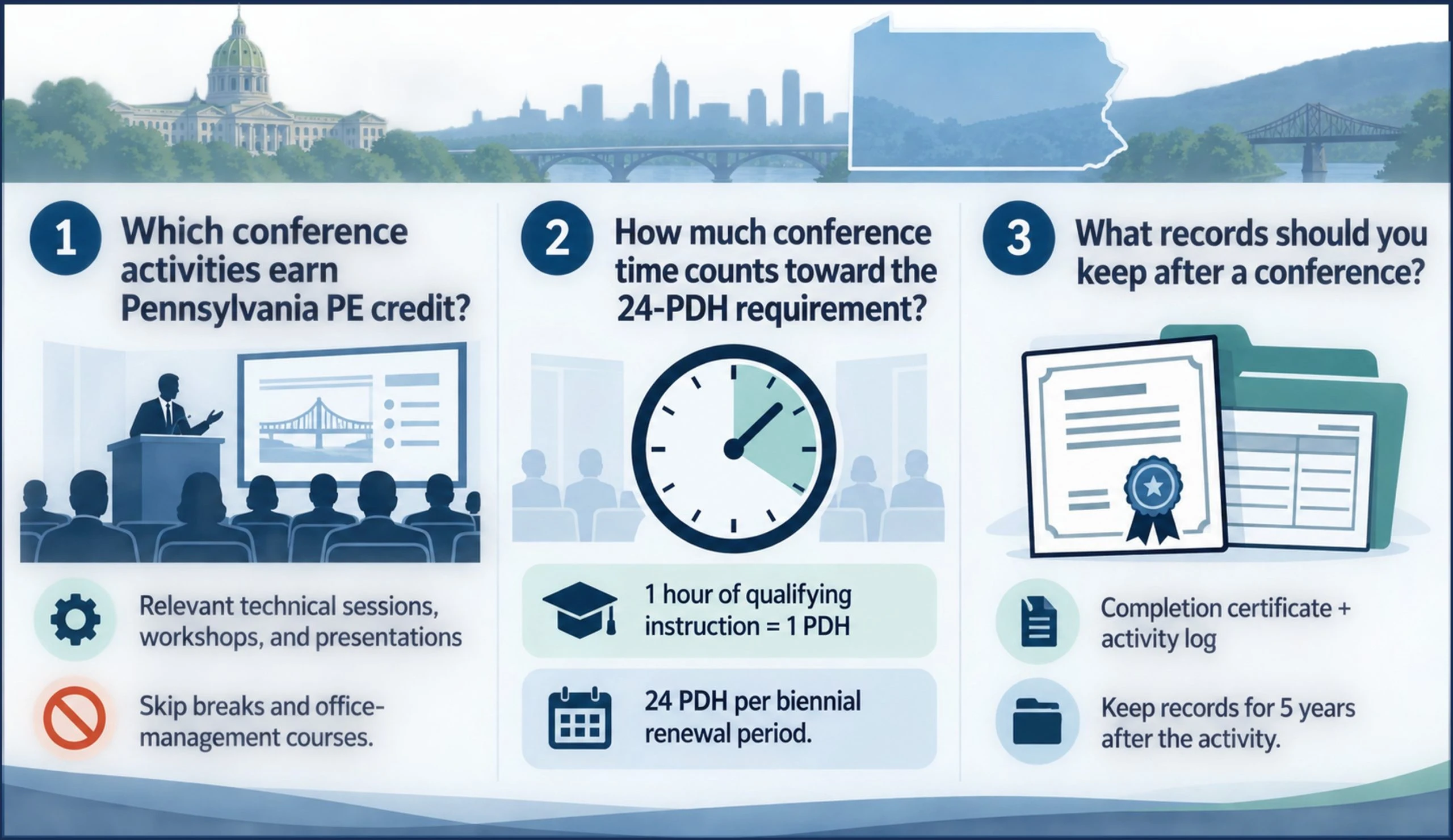 Start with the session description and its learning objective. A technical session is a stronger candidate when it maintains, improves, or expands knowledge you use in engineering practice. Examples might include a presentation on a revised design standard, a workshop on groundwater treatment performance, or instruction on evaluating an engineering failure. These are examples, not a board-approved list.
The law also recognizes instruction concerning law and ethics applicable to the profession as potentially relevant professional development. It does not, in the provisions reviewed for this article, impose a separate numerical ethics-course requirement within the state’s 24 PDH. An engineering ethics presentation may qualify when its content is relevant and the other requirements are met. Do not assume that a session labeled “ethics” for a different profession automatically serves an engineer’s CPC requirement.
Before relying on a session, ask:
- Was there identifiable instruction or a professional or technical presentation?
- Is its subject relevant to my engineering practice?
- Can I establish its duration and my completion or attendance?
- Will the sponsor provide documentation with enough detail to support the PDH claimed?
A professional responsibility topic may qualify when it addresses engineering judgment, public protection, professional conduct, or another matter connected to the engineer’s practice.
Those questions follow from the law’s qualifying-activity language and the board’s documentation guidance. They are a practical screening method, not an additional board test. For the role of professional conduct instruction in your course plan, see Pennsylvania PE continuing education ethics requirement.
Firm Training, Breaks, and Activities That Do Not Qualify
The Board expressly denies credit for courses in practice building or office management. A presentation about technical risk, engineering standards, or a method used in professional practice deserves a content-specific review; a session devoted to marketing a firm or organizing office administration should not be counted merely because engineers attend it.
Similarly, conference registration, travel, networking, an exhibition-hall visit, or a meal does not by itself establish completion of qualifying instruction. This is a practical application of the law’s focus on courses and presentations, rather than a claim that the board has published a separate rule for every conference activity. If a lunch includes a documented technical presentation, examine the instructional portion on its own merits. Do not claim the entire meal period simply because the presentation occurred during lunch.
A firm may host useful training for its team or clients, but a session focused mainly on business development, managed services, or marketing should not be treated as PDH without a separate technical or professional component.
A vendor presentation is another situation to assess carefully. A detailed explanation of an engineering method or equipment performance may teach relevant technical material. A sales pitch consisting chiefly of product promotion may offer little support for a CPC claim. Keep the description and learning materials when the distinction is close, and claim only the portion you can substantiate.
How Much Event Time Counts Toward the 24-PDH Requirement?
PA requires 24 PDH during each biennial renewal period. Licenses expire September 30 of every odd-numbered year; the next regular expiration date after this article’s verification date is September 30, 2027. The board states that a licensee need not complete continuing education during the biennium in which the licensee is first licensed.
For conferences, the statute provides that one hour of professional development in qualifying coursework, seminars, or professional or technical presentations at meetings, conventions, or conferences equals one PDH. It also defines a PDH as 50 minutes of instruction or presentation relevant to professional practice, or an equivalent. The board repeats that 50-minute definition on its CPC activity log. Use the sponsor’s documented instructional duration and PDH allocation; do not convert the total duration spent at a venue into PDH.
| Conference activity | Practical treatment |
| Relevant technical session with documented completion | Claim the supported PDH for that session |
| Break between sessions | Do not add it to instructional time |
| Concurrent sessions | Claim only the instruction you actually completed |
| General admission certificate with no session detail | Seek more detailed completion documentation before relying on a specific PDH total |
| Session repeated during the same renewal period | Do not claim the same course or activity twice |
The important distinction is between documented learning period and general program attendance; only the supported instructional portion should be claimed.
The last point is an express regulation: a licensee may not receive allowance for more than one presentation of a particular course or other specific activity in a renewal period. The other rows are practical ways to apply the qualifying-activity and recordkeeping requirements.
Counting Event Time and Converting CEUs
Suppose a conference agenda schedules a 75-minute technical session, followed by a 15-minute break, and the sponsor documents 1.5 PDH for completed attendance. Claim the supported instructional recognition, subject to the session’s relevance to your practice. Do not add the break or treat a full-day registration as proof of full-day instruction. This example illustrates a documentation decision; it does not establish a universal rounding rule.
A sponsor may express education in continuing education units rather than PDH. Pennsylvania’s statute provides that one CEU equals 10 PDH. Check what the certificate actually awards before converting it. For example, a properly awarded 0.2 CEU corresponds to 2 PDH under that conversion. A label on a promotional agenda is less useful than a completion record showing what you earned.
Where the schedule contains several sessions, keep a session-by-session accounting. It helps distinguish instructional hours from breaks and connects each claimed activity to its topic, instructor, sponsor, and completion evidence. If the sponsor issues one certificate for an entire conference, ask whether it identifies the instruction completed and the PDH earned clearly enough to support your log.
Presenting, Teaching, or Leading a Conference Session
Pennsylvania permits PDH for teaching, presenting, or instructing qualifying activities, including professional or technical conference presentations. The statute awards teaching PDH at double the applicable PDH amount for the underlying instruction. It also states that teaching allowance for a course or seminar is unavailable to full-time faculty members performing their duties at their employing institutions.
Do not apply that multiplier to an entire conference simply because you delivered one session. Identify the specific qualifying presentation and its instructional duration. The board’s published documentation says a presenter whose name does not appear as an instructor on the certificate should provide a sponsor letter clearly identifying the person responsible for teaching, presenting, or instructing. Its general guidelines also describe a sponsor letter as support for presenting activity. Keeping both the program and a clear sponsor letter is a prudent way to document a claim.
If you both present and attend other sessions, record the activities separately. That makes the basis for each PDH amount visible during an audit and avoids treating attendance at your own presentation as an unexplained second award.
Who Decides Whether a Session Qualifies?
The Engineering Board says it does not preapprove CPC activities, courses, or providers and does not maintain a list of available qualifying activities. The registration law gives the board final authority over the approval of courses, credit, PDH value, and other methods of earning allowance. In practice, the licensee must make and document a reasonable claim, subject to board review.
This distinction matters when a function advertises “PE credit” or a sponsor says its sessions are “approved.” A sponsor can describe its educational offering and issue a completion certificate. Its statement does not replace the Pennsylvania board’s authority to evaluate a claim. Review the content and documentation yourself before placing the hours on your renewal log.
The board’s general guidelines say its office will not review unsolicited completion documents to advise whether a licensee has met the requirement or whether a specific activity is acceptable. That makes careful selection before the conference especially useful. If an unusual session leaves a material question about eligibility, contact the board for guidance, but do not treat an anticipated informal answer as preapproval.
Do not rely on state bar, Pennsylvania Bar, continuing legal education, or legal education terminology unless the content also satisfies the engineering board’s CPC requirements.
Provider Claims, Board Review, and Professional Responsibility
Consider three separate questions:
- Does the sponsor offer PDH documentation? Ask for a completion certificate and a breakdown of any sessions included.
- Does the session fit your practice? Compare its actual educational content with the work and professional responsibilities for which you hold an engineering license.
- Could you support the claim later? Keep the evidence required by the board, including the activity log and attendance verification.
A “nationally recognized” conference is not automatically creditable in Pennsylvania. Conversely, a small employer-sponsored workshop is not automatically excluded; the statute expressly recognizes employer-sponsored courses and workshops when they meet its requirements. The educational substance and supporting records matter more than the size or branding of the event.
A compliance conference certificate may be useful evidence, but the licensee still needs enough event details to show the activity was relevant and properly documented.
Pennsylvania also accepts hours earned in another jurisdiction if the activity otherwise complies with the Board’s requirements. That provision is useful when you attend a conference outside the state, but it is not blanket acceptance of every hour another state or organizer awards. Review the session against the state’s rules as well.
Preparation: What Records Should You Keep After a Conference?
The licensee is responsible for keeping a log of claimed CPC activities and attendance verification. The statutory log fields include the type of activity, sponsor, location, duration, instructor or speaker, and PDH earned. The board offers a continuing professional competency activity log with fields for the course title and date as well.
The board’s PDH guidance says an acceptable completion certificate should identify the participant, sponsoring organization, date, location, duration, instructor or speaker, and PDH earned. Ask the organizer for corrected or supplemental documentation promptly if an essential item is missing. A conference agenda can help explain what happened, but the board says brochures, course literature, registration confirmations, payment receipts, and sign-in sheets do not substitute for completion certificates as audit evidence.
Certificates, agendas, and a session-by-session activity log
For each conference, save:
- The completion certificate or other board-acceptable attendance verification.
- A log entry for each distinct activity claimed, with the sponsor, location, instructor, duration, and PDH.
- The agenda and session descriptions as supporting context for the subject matter and schedule.
- Any sponsor correspondence clarifying session attendance, awarded hours, or a presentation you delivered.
The first two items satisfy the central recordkeeping requirements. The agenda and correspondence are practical backup; they do not replace proof of completion. The board’s published guidelines specify that an audited licensee should submit the completed activity log and copies of attendance verification records when requested.
Pennsylvania requires licensees to retain records verifying continuing education for five years after completion of the activity. That clock runs from the activity date, not simply from the renewal date. During an audit, the board may infer from missing required records that the education was not completed. An audited licensee must fully respond to each information request within 30 days, unless the request specifies another time.
A useful routine is to download certificates immediately after the conference, give files names containing the date and session title, and update your log while the details are fresh. If the organizer issues only one broad certificate, request clarification before the event records become difficult to retrieve.
How Conference Hours Fit into License Renewal
Conference sessions are one way to build the required 24 PDH; Pennsylvania does not require that all hours come from conferences. Qualifying courses, correspondence or other short courses, seminars, workshops, and the other activities specified in the law may also contribute. Choose a mix that maintains or develops knowledge relevant to your practice and that you can document.
Before submitting a renewal, reconcile the conference certificates against your CPC log. Check the dates, distinct activities, supported PDH totals, and whether each activity belongs in the correct renewal period. Confirm that you are not claiming the same presentation of a course twice. This review is particularly valuable when a conference organizer’s certificate reports a total that includes several sessions with different levels of relevance.
Renewal Timing, Carryover, and Other State Requirements
Pennsylvania licenses expire September 30 in odd-numbered years, and the standard requirement is 24 PDH per biennium. If you earn more than required in one renewal period, the law permits you to carry up to 12 PDH into the next. The regulation limits how a PDH may be applied across biennia; do not repeatedly roll the same hours forward. Keep the dates and carryover calculation clear in your records.
A licensee holding more than one class of license from the Pennsylvania board must satisfy the continuing education requirement for each license. A particular activity may be applied to more than one of those licenses if it is applicable to each. If you also hold a professional engineering license in another state, check that state’s rules separately. Completing Pennsylvania’s 24 PDH does not automatically satisfy a different state’s subject, format, timing, or documentation requirements.
If this is the biennium in which you were first licensed in Pennsylvania, the board’s PE licensure snapshot says you are exempt from completing continuing education during that biennium. Other exemptions described in the statute concern qualifying temporary active military duty and circumstances such as illness or disability that the board reviews and approves. Do not assume an exemption applies without checking its conditions and, when required, obtaining the board’s decision.
If another jurisdiction awards hours states differently or uses status PDHs, keep a separate calculation showing how the Pennsylvania requirement is satisfied.
If a license expires, reactivation is a separate process. The board’s renewal page directs licensees to request reactivation through PALS. Its regulation generally requires completion of delinquent continuing education, capped at 24 PDH for reactivation, and explains that previously delinquent hours may be additional to the current biennium’s requirement. Avoid treating a conference attended after expiration as an automatic fix for an expired license or for hours missing from an earlier period.
After identifying how many qualifying hours you still need, you can compare course formats with your schedule. PDH Pro’s webinar schedule is one option for finding additional live instruction. Check each activity’s relevance and retain its completion documentation, just as you would for a conference session.
Frequently Asked Questions About Conference PDH
Can an online conference session count?
Yes, an online session can be a qualifying activity when it provides relevant instruction, fits an activity recognized by Pennsylvania’s law, and can be documented. The law recognizes televised, videotaped, and other short courses or tutorials as well as qualifying presentations at conferences; it does not make physical attendance at a conference hall a condition for every eligible activity. Confirm what you completed and obtain suitable attendance verification.
What happens if I do not complete enough PDH?
Failure to complete the minimum continuing education during the applicable renewal period can subject a licensee to discipline. The regulation provides a process following a citation that requires the licensee to make up the deficiency and provide proof within six months; it does not make the original shortfall permissible. If you discover a shortage, review your status and the board’s instructions promptly rather than certifying completion you cannot support.
Who is responsible for supporting claimed PDH?
You are responsible for maintaining the activity log and attendance records that support the PDH you claim. The conference organizer can supply completion documentation, but the Pennsylvania board retains final authority over credit and may audit your compliance. Keep the certificate and log for five years after the activity, and respond to an audit within the hours stated in the board’s request.
Preparation Before You Submit Your Renewal
- Add the PDH from qualifying sessions and any other eligible activities for the correct biennium.
- Remove breaks, duplicate course presentations, and activities you cannot support.
- Match each claimed activity to your log and completion evidence.
- Check any carryover separately, up to Pennsylvania’s 12-PDH limit.
- Confirm the requirements of every other jurisdiction in which you hold a license.
- Retain your records for five years from each activity’s completion date.