
Written by: Jordan Ellis
Published: Sep 30, 2026
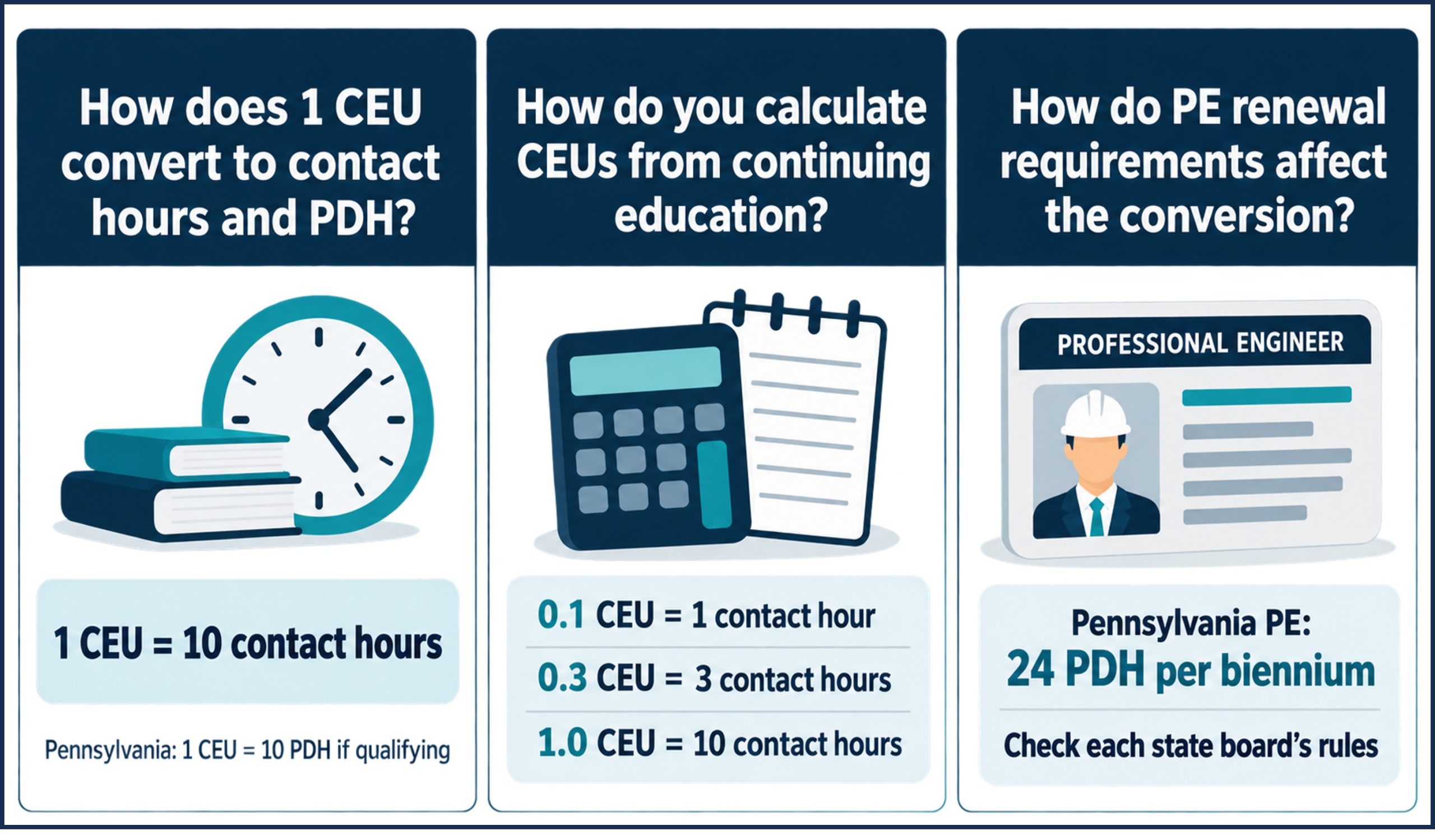
 One continuing education unit (CEU) equals 10 contact hours of participation in an organized learning experience. For a Pennsylvania professional engineer, state law also converts 1 CEU to 10 professional development hours (PDH) toward license renewal, provided the activity qualifies under the engineering board’s rules. If you are applying the conversion to a Pennsylvania license, review the continuing education requirements for Pennsylvania engineers as well as the number printed on your completion record.
How does 1 CEU convert to contact hours and PDH?
Table of Contents
A CEU is a unit used to record participation in organized continuing education. The International Accreditors for Continuing Education and Training (IACET) defines one CEU as 10 contact hours in an organized learning experience under responsible sponsorship, capable direction, and qualified instruction. The straightforward arithmetic is:
CEUs × 10 = contact hours
If a completed program awards 0.5 CEU, that represents five contact hours under this definition. If it awards 1.0 CEU, that represents 10. The CEU measures educational participation; it is not a college semester credit or a professional license by itself.
Pennsylvania’s engineering law supplies a separate licensing conversion: one CEU equals 10 PDH. It defines a PDH as 50 minutes of instruction or presentation relevant to professional practice, or an equivalent. Because those definitions use different language, rely on the state’s express CEU-to-PDH conversion when reporting a properly documented CEU for Pennsylvania PE renewal. Do not attempt to create extra PDH by dividing 10 contact hours into 50-minute blocks.
That distinction matters most when a certificate uses several labels. “Ten contact hours,” “1.0 CEU,” and “10 PDH” can describe related educational quantities, but the awarding organization and licensing board determine what has actually been documented and what is acceptable for renewal. Check the certificate and the board’s activity rules before entering an amount on your renewal log.
What counts as a contact hour of participation?
 A contact hour concerns time spent in an organized learning experience, rather than every clock hour associated with an event. IACET’s CEU definition expressly refers to participation under responsible sponsorship and qualified instruction. A course provider’s documented educational time is therefore more useful than the total time between event check-in and departure.
For example, a workshop might run from morning through afternoon while also including registration, breaks, and lunch. Its awarded CEU should be based on the learning experience documented by the provider. Do not calculate your own CEU from the full event schedule and assume a licensing board will accept it. If the completion record does not explain the amount awarded, ask the provider for a clear record.
For PE renewal, attendance is only part of the evaluation. Pennsylvania requires a qualifying activity to maintain, improve, or expand knowledge relevant to professional practice. The state does not give credit for courses in practice building or office management. Thus, a documented CEU is a measurable amount, while eligibility depends on the content and the applicable board rules.
CEU, PDH, and academic credit: different units
The three terms answer different questions:
| Unit | What it measures | Conversion relevant here |
| CEU | Participation in organized continuing education | 1 CEU = 10 contact hours under IACET’s definition |
| PDH | Professional development used by engineering boards | Pennsylvania converts 1 CEU to 10 PDH |
| College semester or quarter hour | Academic coursework shown on a transcript | Pennsylvania converts 1 semester hour to 45 PDH and 1 quarter hour to 30 PDH |
The IACET definition supports the first row. Pennsylvania’s engineering registration law establishes the state-specific conversions in the other rows. A three-credit college class is not the same thing as 0.3 CEU, and a certificate advertising “credits” should identify which kind it awards. Converting the units does not establish whether the activity qualifies; Pennsylvania professional engineer continuing education courses explains how to assess the course itself.
You may also see CPC, short for continuing professional competency. In Pennsylvania, CPC describes the renewal education requirement, while PDH is the unit used to count it. A certificate can display CEUs even though the engineer reports qualifying education in PDH.
How do you calculate CEUs from continuing education?
Use the amount the provider actually awarded. To convert documented contact hours under the standard CEU definition, divide by 10. To convert an awarded CEU amount into contact hours, multiply by 10. For Pennsylvania PE reporting, multiply a qualifying awarded CEU amount by 10 to obtain PDH under the state’s statute.
| Award shown on the completion record | Contact-hour equivalent | Pennsylvania statutory PDH conversion, if qualifying |
| 0.1 CEU | 1 contact hour | 1 PDH |
| 0.3 CEU | 3 contact hours | 3 PDH |
| 0.5 CEU | 5 contact hours | 5 PDH |
| 1.0 CEU | 10 contact hours | 10 PDH |
These are arithmetic conversions, not an approval list. A Pennsylvania PE must still establish that the course relates to professional practice and meets the state’s other conditions. Another jurisdiction may have different rules for acceptable subjects, providers, formats, and documentation.
Examples: 0.1, 0.3, and 1.0 CEU
Suppose you finish a relevant technical webinar and receive a certificate for 0.1 CEU. Under the CEU definition, that amount represents one contact hour. Under Pennsylvania’s statutory conversion, it corresponds to one PDH if the activity otherwise qualifies. Retain the certificate rather than recording a number from the advertised webinar length alone.
For 0.3 CEU, multiply 0.3 by 10. The result is three contact hours. A Pennsylvania PE may convert that awarded amount to three PDH when the completed activity satisfies the state’s CPC requirements. It does not mean three college credits. Academic credit uses semester- or quarter-hour units and different conversions.
For 1.0 CEU, the contact-hour equivalent is 10. Pennsylvania converts it to 10 PDH if qualifying. Since the state ordinarily requires 24 PDH per biennial renewal period, that one activity would supply part of the requirement, not the entire amount. The engineer would need another 14 qualifying PDH unless allowable carryover, an exemption, or another applicable circumstance changes the calculation.
Check the course certificate before converting units
Look for the completed activity’s title, date, sponsor, duration, instructor, and awarded education amount. Pennsylvania’s board guidance says acceptable completion certificates should identify the participant, sponsor, date, location, duration, instructor or speaker, and PDH earned. If a CEU certificate omits information needed to support a Pennsylvania PDH claim, ask the provider whether it can issue a more complete record.
Watch for these distinctions:
- “Eligible for 1 CEU” advertises a potential award; it does not establish that you completed the activity.
- “1 CEU awarded” documents an amount, but you still need to check professional relevance and board rules.
- “10 hours scheduled” does not necessarily document 10 contact hours of completed education.
- “10 credits” is ambiguous until the certificate identifies the credit unit.
This is a practical reading checklist, not a new Pennsylvania regulation. The board’s guidance says registration notices, payment receipts, sign-in sheets, brochures, and course literature do not replace completion evidence during an audit.
If a provider offers a written self-paced course, live webinar, or recorded webinar, identify the actual unit it awards and the proof of completion it supplies. Pennsylvania’s law recognizes several forms of relevant coursework and short courses; it does not make a CEU label alone sufficient for acceptance.
How do PE renewal requirements affect the conversion?
The CEU calculation tells you the quantity of education. Your licensing board decides what may count toward renewal. A course worth 1.0 CEU is not automatically worth acceptable PE credit in every state merely because its numerical equivalent is 10 contact hours. Review the subject matter, completion record, renewal period, and any jurisdiction-specific limitations.
This is particularly important for engineers with several licenses. Satisfying Pennsylvania’s rules does not automatically satisfy another state’s ethics, laws-and-rules, provider, or recordkeeping requirements. Keep the original certificate and record each jurisdiction’s accepted amount separately rather than assuming one conversion settles every renewal.
Pennsylvania’s 24-PDH renewal period
Pennsylvania requires 24 PDH during each biennial renewal period. Licenses expire September 30 of odd-numbered years. A licensee who exceeds the requirement may carry no more than 12 PDH into the next renewal period. The board says it does not preapprove continuing professional competency activities, courses, or providers, so the engineer should assess relevance and retain supporting records. College coursework uses a different credit calculation, explained in Pennsylvania PE college course credits.
As an example, suppose an engineer completes two qualifying activities, each documented as 1.0 CEU, plus another qualifying 4-PDH course during the biennium. Pennsylvania’s conversion produces 10 + 10 + 4 = 24 PDH. The arithmetic meets the ordinary total, provided the activities qualify, were completed in the applicable period, and are properly documented.
The board may audit compliance. Pennsylvania requires licensees to keep verification records for five years after each activity is completed. An audited licensee must respond to an information request within 30 days unless the request states another time. Record the original CEU amount, the Pennsylvania PDH conversion, and the activity details in your CPC log.
A PE first licensed during a biennium is not required to complete continuing education during that initial biennium, according to the board’s licensure snapshot. Other statutory exemptions have specific conditions. Confirm an unusual circumstance with the board rather than applying a general conversion formula to an exemption question.
Why another state may use a different conversion
IACET defines the CEU, but a state licensing board controls credit toward its license. Some boards state their own CEU-to-PDH conversion; others specify qualifying activities or use different measures. The Pennsylvania conversion in this article is supported by Pennsylvania law and should not be presented as a rule for California or every other state.
Before claiming an activity for multiple PE licenses:
- Check each board’s current renewal rules and completion period.
- Confirm the course subject and format qualify in each jurisdiction.
- Apply each board’s conversion, rather than reusing Pennsylvania’s by default.
- Save the certificate and any supporting course information.
- Record the amount claimed for each license.
Frequently asked questions about the conversion
Does 0.3 CEU mean three contact hours?
Yes. Under IACET’s definition, 0.3 CEU equals three contact hours because each CEU represents 10 contact hours. For a Pennsylvania PE, the statute converts 0.3 CEU to three PDH if the completed education qualifies. It does not equal three academic semester credits.
Are contact hours and CEUs interchangeable?
No. A CEU is a unit representing 10 contact hours, so one contact hour corresponds mathematically to 0.1 CEU, not one full CEU. Whether a particular provider awards fractional CEUs, and whether your board accepts the activity, are separate questions.
How much CEU credit meets Pennsylvania’s PE renewal requirement?
The ordinary Pennsylvania requirement is 24 PDH per biennium. At the statutory rate of 10 PDH for each qualifying CEU, 2.4 CEUs would convert to 24 PDH if every activity qualifies and is completed in the applicable period. Pennsylvania states its requirement in PDH; it does not require engineers to earn exactly 2.4 CEUs or to use CEU-awarding courses exclusively. Check your individual record, including any allowable carryover.