
 Contributor: Jordan Ellis
Written: Sep 28, 2026
Michigan PEs must retain documentation supporting their continuing education for four years after the date they file their license renewal application. The clock starts when the application is filed, not when a course ends or when the license expires. The documentation must show that the activities and hours claimed satisfy Michigan’s rules and be available if the department audits the engineer. PDH Pro’s Michigan PE continuing education requirements guide provides broader renewal context, but the current administrative rules control the retention deadline and the evidence required for each activity.
For Michigan professional engineers, continuing education records are part of basic records management for license requirements. The records required should show completed courses, dates, providers, PDH credits, and enough information to demonstrate that the activity supported competent engineering practice.
How Long Should Michigan PEs Keep Records?
Table of Contents
Rule R 339.16040 requires a licensee to maintain documentation showing compliance with the continuing education rules for four years after filing the renewal application. The department may audit an engineer and request the proof described in Rule R 339.16041. This is an obligation to retain evidence of the education you claimed, even though you generally attest to compliance when submitting renewal rather than sending every certificate with the application.
Michigan professional engineers should treat CE records management as part of meeting their ongoing license requirements. The records required to support continuing education credit should be retained for the applicable four-year period.
For a standard renewal, Michigan requires 30 qualifying continuing education hours during the two years immediately before license expiration. Two of the 30 must focus on professional ethics related to engineering. Those requirements explain what your file needs to demonstrate: qualifying activities, an adequate total, the ethics component, and completion within the applicable window. The renewal application itself certifies that you met the rules.
The four-year rule applies to continuing education compliance documentation. Do not assume it sets the retention period for every drawing, design calculation, client file, contract, or engineering project record. Those materials may be governed by other laws, agreements, or an employer’s retention policy. Keep the education file separate so the PE renewal rule is easy to apply and the appropriate material is easy to retrieve.
The rule does not require a particular folder name or software platform. A local folder, secure cloud storage, or an employer-supported system can work if you can still produce the records when asked. PDH Pro recommends keeping your own accessible copy, particularly if you may change employers or lose access to a course platform before the four-year period ends.
When Does the Michigan PE Record Retention Clock Start?
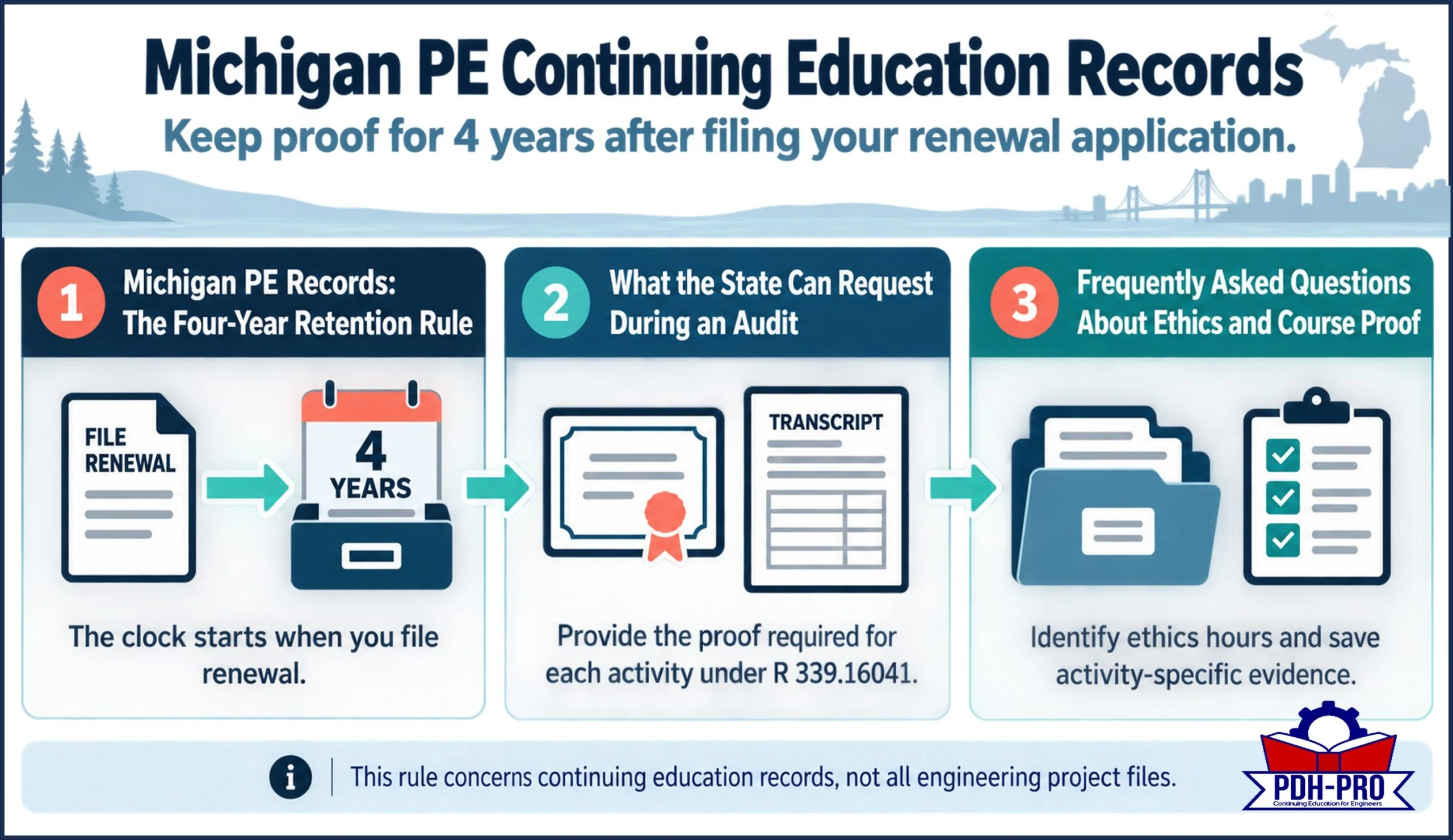 It starts on the date you file the renewal application. For example, if an engineer files on September 15, 2026, the rule requires the supporting documentation to be maintained for four years after that filing date. The example is only an illustration; use the submission date shown in your own renewal confirmation.
The four-year retention period begins after the renewal application is filed, rather than on the date the course was completed.
Three dates are easy to confuse:
- Course completion date: Helps show that an activity falls within the required education window.
- License expiration date: Determines the two-year lookback for a standard renewal.
- Renewal application filing date: Starts the four-year documentation-retention period.
Michigan’s Professional Engineer Licensing Guide directs engineers to complete their education before submitting the online application. Save its confirmation with the course file. That confirmation provides a practical reference for calculating the retention end date; it does not replace the evidence of completed activities.
If you file earlier than expiration, do not add four years to the expiration date out of habit. Likewise, do not start the clock on the date of the first course in the renewal period. The regulation specifies filing as its starting point.
An engineer with several licenses should maintain records for each jurisdiction’s applicable period. A certificate might support more than one license, but satisfying Michigan’s four-year rule does not automatically satisfy another board’s retention or audit requirements. Note each state’s filing date and record period separately.
What Records Can the State Request During a Michigan PE Audit?
Rule R 339.16041 describes acceptable activities and the evidence required for each if audited. This is why a single list of course titles is not enough. The right proof depends on how you earned the hours. Michigan accepts various qualifying in-person and online activities, but their documentation is not identical.
The department may audit a licensee and request the proof described in Rule R 339.16041. During an audit, the engineering board may request documentation demonstrating that the activities claimed by professional engineers satisfy the continuing education rules applicable to engineering practice.
For a qualifying program offered or approved for credit by one of the organizations specified in Rule R 339.16041(a), the rule calls for documentation or a completion certificate identifying the licensee, total hours, sponsor name and contact information, program title, and the date held or completed. A certificate missing the participant’s name or completion date could make an audit harder to answer, even if you remember taking the course.
Other activities call for different evidence. A qualifying academic course requires a transcript. For an engineering-related seminar, in-house course, workshop, or professional presentation, the rule describes a presentation notice or advertisement showing its date, the PE listed as a presenter or attendee, and the organization that approved or offered it. Company-sponsored training has its own documentation conditions. Read the category you are claiming instead of assuming a generic certificate covers every activity.
If a provider supplies a completion certificate, download it promptly and check its details while the event is fresh. You can ask for a correction before a missing name, date, or hour total becomes difficult to reconstruct. Retain supporting program information where it helps establish the subject or sponsor. That additional material is a practical safeguard; the rule’s activity-specific proof remains the requirement.
An audit may ask you to substantiate the hours you certified at renewal. Your best response is an organized file that lets the reviewer connect each claimed activity to its completion date, credit amount, and applicable category. The Michigan rule does not guarantee that a course will be accepted merely because the provider issued a certificate.
What Records Should Michigan Professional Engineers Keep?
Start with the evidence required by Rule R 339.16041 for each activity. Then make the file easy to interpret. A practical renewal folder includes:
- Your renewal submission confirmation and filing date.
- A simple log of qualifying activities, completion dates, and hours claimed.
- Certificates, transcripts, attendance evidence, or other proof specified by the applicable activity category.
- Clear identification of the activities used for the two engineering ethics hours.
- Course descriptions or event notices when the completion evidence alone does not explain the engineering subject.
- Any correspondence that resolves a specific question about an unusual activity.
The log and extra context are PDH Pro recordkeeping recommendations. They help you find and explain the required proof but are not substitutes for it. Keep copies that remain readable throughout the four-year period, including after a course-provider account or employer email address closes. Before relying on a provider’s approval claim as proof of eligibility, read do Michigan PE courses need to be board approved.
If a course has several components, avoid claiming hours for substantially duplicate content within the same cycle. Rule R 339.16041 denies additional credit for an activity with substantially the same content as one already credited in that period. It also limits credit to 12 hours in a 24-hour period. A completion file should support the allowable hours claimed, not merely show every certificate you received.
Michigan’s licensing guide points to CE Broker as an option for tracking education. A tracking service can help organize information, but keep the underlying activity-specific documents accessible so you can respond to a department request. If you claim credit for an academic course, do college courses count as CEU explains why you should retain the transcript and check the applicable credit calculation.
Frequently Asked Questions About Michigan PE Records
Do I need to keep my ethics certificate separately?
You should make the ethics evidence easy to identify, whether it sits in a separate folder or alongside your other course documents. Michigan requires two of the standard 30 hours to focus on professional ethics related to engineering. Retain the proof applicable to the activity you used for those hours for four years after filing renewal.
What if I lose a certificate?
Contact the provider promptly for a replacement and check Rule R 339.16041 for the proof required by that activity category. A payment receipt or personal spreadsheet may help locate a course, but it should not be assumed to satisfy the rule’s audit documentation.
Do I submit every certificate with my routine renewal?
The renewal application certifies compliance, and the department may request documentation through an audit. Keep the evidence even when it is not requested at the time you file. Relicensure after a lapse is a separate process that may require proof with the application.
Does the four-year rule apply to engineering project and client files?
The cited PE rule addresses documentation of continuing education compliance. It does not establish one retention schedule for all project or client materials. Review the obligations that govern those files separately.
Can one certificate support licenses in several states?
Possibly, if the activity independently satisfies each board’s rules and falls within each license’s reporting period. Preserve the certificate for as long as the longest applicable retention obligation requires, and record each jurisdiction’s deadline separately.
Before you file your next renewal, check that each claimed activity has the proof Michigan specifies, save the submission confirmation, and calendar four years from its filing date. If you still need qualifying hours, PDH Pro’s Michigan PE renewal packages offer discipline-based options that include ethics instruction. Review the course details and retain the completion documents for the activities you claim.