
 Contributor: Jordan Ellis
Written: Sep 24, 2026
No, Michigan does not require every PE continuing education course to receive individual advance approval from its engineering board. The course or activity must, however, qualify under Michigan Administrative Rule R 339.16041. For a standard renewal, a professional engineer needs 30 qualifying hours during the two years before the license expires, including two hours focused on ethics related to engineering. The distinction matters: a course can qualify without carrying a “Michigan board approved” label, but an advertisement promising PDH credit does not, by itself, establish that it qualifies.
For the full rules on qualifying hours, ethics, and renewal, review the Michigan PE continuing education requirements.
Board Approval: What the State Board Requires
Table of Contents
Michigan regulates which activities earn continuing education credit. Rule R 339.16041 lists acceptable activities and, for each, describes the credit awarded and the proof a licensee may have to provide during an audit. Its categories include qualifying programs offered or approved for credit by specified organizations, academic courses, seminars and technical presentations, company training, and several other professional activities. The rule does not establish a general requirement that every provider submit each course to the Michigan board for advance approval.
That answer needs a qualification. “No individual Michigan board approval required” does not mean “any engineering-related material earns credit.” You need a qualifying activity, an appropriate number of hours, and the records specified for that activity. The category you rely on determines what evidence you should collect.
For example, Rule R 339.16041(a) recognizes a program related to professional engineering that is approved or offered for continuing education credit by another state’s engineering board, a professional engineering association, organization or society, NCEES, or ABET. Rule R 339.16041(c) separately covers attendance at an engineering-related seminar, in-house course, workshop, or professional or technical presentation. Those are different routes to credit, with different audit documentation. Approval by one of the organizations named in subsection (a) is therefore a possible basis for credit, not a requirement imposed on every activity described elsewhere in the rule.
A useful question when reviewing a course is: Which part of R 339.16041 supports the credit claimed for this activity? If the answer is unclear from the description and completion records, ask the provider before enrolling. For an unusual format or a substantial block of hours, you can also ask the Michigan Bureau of Professional Licensing how the rule applies to your circumstances. That is a practical way to resolve an ambiguity; it is not a routine preapproval step stated in the rule.
Must a Provider Be Authorized?
Michigan’s PE continuing education rule does not set out a blanket registration or authorization process for all course providers. Instead, it identifies acceptable activities and the supporting proof. For the particular category in R 339.16041(a), the identity of the organization approving or offering credit matters because the rule names the types of organizations that can do so. Other categories have their own conditions.
This is also why “approved provider” can be an imprecise description. A provider may hold an approval in another jurisdiction, and one of its programs may qualify under Michigan’s rules, without the provider having received a separate Michigan approval for every course. When selecting a course, focus on the applicable Michigan rule, what the activity teaches, the credit claimed, and the documentation you will receive.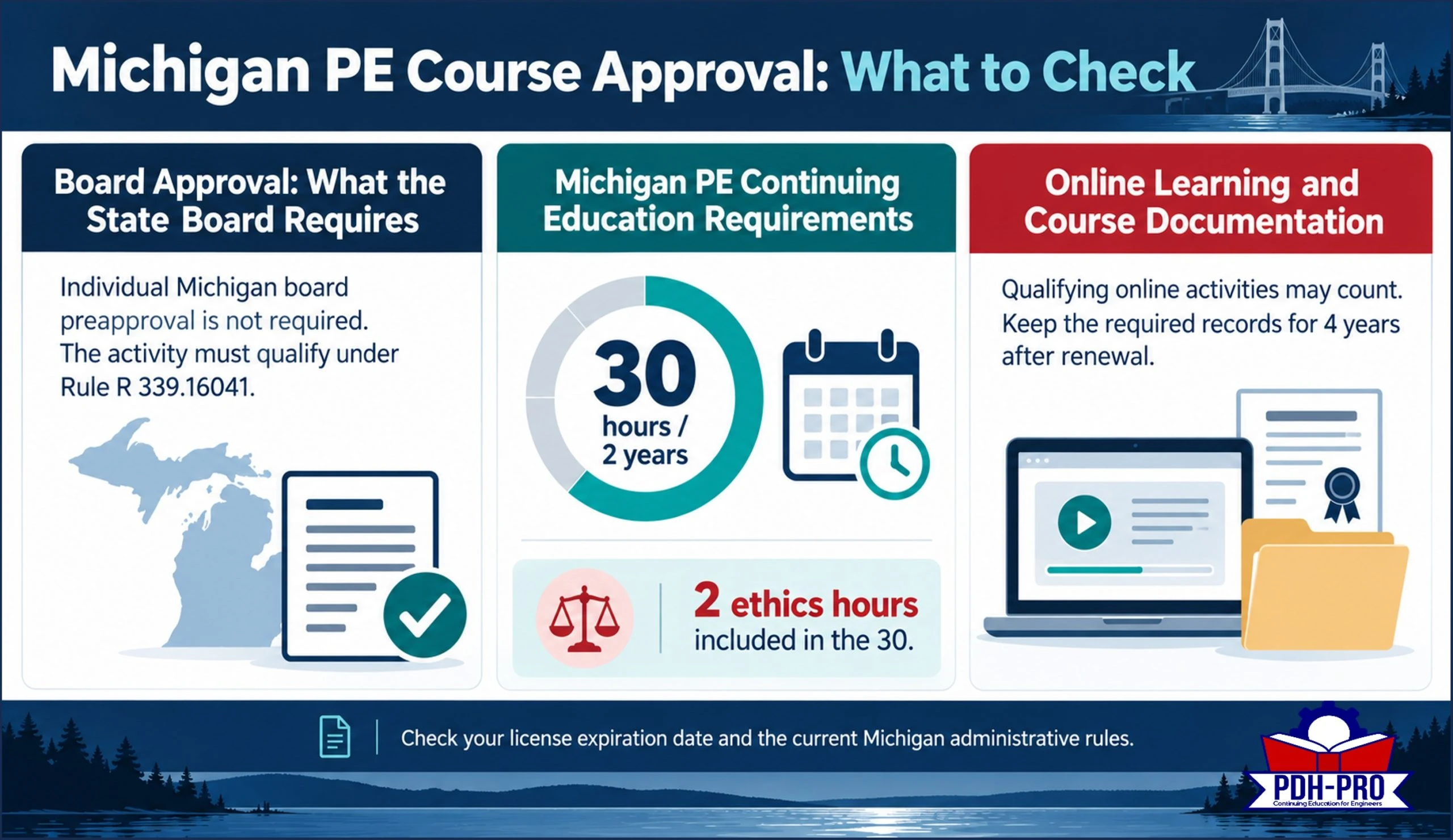
Michigan PE Continuing Education Requirements
The Michigan administrative rules for professional engineers and the state’s Professional Engineer Licensing Guide provide the starting point for renewal planning. The guide states that the renewal cycle is two years and that an engineer must finish the qualifying education before completing the online renewal application. Filing the application is an attestation that the requirements have been met.
| Requirement | Current Michigan rule or guidance |
| Standard renewal cycle | Two years |
| Continuing education | 30 qualifying credit hours during the two years immediately before license expiration |
| Ethics | Two of the 30 hours must focus on professional ethics related to engineering |
| Laws and rules course | The ethics activity does not have to focus specifically on statutes or administrative rules |
| Online participation | In-person and online hours can receive credit when the activity satisfies R 339.16041 |
| Records | Maintain documentation for four years after filing the renewal application |
| Audit | Provide the activity-specific evidence described in R 339.16041 if the department requests it |
These points come from Rules R 339.16040 and R 339.16041 and the state’s renewal checklist. The table addresses an ordinary renewal; relicensure after a lapse follows a separate process.
Use the expiration date shown for your license. The current state guide describes renewal in relation to that date and says the online application may be submitted no sooner than 90 days before expiration. It does not give engineers a reason to assume that a date repeated on an older course-provider page is the expiration date of every individual license.
The two-year lookback also affects carryover. Rule R 339.16040 requires the hours to be earned during the two years immediately preceding expiration; it does not provide an allowance to bring older excess hours forward. If you complete more than 30 qualifying hours, keep the records, but do not plan the next renewal around hours that fall outside its applicable two-year period.
How Many Hours of Engineering Ethics Count?
At least two of the required 30 hours must focus on professional ethics related to engineering. Those two hours are part of the 30, so a standard renewal calls for 30 total qualifying hours, not 32. The rule expressly says the ethics activity does not have to focus on Michigan statutes or administrative rules.
Choose an activity whose description makes the ethics focus clear, and retain its completion record. A technical course that briefly mentions a professional obligation should not automatically be treated as two ethics hours. Conversely, a course addressing engineering judgment, conflicts of interest, public safety, or professional responsibility may be relevant when its actual instruction focuses on ethics. The course content and documented credit, rather than its marketing label alone, are what you should review.
Michigan’s rules also limit credit in two ways that are easy to overlook. You cannot earn credit twice in the same renewal period for activities with substantially the same content. And you cannot earn more than 12 continuing education hours in a 24-hour period. These limits apply even when individual activities otherwise qualify.
If you were licensed recently, do not assume that an older reference to a 15-hour first renewal applies to your situation. The current rule describes a 30-hour obligation for an applicant who was licensed during the two-year period immediately before expiration, while the state guide presents 30 hours in its renewal checklist. Review your particular licensing dates with the bureau if your first cycle is shorter than a full two years.
Qualifying Professional Engineering Courses
Rule R 339.16041 offers more than one path to credit. The following examples show why checking the activity category is more useful than looking only for a provider badge:
- Programs offered or approved for credit by specified organizations: Subsection (a) names another state’s engineering board, a professional engineering association, organization or society, NCEES, and ABET. The activity must relate to professional engineering. If audited, the engineer provides a completion record with the name, credit hours, sponsor and contact information, title, and completion date.
- Academic study: Subsection (b) covers passing a related course at a qualifying college or university. Its credit conversion and transcript requirements differ from those for a short course.
- Seminars and presentations: Subsection (c) covers attendance at related seminars, in-house courses, workshops, and professional or technical presentations. It awards one credit hour per 50 minutes of attendance and describes the notice or other evidence needed for an audit.
- Company training: Subsection (i) covers company-sponsored or hosted seminars or training designed to enhance development in the licensee’s area of practice. It specifies both a time conversion and the information the company’s completion record must show.
- Other professional activities: The rule also addresses teaching, peer-reviewed publication, service in specified organizations, complete board-meeting attendance, school-sponsored mentoring, journal-article study, and patents. Several of these categories have per-cycle caps and specialized proof requirements.
The list is a summary, not a substitute for the full rule. In particular, a credit figure that works for a seminar does not automatically apply to academic study, teaching, or independent reading.
A course can be valuable for your practice yet leave a credit question unresolved. Consider a self-paced written lesson followed by a quiz. Michigan allows qualifying online education, but its rule does not expressly say that every PDF-and-quiz product falls under the seminar attendance category. A provider should be able to explain the category it relies on, how it determines credit, and what record it issues. If those details are missing, clarify them before counting the hours.
Likewise, a course advertised as “approved in all states” deserves a closer look. Michigan asks whether the activity meets its own rule. Another state’s board approval may be relevant under subsection (a), but acceptance of an activity in one jurisdiction does not automatically establish that it meets every other state’s renewal requirements. Engineers with several licenses should check the dates, ethics rules, format limits, and documentation for each jurisdiction.
What Should You Check Before Enrolling?
Use this short review before committing to a course:
- Identify the activity category. Ask which provision of R 339.16041 supports the proposed credit.
- Check the subject. Confirm that the instruction relates to professional engineering, or, for company training, to development in your area of practice as the applicable category requires.
- Confirm the amount of credit. Check whether the claimed hours follow the rule for that category and whether a category cap applies.
- Check the completion evidence. Verify that you will receive the certificate, attendance record, transcript, or other proof the rule specifies.
- Check your dates and totals. Make sure the activity falls within your applicable two-year period, leaves you with two qualifying ethics hours, and does not duplicate substantially similar content already counted.
- Review your other licenses separately. Save the same underlying course record if you intend to claim it elsewhere, but apply each jurisdiction’s own rules.
These are planning steps for the licensee. Michigan’s rule, rather than this checklist, controls whether credit is ultimately available.
Online Learning and Course Documentation
Michigan expressly allows credit for in-person or online education that satisfies R 339.16041. That can make live webinars, online technical presentations, and other qualifying remote instruction practical choices. The delivery method alone does not determine eligibility: an online activity still needs to fit an accepted category and have the required evidence.
For an online seminar, retain the information that connects you to the event, its date, sponsor, subject, and attendance. For a qualifying program under subsection (a), the rule calls for a certificate or documentation identifying the licensee, hours, sponsor name and contact information, program title, and completion date if audited. For company training, the required evidence identifies the licensee, company, subject, and date. Because the proof changes by category, downloading a generic certificate without checking its contents can leave a gap later.
Michigan requires a licensee to maintain documentation for four years after filing the renewal application. Renewal itself certifies compliance; the department may subsequently audit the licensee and request the documentation described in the rule. Keep readable copies of certificates and supporting course information where you can retrieve them after changing employers or learning platforms.
What Records Should You Keep for an Audit?
Keep the proof specified for each activity you claim. A practical folder for each renewal cycle can contain the following:
- The completion certificate or other category-specific proof.
- The course description, learning objectives, or event notice available when you enrolled.
- The completion or attendance date and number of hours claimed.
- A separate record identifying the two ethics hours.
- Your own running total and a copy of the submitted renewal confirmation.
To make sure you keep that documentation for the required period, see how long must Michigan PEs retain continuing education records.
The first item follows the rule’s audit provisions; retaining the additional context is a practical recommendation that can help explain an activity later. A spreadsheet is useful for tracking dates and totals, but it does not replace the underlying documentation. Michigan also links to CE Broker as a way for licensees to track credits; use whichever record system lets you retain and produce the required evidence.
Before submitting renewal, compare your records with the two-year window ending on your license expiration date. Confirm the 30-hour total, the two ethics hours, and any limits that affect activities you used. The state guide says to finish the education before completing the application and accepting its attestation. If you have an unusual exemption request, address it early: Rule R 339.16040 specifies that a waiver request must reach the department for board consideration at least 30 days before the last regularly scheduled board meeting before expiration. A waiver is a request for consideration, not an automatic exception.
Frequently Asked Questions
Are PDH Pro courses accepted for Michigan PE renewal?
A PDH Pro course may count when its particular activity and documentation satisfy R 339.16041. Michigan does not give every course an individual advance board approval. Before relying on a course, check its subject, claimed hours, completion record, and the rule category that supports the credit. PDH Pro’s Michigan renewal packages offer course selections intended for the state’s 30-hour requirement, including ethics; the engineer remains responsible for the renewal attestation.
Can I complete all 30 hours online?
The Michigan rule allows online hours that satisfy its activity requirements and does not state a separate overall cap merely because instruction is online. Check the qualification and proof for each course; “online” is a delivery method, not an independent credit category.
Does a Michigan PE need an ethics course?
You need two qualifying hours in an activity focused on professional ethics related to engineering. The rule does not require the ethics activity to focus specifically on Michigan laws or rules.
Can I carry excess hours into the next renewal period?
Do not plan on carrying them over. For a standard renewal, Michigan requires qualifying hours earned during the two years immediately before that license’s expiration; the rule provides no general carryover allowance for older hours.
Do PE licenses need to be renewed?
Yes. Michigan’s professional engineer renewal cycle is two years. Check your individual expiration date and complete the required education before submitting the online renewal application.
What if my license expires before I finish the education?
Do not attest that you completed hours you have not earned. Michigan’s licensing guide says an engineer who has not met the continuing education requirement before expiration will need to apply for relicensure. The guide also describes a 60-day late-renewal grace period, so a licensee facing this situation should contact the bureau about the appropriate procedure rather than assume the grace period extends the education deadline.
Can one course support licenses in several states?
Potentially, if it independently satisfies each state’s rules and falls within each applicable reporting period. A Michigan-qualifying course does not automatically meet another jurisdiction’s ethics, provider, format, or record requirements.
For your next renewal, start with your license expiration date, select activities you can tie to Michigan’s accepted categories, and save the proof as you complete each one.