
Contributor: Jordan Ellis
Written: Oct 11. 2026
 Finding approved PE continuing education courses starts with the state board’s rules, not the course provider’s marketing language. For South Carolina engineers, the first step is to confirm the full South Carolina PE Continuing Education Requirements, including the number of PDH units required, acceptable course formats, documentation rules, and any limits on course subject matter. South Carolina requires professional engineers to complete 30 PDH units during each biennial renewal period, and the Board has final authority over course approval, credit, and PDH value.
South Carolina does not require engineers to use only one specific course provider or one single course format. The state allows PDH credit for several types of activities, including continuing education courses, college courses, short courses, tutorials, webinars, and distance-education courses offered for documented individual or group study. The regulation specifically recognizes face-to-face programs, live internet-based programs, archived prerecorded programs, and archived correspondence programs.
That flexibility is useful, but it also means the professional engineer has to make a careful judgment before registering. A course may be convenient, affordable, or interesting, but it still needs to fit the board’s continuing professional competency rules.
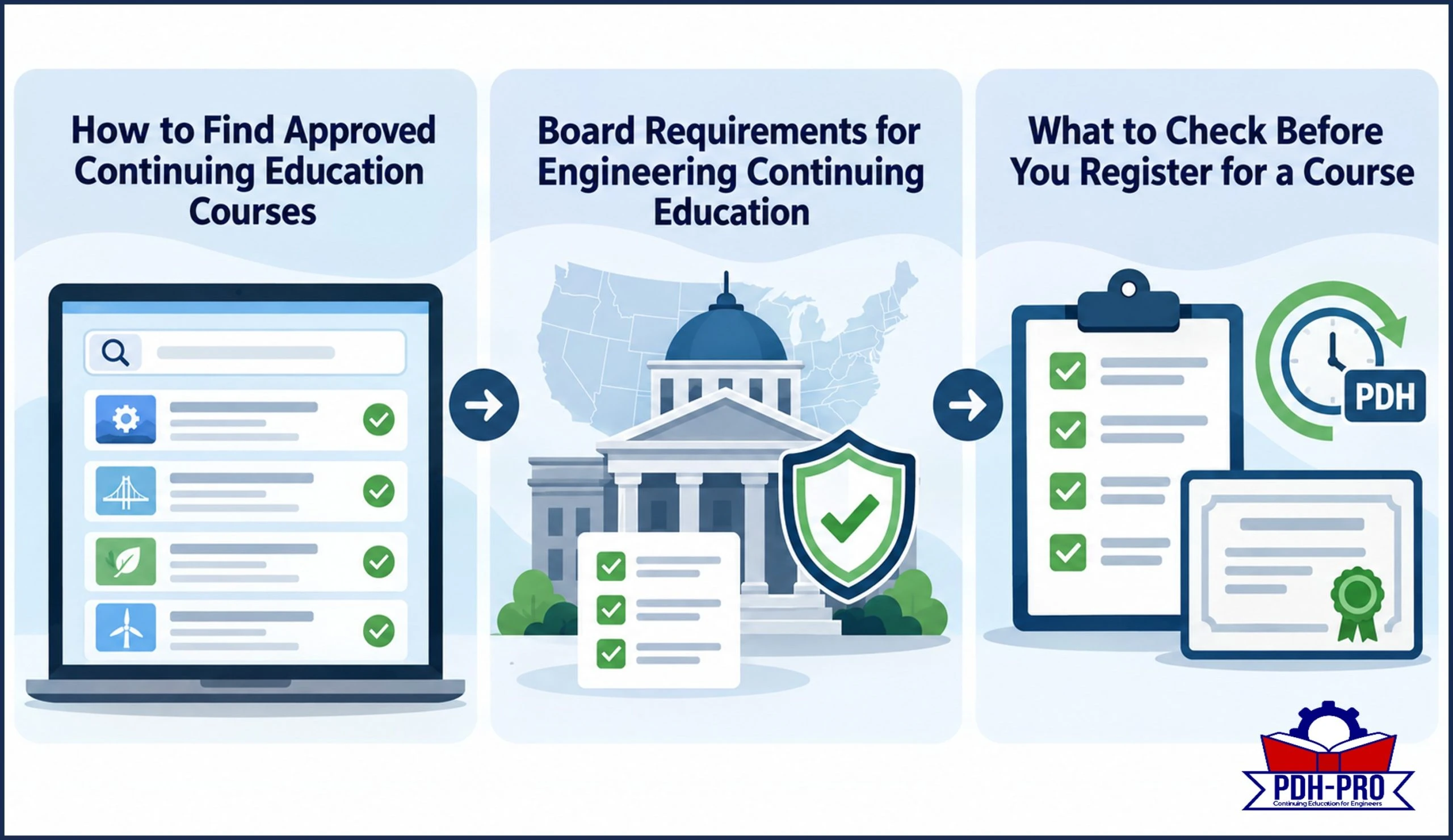
How to Find Approved Continuing Education Courses
Table of Contents
 The safest way to find approved continuing education courses is to work backward from the state requirements. Start by reading the board’s continuing education rules, then evaluate each course against those rules before you count it toward renewal.
For South Carolina PEs, a qualifying course or activity must have a clear purpose and objective and must maintain, improve, or expand the skills and knowledge relevant to the licensee’s field of practice. Regular job duties do not count as qualified activities.
A practical review process looks like this:
- Confirm the renewal rule. Check how many PDH units are required and the renewal period that applies to your license.
- Confirm the course topic. Make sure the course relates to engineering practice, technical competence, ethics, laws and rules, project delivery, safety, or another relevant professional subject.
- Confirm the format. Verify whether the course is live, recorded, written, correspondence-based, webinar-based, or classroom-based.
- Confirm the PDH value. South Carolina generally treats one hour of professional development for course work, seminars, or professional/technical presentations as 1 PDH.
- Confirm documentation. Make sure you will receive a certificate or other completion record showing the course name, provider, date, duration, and PDH credits.
- Confirm any state-specific limits. South Carolina limits business or non-technical subject matter to no more than 50 percent of PDHs claimed during a renewal cycle.
A course provider may describe a class as “PE approved,” “board accepted,” or “state compliant,” but the engineer should still verify what that means. Some states preapprove providers. Some preapprove individual courses. Some leave more responsibility with the licensee. South Carolina’s regulation says the Board has final authority over approval of courses, credit, PDH value, and other methods of earning credit.
Ethics courses can be useful when they relate to professional conduct, public safety, responsible charge, conflicts of interest, or board rules. Engineers who need to strengthen that part of their renewal record can review engineering ethics courses for South Carolina PEs.
Free courses can count in some situations, but price is not the test. A free engineering PDH course still needs to be relevant, documented, and consistent with the board’s rules. If the provider cannot issue a completion certificate or clearly state the learning objective, course duration, and PDH value, it may be difficult to defend in an audit.
Board Requirements for Engineering Continuing Education
The board requirements matter more than the course description because the licensee is responsible for the renewal claim. South Carolina requires licensees to maintain records that support the credits claimed. These records include a log showing the type of activity, sponsoring organization, location, duration, instructor or speaker name, and PDH credits earned, along with attendance verification records such as completion certificates or other documents supporting attendance.
South Carolina requires those records to be maintained for at least two renewal cycles. The Board may request copies for audit verification. If PDH units are disallowed after review or audit, the licensee has 90 days to remedy the deficiency. If the deficiency is not remedied within that time, the license is automatically deemed lapsed.
Before selecting a course, check these items:
| Course review item | What to verify |
| State relevance | The course fits South Carolina’s continuing professional competency rules |
| Technical relevance | The course supports your engineering field or professional responsibilities |
| PDH value | The provider states the number of PDH credits clearly |
| Completion proof | You receive a certificate or other attendance record |
| Course date | The course falls within the correct renewal period |
| Subject limits | Business or non-technical PDH does not exceed South Carolina’s limit |
| Audit readiness | You can explain why the course was relevant if the board asks |
South Carolina also allows limited carryover. If a licensee exceeds the requirement in a renewal period, a maximum of 15 PDH units may be carried forward into the next renewal period. If the licensee claims 15 carryover PDH units, the previous renewal period is subject to audit. Before taking extra courses near the end of a renewal cycle, engineers should check the South Carolina PE credit carryover rules.
What to Check Before You Register for a Course
Before you register, ask five practical questions:
- Does this course match my PE license renewal period?
- Is the topic relevant to my engineering practice or professional responsibilities?
- Will I receive a certificate or completion record?
- Does the provider clearly state the PDH value?
- Would I be comfortable explaining this course to the board during an audit?
If the answer to any of those questions is unclear, pause before registering. The perfect PDH course is not just the one that fits your schedule. It is the one that fits your renewal requirements, supports your professional development, and leaves you with clean documentation.
PDH Pro offers written self-paced courses, live webinars, and on-demand recorded webinars for professional engineers. When choosing any course, match the topic and format to your state requirements and keep the completion record with your renewal file.
Frequently Asked Questions About Approved PE Courses
Where can I find free engineering PDH courses?
Free engineering PDH courses may be available through professional societies, universities, agencies, manufacturers, or technical organizations. The important question is whether the course qualifies under your state board’s rules. For South Carolina, the course should have a clear purpose and objective, be relevant to the licensee’s field of practice, and provide documentation.
Can I call myself an engineer without a PE?
Rules vary by state, context, job title, and whether the person is offering engineering services to the public. If the title implies licensure or the person is practicing professional engineering, state licensing laws may apply. Engineers should check the applicable state board rules before using titles that could suggest PE status.
How do you get CEU certified?
A CEU is a continuing education unit, not a professional license. South Carolina converts 1 CEU to 10 PDH for continuing professional competency purposes. If a course offers CEUs, confirm the conversion, documentation, and whether the course topic qualifies for your PE renewal.
How much does CPEng cost?
CPEng is a credential used outside the U.S. PE licensing system and is not the same as a South Carolina PE license. Costs and requirements depend on the organization and jurisdiction involved. South Carolina engineers should rely on the South Carolina Board’s PE renewal rules when selecting continuing education for state license renewal.