
 Contributor: Jordan Ellis
Written: Oct 10. 2026
South Carolina PEs need 30 PDH units during each biennial renewal period, and ethics courses can count when they maintain, improve, or expand knowledge relevant to the engineer’s field of practice. South Carolina’s regulations do not create a separate stand-alone ethics-hour requirement for professional engineers, but the state board does regulate ethical standards and continuing professional competency, so ethics training can still be a practical part of a renewal plan. Engineers should review the full South Carolina PE Continuing Education Requirements before selecting courses for renewal.
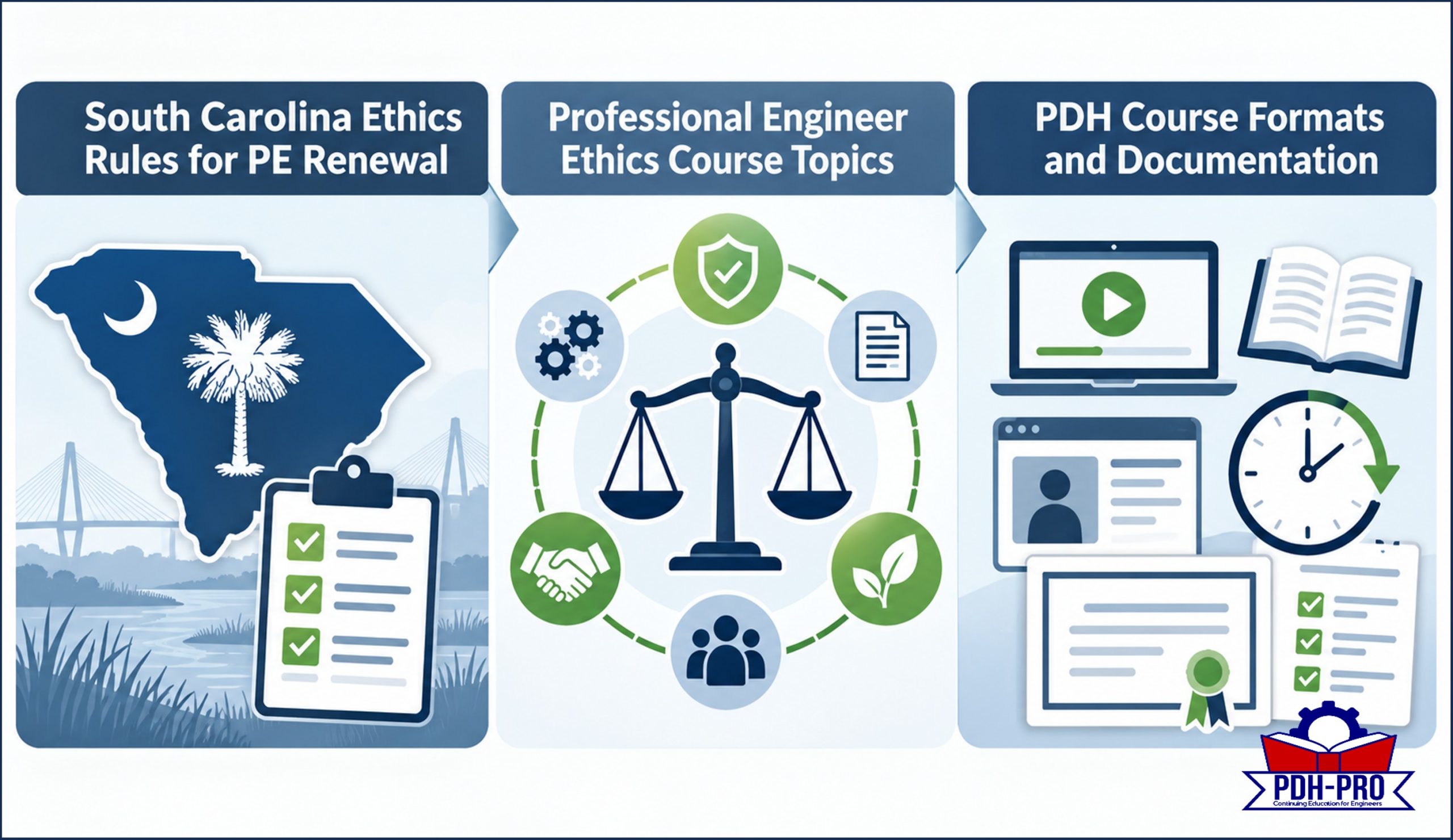
South Carolina Ethics Rules for PE Renewal
Table of Contents
South Carolina regulates professional engineering through the South Carolina State Board of Registration for Professional Engineers and Surveyors. The board’s purpose includes protecting public health, safety, and welfare, promoting technical competency, and promoting ethical standards consistent with the Rules of Professional Conduct for engineers and surveyors. That matters because engineering ethics is not just a classroom topic. It is part of the legal and professional framework for holding a PE license in South Carolina.
For renewal, the key point is this: South Carolina requires continuing professional competency, but the regulation does not appear to say that a specific number of PDH must be in ethics. The state’s continuing professional competency article requires each licensee to obtain 30 PDH units during each biennial renewal period. It also defines a qualifying course or activity as one with a clear purpose and objective that maintains, improves, or expands the skills and knowledge relevant to the licensee’s field of practice.
That gives ethics courses a useful role. An ethics course can help a South Carolina PE review conflicts of interest, public safety duties, responsible charge, professional judgment, sealing obligations, client communications, and disciplinary scenarios. Those topics are directly tied to professional practice. The course should still be relevant, documented, and appropriate for the engineer’s field or professional responsibilities.
South Carolina also limits business or non-technical subject matter. Effective July 1, 2022, no more than 50 percent of PDHs claimed during a renewal cycle may be earned in business or non-technical subject matter. Ethics courses should be selected carefully so they are clearly connected to engineering practice, public protection, professional conduct, or laws and rules affecting engineering decisions.
Continuing Education Requirements and State Board Expectations
 South Carolina PE licenses renew biennially. The regulation states that the privilege to practice as a registered professional engineer or surveyor expires on June 30 in even-numbered years unless renewed. It also says licensees are responsible for renewing before the official expiration date.
The South Carolina Board’s current website notice states that 2026-2028 Professional Engineers and Surveyors license renewals are open and that the deadline to renew without late penalties is July 31, 2026. That current notice is useful for the active renewal cycle, but engineers should always check the board’s renewal page and their own license record before relying on any deadline.
The basic continuing education framework is straightforward:
| Requirement | South Carolina PE rule |
| Renewal cycle | Biennial renewal |
| License expiration | June 30 in even-numbered years unless renewed |
| PDH requirement | 30 PDH units during each biennial renewal period |
| Ethics-specific minimum | No separate ethics-hour requirement identified in the regulation |
| Carryover | Up to 15 excess PDH may be carried forward |
| Delivery formats | College courses, continuing education courses, short courses, tutorials, webinars, distance education, teaching, published work, society participation, and patents may qualify |
| Daily limit | No more than 12 hours of credit may be obtained in one calendar day |
| Records | Keep supporting records for at least two renewal cycles |
South Carolina’s regulation also gives the board final authority over approval of courses, credit, PDH value, and other methods of earning credit. That means the engineer remains responsible for choosing courses that can be defended if the board reviews the renewal record.
When reviewing ethics options, engineers should also understand the process for finding approved PE continuing education courses.
Professional Engineer Ethics Course Topics
A useful professional engineer ethics course should connect ethical principles to actual engineering decisions. For South Carolina PEs, that usually means a course should help the engineer make better decisions in practice, especially where public safety, professional judgment, client pressure, competence, or documentation are involved.
Good engineering ethics topics include:
- Public health, safety, and welfare
- Conflicts of interest
- Responsible charge and supervision
- Signing and sealing documents
- Competence in the engineer’s area of practice
- Truthful statements and professional communications
- Confidentiality and client obligations
- Reporting unsafe conditions
- Use of standards, codes, and accepted engineering practice
- Lessons from disciplinary cases or engineering failures
Ethics is most valuable when it is practical. A civil engineer, environmental engineering professional, mechanical engineer, electrical engineer, or structural engineer may all face different technical facts, but the same underlying professional duties often show up: stay within your competence, document your work, communicate risk clearly, and protect the public when technical judgment matters.
South Carolina’s statute describes the board’s role as promoting technical competency and ethical standards and disciplining violations of laws governing engineering and surveying. That makes ethics training relevant even when the regulation does not require a dedicated ethics PDH hour.
A strong ethics course should also include cases. Case-based learning helps engineers think through facts, alternatives, consequences, and defensible decisions. For example, a course might ask whether an engineer should sign a drawing prepared by others, how to respond when a client rejects a safety recommendation, or what to do when field conditions differ from the design assumptions. Those examples are more useful than abstract statements because they mirror the judgment calls engineers face in practice.
PDH Course Formats and Documentation
South Carolina allows PDH units to be earned through several activities, including continuing education courses, short courses, tutorials, webinars, and distance-education courses offered for documented individual or group study. The regulation specifically recognizes face-to-face programs, live internet-based programs, archived prerecorded programs, and archived correspondence programs.
That gives South Carolina PEs flexibility. A PE can use written self-paced courses, live webinars, on-demand recorded webinars, or other documented course formats if the activity otherwise qualifies. The practical question is whether the course has a clear purpose, a relevant objective, a reasonable PDH value, and proof of completion.
South Carolina defines one PDH as a nominal contact hour of instruction or presentation. It also provides conversions for other credit types, including 1 CEU equaling 10 PDH, 1 college semester hour equaling 45 PDH, and 1 college quarter hour equaling 30 PDH.
For documentation, the burden is on the licensee. South Carolina requires licensees to maintain records supporting claimed credits. Required records include a log showing the type of activity, sponsoring organization, location, duration, instructor or speaker name, and PDH credits earned, along with attendance verification such as completion certificates or other attendance documents. Records maintained by NCEES or other recognized repositories may also support claimed credit.
South Carolina requires these records to be maintained for a minimum of two renewal cycles. If the board reviews or audits a renewal and disallows PDH units, the licensee has 90 days to remedy the deficiency. If the deficiency is not remedied during that period, the license is automatically deemed lapsed.
Before renewal, a South Carolina PE should complete a quick record check:
- Confirm that the course topic is relevant to engineering practice.
- Confirm the PDH value and completion date.
- Save the completion certificate.
- Keep a renewal-cycle log.
- Separate technical, ethics, and business/non-technical topics.
- Confirm that no more than 12 hours are claimed for one calendar day.
- Retain records for at least two renewal cycles.
PDH Pro offers professional engineering continuing education in formats that can fit different renewal workflows, including written self-paced courses, live webinars, and on-demand recorded webinars. For South Carolina PEs, the best approach is to choose courses that support the engineer’s actual practice area, provide completion documentation, and fit within the state’s 30-PDH biennial requirement.
Frequently Asked Questions About Engineering Ethics
Do Engineers Have to Take Ethics Courses?
South Carolina PEs must complete 30 PDH units during each biennial renewal period, but the South Carolina regulation does not appear to require a separate fixed number of ethics PDH for engineers.
That does not mean ethics is unimportant. The board’s statutory purpose includes promoting ethical standards for engineers and surveyors. Ethics courses can be a good way to strengthen professional judgment, review board expectations, and document training related to public protection and professional conduct.
Engineers licensed in multiple states should be especially careful. Satisfying South Carolina’s requirements does not automatically satisfy another state’s ethics requirement. Some states require a specific number of ethics, laws, or rules hours. If you hold licenses in several states, compare each board’s requirements before choosing courses.
Can Engineering Ethics Be Taught?
Yes. Engineering ethics can be taught effectively when the course connects ethical duties to real engineering decisions. The most useful courses are not just lists of rules. They give engineers structured ways to evaluate conflicts, technical uncertainty, public risk, client pressure, and professional responsibility.
Ethics training is especially useful when it includes case studies. Engineers often learn best from examples that show how a decision develops: what the engineer knew, what alternatives were available, what standards applied, how the decision was documented, and what consequences followed.
For a South Carolina PE, an ethics course should ideally reinforce the board’s public-protection purpose and the engineer’s duty to practice competently. It should also be relevant enough to qualify as a continuing professional competency activity.
What Are the Principles of Engineering Ethics?
Different organizations describe engineering ethics in different ways, but most principles come back to the same foundation: protect the public, practice only within your competence, communicate truthfully, avoid conflicts of interest, and act with integrity.
For PE continuing education, the most practical ethics principles are:
- Put public health, safety, and welfare first.
- Accept work only when qualified by education or experience.
- Be truthful in reports, statements, and professional communications.
- Disclose conflicts of interest.
- Exercise independent professional judgment.
- Maintain appropriate records.
- Follow applicable laws, rules, codes, and standards.
- Take action when a condition may endanger the public.
Those principles are not separate from technical practice. They show up in design assumptions, permitting, field changes, quality control, expert opinions, and project communication. That is why ethics courses can be valuable even when a state does not require a separate ethics minimum.
For South Carolina engineers preparing for renewal, the practical path is simple: complete 30 PDH during the biennial period, choose courses that are relevant to your engineering practice, keep strong records, and include ethics training when it helps reinforce sound professional judgment.