
Green Roof Design CEU Benefits: Green Roof Systems, Green Roofs, and Their Benefits for Sustainability
Green roof design is becoming a practical priority for architects working on sustainable buildings, resilient sites, and urban infrastructure. As owners, municipalities, architects, and design teams look for better ways to manage stormwater, reduce heat island impacts, and improve long-term building performance, green roofs continue to move from specialty feature to proven design strategy.
For architects, green roof design CEU benefits reach beyond meeting license renewal requirements and can support PDH and CPC goals when the course content meets state board rules. Strong continuing education connects design theory with field-ready decisions, from load considerations and drainage layers to vegetation selection and maintenance planning. PDH-Pro supports that need with flexible online courses and webinars built for busy engineers who need reliable PDH credits, clear documentation, and training that fits around active project schedules.
How Green Roof Systems Fit into Modern Engineering Practice
Green roof systems combine landscape design, drainage engineering, waterproofing, structural analysis, and long-term maintenance planning. A successful system is not only a layer of vegetation on a building. It is an integrated assembly that must protect the roof membrane, manage water, support plant health, and work within the structural limits of the building.
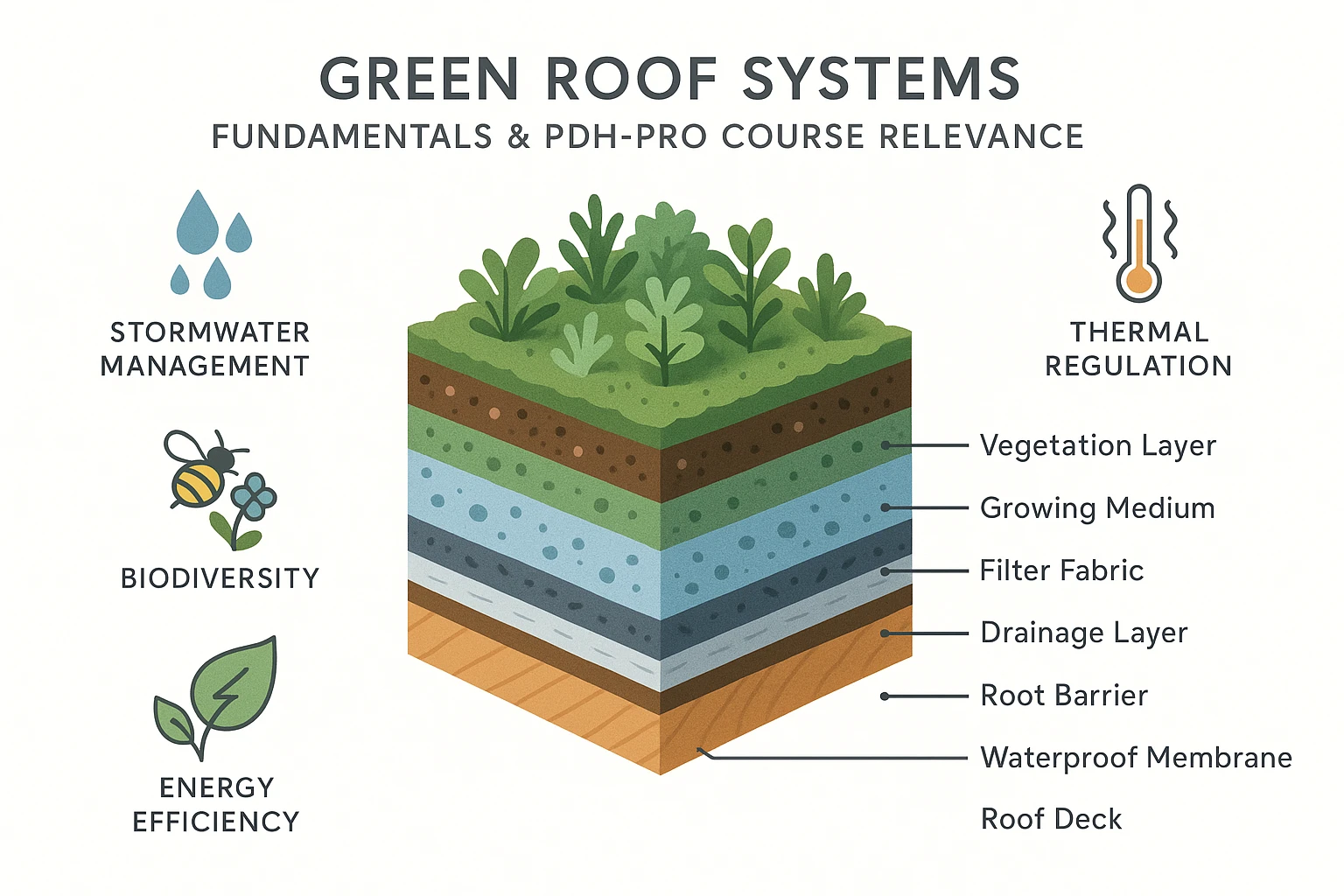
For architects, the first step is understanding the difference between extensive green and intensive green roof assemblies. Extensive systems are generally lighter, shallower, and lower maintenance. They often use hardy vegetation such as sedum and are common on projects where stormwater management, energy performance, or reduced roof surface temperature are primary goals. Intensive systems are deeper and heavier. They may include larger plants, walkways, seating areas, irrigation systems, and richer soil profiles.
Each approach affects design decisions. Structural loading, roof slope, waterproofing, root barriers, drainage capacity, access, irrigation, and inspection needs all change based on the system type. Continuing education helps engineers evaluate these variables in a structured way, rather than treating green roofs as a one-size-fits-all solution.
A well-designed green roof can support several project goals at once:
● Reduce runoff volume and slow peak discharge during rain events
● Improve roof insulation and reduce surface temperature
● Support biodiversity in dense urban areas
● Extend roof membrane service life by reducing UV and temperature exposure
● Improve building and site performance for sustainability programs
These benefits are strongest when the engineer understands the full assembly. PDH-Pro’s related technical courses can help connect sustainable design, roofing, stormwater, and code topics with professional development needs, so engineers can earn education credits while strengthening their ability to evaluate sustainable building strategies.
Benefits of Green Roofs for Stormwater, Energy, and Urban Design
Green roofs are often discussed for their environmental benefits, but engineers need to evaluate them in terms of measurable performance. The most common project drivers include stormwater management, energy use, heat island reduction, air quality, and improved use of roof space.
Stormwater is often the primary reason a project team considers a green roof. Vegetation and growing media absorb rainfall, slow runoff, and reduce the burden on drainage infrastructure. In dense urban settings, where paved surfaces dominate and site detention options may be limited, roof area can become part of the stormwater strategy.
Green roofs can also support energy performance. By shading the roof membrane and adding an insulating layer, they can reduce roof surface temperature and help limit heat transfer into the building. Their impact varies based on climate, roof assembly, irrigation, plant coverage, and building type, but the design principle is clear. A living roof can help moderate temperature swings and support better building performance.
Urban design benefits are also important. Green roofs can turn unused roof area into functional space, visual relief, or habitat. In some projects, they contribute to occupant well-being by improving views or providing access to planted outdoor areas. They can also help re-oxygenate dense urban environments by adding living plant material where hard surfaces would otherwise dominate.
The table below outlines common benefits and the design issues engineers should review before recommending a system.
| Green Roof Benefit | Engineering Value | Design Considerations |
| Stormwater management | Slows runoff and can reduce peak discharge | Growing media depth, drainage layers, overflow paths, local rainfall patterns |
| Energy performance | Helps reduce roof surface temperature and heat transfer | Climate, insulation strategy, plant coverage, irrigation, roof exposure |
| Heat island reduction | Lowers surface temperatures compared with dark roof materials | Surrounding materials, roof area, vegetation density, maintenance |
| Roof membrane protection | Reduces UV exposure and temperature stress | Waterproofing quality, root barriers, inspection access |
| Biodiversity and air quality | Adds vegetation and habitat in built environments | Plant species, local ecology, maintenance plan, irrigation needs |
| LEED support | May contribute to sustainability documentation | Project rating goals, documentation requirements, system performance data |
These economic benefits should also be part of the discussion. A green roof may cost more upfront than a conventional roof, but it can provide value through stormwater fee reductions where available, longer membrane life, lower cooling demand, higher asset appeal, or improved compliance with municipal green infrastructure requirements. The right analysis depends on the project location, owner goals, and maintenance capacity.
Green Roof, Cool Roofs, and Living Architecture Design Choices
Architects are often asked to compare green roofs with cool roofs. Both can support sustainable design, but they solve different problems.
Cool roofs use reflective materials to reduce roof surface temperature. They are often easier to install, lighter than vegetated systems, and well suited to many retrofit projects. They can reduce cooling loads in hot climates and may help meet high albedo roof requirements. Their simplicity makes them a strong option when stormwater management or roof habitat is not a major project goal.
Green roofs offer a broader set of benefits. They can reduce runoff, provide insulation value, protect roof membranes, create usable amenity space, and support living architecture. They also require greater coordination. Engineers must account for added weight, drainage, waterproofing, vegetation, long-term care, and access for inspection.
The right choice depends on project priorities. A warehouse in a hot, dry climate may benefit most from a reflective roof. A municipal building in a dense city with combined sewer challenges may gain more from a vegetated system. Some projects use both approaches by combining reflective materials, planted areas, and other sustainable roof strategies.
Engineers should also be ready to explain the downside of green roofs in plain language. These systems need proper design, routine maintenance, and careful installation. They can fail if the roof membrane is poorly protected, if drainage is undersized, if plants are mismatched to the climate, or if the owner does not plan for upkeep. Training helps engineers identify those risks before they become expensive field problems.
For many projects, the comparison should include:
● Structural capacity and potential reinforcement needs
● Stormwater goals and local runoff requirements
● Roof access and maintenance expectations
● Climate, sun exposure, wind, and drought conditions
● Owner budget and long-term operating goals
● LEED, municipal, or sustainability program targets
This is where continuing education creates practical value. A green roof course can help engineers compare systems, communicate trade-offs, and make recommendations that fit the building, site, and owner.
LEED, Sustainability Benefits, and State Compliance
Green roofs can support LEED and other sustainable building programs when they are documented properly. They may contribute to categories related to sustainable sites, rainwater management, heat island reduction, energy performance, habitat, and occupant experience. The exact contribution depends on the rating system version, project type, and documentation requirements.
Architects play an important role in that process. They help translate broad sustainability goals into design calculations, specifications, performance assumptions, and construction details. A strong green roof design should show how the system functions, how water moves through the assembly, how the roof is protected, and how the owner will maintain performance over time.
This level of detail also connects directly to license renewal. Many architects need PDH credits that meet state board rules. PDH-Pro’s online courses and webinars are designed to support those requirements with technical content, accessible formats, and completion documentation. For architects managing multiple licenses or tight renewal timelines, that convenience matters.
State compliance can vary, so engineers should always review the rules for each state where they hold a license. Some boards have specific requirements for ethics, live instruction, timed courses, or approved providers. PDH-Pro helps simplify that process by offering state-focused resources, code-focused training, technical course options, and certificates that support recordkeeping.
Green roof education can be especially useful for civil, structural, environmental, and building systems engineers. Civil engineers may focus on runoff and site design. Structural engineers may review dead loads, saturated media weight, and reinforcement. Environmental engineers may evaluate green infrastructure benefits. Mechanical and building systems professionals may consider energy impacts and roof-level coordination.
The shared goal is better project judgment. Architects who understand green roofing can ask better questions during design review, coordinate more effectively with architects and landscape professionals, and provide clients with clearer recommendations.
Materials, Construction, and Maintenance Lessons for Engineers
Green roofing performance depends heavily on materials and installation quality. Even a strong design can underperform if the assembly is poorly constructed or if maintenance is ignored after occupancy.
A typical green roof assembly may include vegetation, growing media, filter fabric, drainage components, a root barrier, waterproofing, insulation, and the structural roof deck. Each layer has a job. The vegetation manages evapotranspiration, shading, and appearance. Growing media supports plant health and water storage. Drainage layers move excess water safely away from the roof. Waterproofing protects the building. Root barriers help prevent plant roots from damaging the membrane.
Architects do not always specify every landscape component, but they need to understand how the system works as a whole. Poor coordination between roof design, irrigation, drainage, and maintenance can lead to ponding, plant failure, leaks, or added load concerns.
Maintenance planning should be addressed early. Extensive systems may need less care than intensive systems, but no vegetated roof is maintenance-free. Owners need a plan for inspections, plant replacement, drain clearing, weed control, irrigation checks, and membrane access. Engineers can support better outcomes by making sure maintenance requirements are visible in project documents and owner handoff materials.
Sedum roof benefits often include drought tolerance, low growing height, and suitability for shallow assemblies. Moss roof benefits may be considered in specific climates or design contexts, but plant selection should always match local conditions and performance goals. A course that covers vegetation, drainage, and maintenance can help engineers avoid generic recommendations and focus on what will work in the field.
Construction sequencing also matters. Roofing crews, landscape installers, drainage specialists, and general contractors need clear responsibilities. The waterproofing membrane should be protected during installation, and inspection access should not be treated as an afterthought. Testing, quality control, and documentation help reduce the risk of hidden defects.
For engineers pursuing PDH credits, project-driven learning is valuable because it mirrors real decisions. Instead of only reviewing broad sustainability concepts, engineers can study load calculations, stormwater performance, material selection, maintenance planning, and documentation. That makes the education useful both for license renewal and for better project delivery.
Grow Your Sustainable Design Knowledge with PDH-Pro
Green roofs can support better buildings, stronger stormwater strategies, and more resilient urban spaces when they are designed with care. They also give architects a timely continuing education topic that connects sustainability with real technical decisions.
PDH-Pro makes it easier to fit that learning into a busy professional schedule. With self-paced online courses, live and on-demand webinar options, expert-led instruction, and completion certificates, architects can earn PDH credits while building skills they can apply to active and future projects.