
Written by: Jordan Ellis
Published: Oct 2, 2026
 Pennsylvania professional engineer continuing education courses count toward renewal when they are completed, relevant to the engineer’s professional practice, and supported by appropriate records. A PE ordinarily needs 24 PDH in each biennial renewal period. Pennsylvania does not require courses or providers to be preapproved, so a course’s subject and documentation matter more than a claim that it is “board approved.” See the continuing education requirements for Pennsylvania engineers for the broader renewal rules.
Which courses meet Pennsylvania continuing education requirements?
Table of Contents
Pennsylvania calls its renewal program continuing professional competency (CPC) and measures it in professional development hours (PDH). The law recognizes relevant college courses, continuing education courses, short courses or tutorials, seminars, workshops, employer-sponsored instruction, and technical presentations, among other activities. It excludes courses in practice building or office management.
| Renewal item | Pennsylvania rule |
| Ordinary requirement | 24 PDH per biennial period |
| License expiration | September 30 of odd-numbered years |
| Course or provider preapproval | The board says it does not preapprove either |
| Carryover | Up to 12 excess PDH into the next period |
| Record retention | Five years after each activity is completed |
These are general rules. The board’s PE licensure snapshot says an engineer need not complete continuing education during the biennium in which the engineer is first licensed. Other exemptions have specific statutory or board-review conditions.
What does state law say about relevance to engineering practice?
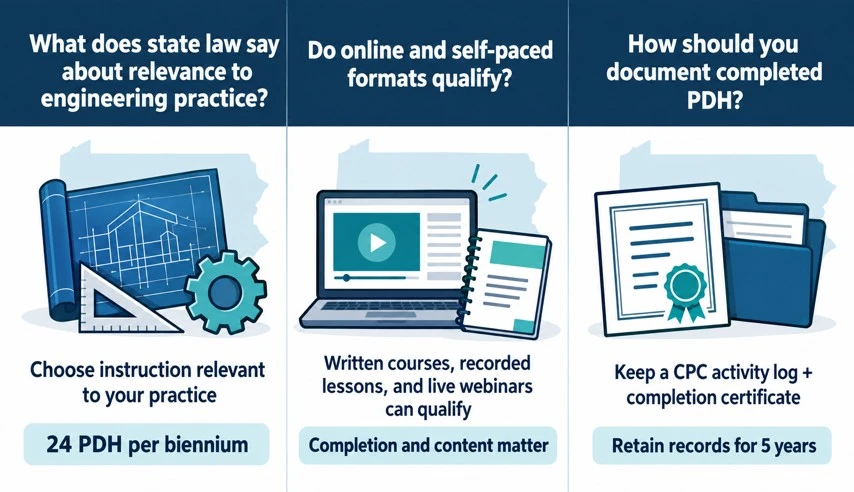 A qualifying course should maintain, improve, or expand skills and knowledge relevant to your professional work, including applicable law and ethics, or develop new and relevant knowledge. For example, instruction on structural analysis could be relevant to an engineer who designs structures; a groundwater treatment course could be relevant to an environmental engineer. These are examples, not a state-approved course list.
Review what the course actually teaches rather than relying on its title. The state board has final authority over course acceptability and PDH value. A sponsor’s certificate documents completion, but its assertion of universal acceptance cannot decide how every licensing board will treat the activity.
Do online and self-paced formats qualify?
They can. Pennsylvania’s law recognizes relevant correspondence, televised, videotaped, and other short courses or tutorials. That permits consideration of appropriate online and self-paced education, as well as live instruction. The format alone does not guarantee credit: the subject must qualify and you need support for the hours claimed.
When comparing a written course with a quiz, recorded webinar, or live webinar, check its learning objective, PDH amount, completion conditions, and certificate. If a live event suits your schedule, PDH Pro’s webinar schedule is one place to find options. Select a topic relevant to your practice rather than choosing by format alone.
How should you document completed PDH?
Maintain a CPC log showing the activity, sponsor, location, duration, instructor or speaker, and PDH claimed, together with completion or attendance evidence. The board’s CPC activity log provides a useful format. Its guidance says a completion certificate should identify the participant, sponsor, date, location, duration, instructor or speaker, and PDH earned.
If your certificate reports CEUs instead of PDH, how many hours does 1 CEU equal explains how to convert the units before recording your credit.
Before renewal:
- Match each completed activity to the correct biennium.
- Confirm that its subject relates to your engineering practice.
- Add the supported PDH and calculate any allowable carryover separately.
- Save your log and completion records for five years after each activity.
The board may audit your compliance. Its regulation requires an audited licensee to respond within 30 days unless the request specifies another period.
Frequently asked questions about PE course selection
How many PDH do engineers need for renewal?
A Pennsylvania PE ordinarily needs 24 PDH during each biennial renewal period. Licenses expire September 30 of odd-numbered years; as of this article’s verification date, the next regular expiration is September 30, 2027. The first-licensure biennium and specific exemptions require separate consideration.
Must a provider or course be preapproved?
No. The Pennsylvania board says it does not preapprove CPC courses, activities, or providers. It retains final authority over whether a claimed activity and PDH value satisfy its rules. Check professional relevance and keep adequate completion evidence.
Can the same course support another license?
Possibly, if it independently meets each license’s rules. Pennsylvania permits an activity applicable to more than one class of license issued by its engineering, surveying, and geology board to be applied to each applicable license. A PE license issued by another state is governed by that state’s own subject, format, timing, and documentation requirements. Satisfying Pennsylvania’s requirement does not automatically satisfy the other board.