
Contributor: Jordan Ellis
Written: Sep 26, 2026
 In the Michigan PE continuing education audit process, the Bureau of Professional Licensing may ask you to prove the credit hours you certified when renewing your license. You must keep documentation for four years after filing the renewal application, and, if selected for an audit, upload the requested records into CE Broker. For a standard two-year renewal, the records need to support 30 qualifying credit hours, including two in professional ethics related to engineering. Michigan’s Continuing Education Requirements for Michigan Engineers page provides a broader renewal overview; the state rules govern what you must be able to substantiate.
CPE Requirements for Michigan Engineers
Table of Contents
Michigan’s renewal application is an attestation. When you submit it, you certify that you complied with the continuing education rules. You do not establish compliance merely by entering a total: Rule R 339.16040 makes you responsible for retaining documentation, and it permits the department to request the proof described in Rule R 339.16041 during an audit. These continuing education requirements apply to the professional development activities used to support license renewal.
Michigan Continuing Education Audits: What the Rules Say
The state rules establish what an engineer must earn and retain. For a standard renewal, the 30 credit hours must fall within the two years immediately before license expiration. Two of the 30 must focus on professional ethics related to engineering; those two are part of the total, not an additional requirement. The ethics instruction does not have to focus specifically on Michigan statutes or rules. Michigan’s licensing guide says to finish the required education before completing the online renewal application.
If your records include hours from an earlier renewal period, review can Michigan PEs carry forward PDH before including them in your total.
What causes a particular licensee to be selected? The published PE rules reviewed for this article authorize audits, but do not specify a selection formula, selection frequency, standard notice period, or universal response deadline. The Bureau says licensees selected for a continuing education audit are required to upload documentation into CE Broker. Follow the instructions and deadline in any notice you personally receive; do not assume another engineer’s notice describes your case.
The most useful way to prepare is to treat each claimed credit as a small, verifiable record. You should be able to identify what you did, when you did it, why it qualified under Rule 41, how you calculated its credit, and which document proves it. A certificate alone may answer all of those questions for one course but leave gaps for a different type of activity.
For example, a qualifying program offered for credit by an organization specified in Rule 41(a) has a certificate requirement different from that for teaching an engineering course or serving on a committee. The activity determines the proof. An engineer who combines courses, conference sessions, and professional contributions should expect to keep several kinds of records, rather than one generic transcript.
An audit also brings timing and credit limits into focus. Rule 41 excludes a program or activity with substantially the same content as one for which you already claimed credit during the same renewal period. It permits no more than 12 continuing education credit hours in a 24-hour period. Some activity categories have additional limits. A folder full of genuine completion documents can therefore still support fewer credit hours than the sum printed on its certificates.
Education Hours and Records to Keep
The governing distinction is between a personal tracking record and proof of an activity. A spreadsheet can show your running total and help you spot a missing ethics course. If the department requests evidence, however, Rule 41 calls for the particular certificate, transcript, letter, publication record, or other documentation assigned to the activity. Keep both the tracking record and its supporting files. Your records should clearly identify the education hours completed during the renewal period and provide documentation supporting each claim.
The following table condenses several common proof requirements. It is a planning aid; the state’s PE rules contain the complete activity chart and should control when you prepare a response.
| Credit claimed for | Proof to retain under the applicable rule |
| A qualifying program offered or approved for credit by an entity listed in Rule 41(a) | Documentation or a completion certificate showing your name, hours earned, sponsor name and contact information, program title, and date held or completed |
| A qualifying engineering academic course | A transcript showing the relevant course and credit |
| A seminar, workshop, in-house course, or technical presentation attended | The presentation notice or advertisement identifying the date, your name as attendee, and the organization that approved or offered it |
| Teaching, instructing, or presenting | College or university documentation confirming your role, course or presentation dates, classroom hours, and title |
| Publishing a peer-reviewed engineering work | A copy identifying you as author or a publication acceptance letter |
| Qualifying committee service | Documentation of voting-member status and participation in at least 50% of regularly scheduled meetings |
| School-sponsored engineering mentorship | A letter from an authorized school official confirming your role and mentoring hours |
| Company-sponsored or hosted training | Company-issued completion documentation identifying you, the company, subject, and date |
The table draws from the distinct proof provisions in Rule 41. A board meeting, journal article studied, or patent has its own documentation rule. If you claim one of those categories, read its entry rather than substituting a course certificate.
Certificates, Course Details, and Four-Year Retention
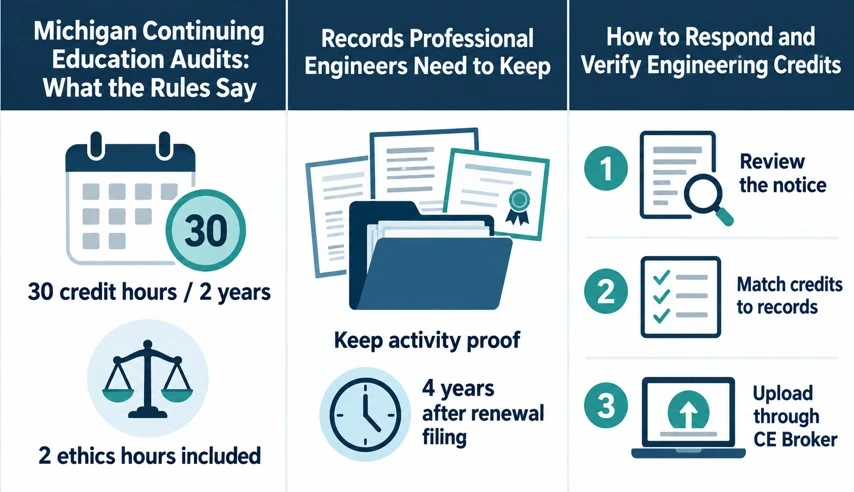 Rule R 339.16040 measures retention from a precise event: the date you file the renewal application. You must maintain documentation for four years after that date. It is not four years from the date you took the course or simply four years from the beginning of the renewal cycle. Record your filing date with the supporting education documents so the retention endpoint remains clear. The documentation should make it easy to connect each course or activity with the PDHs claimed for that renewal period.
For course-based credit, check the certificate as soon as it arrives. Does it identify you correctly? Does it give the program title, completion date, credit earned, and sponsor information required for the category under which you plan to claim it? If something is missing, request a corrected or supplemental record while the provider still has ready access to attendance and course data. This is a practical preparation step, not a separate requirement stated by the board.
Save your records in a format you can retrieve and upload. A straightforward folder for each renewal, with filenames that include the completion date and activity title, is usually enough. You might also retain the course description or agenda if it helps establish the engineering subject or separate the instructional time from breaks. Keep the original documentation and an accessible copy; a provider’s account history may change during the four-year retention period.
Your tracking sheet should, at a minimum, help you reconcile these items:
- Activity title, provider or sponsoring organization, and completion date
- Rule 41 activity category and the credit claimed
- Engineering subject and any ethics credit claimed
- Proof filename or location
- Any category cap, duplicate-content issue, or 24-hour limit affecting the total
- Renewal filing date and the date four years later
The sheet is a PDH Pro organizational recommendation. The state’s enforceable record requirement comes from Rules 40 and 41. In particular, do not use a self-entered spreadsheet row as a substitute for the proof specified in the activity chart.
Teaching, publications, committee work, and mentorship deserve extra attention because their documentation does not always arrive automatically. Ask the college, school, or organization for the required confirmation while the responsible person and records are available. Check the category limit too: MI caps teaching at 12 credit hours, peer-reviewed publication at 18, qualifying committee service at six, and school-sponsored mentoring at eight during a renewal period.
How to Respond and Verify Engineering Credits
If you receive an audit notice, begin with its instructions. Identify the renewal being reviewed, the response deadline stated in the notice, the records requested, and the route for submission. Then reconcile the hours you certified against your documents before uploading anything. Do not estimate missing dates or alter a certificate to make a record match your ledger.
A practical response sequence is:
- Read the entire notice and preserve a copy.
- Identify the expiration date, the applicable two-year earning window, and the renewal filing date.
- Recalculate the 30-hour total and separately confirm the two engineering-ethics hours.
- Match each claimed item to a Rule 41 category, its credit calculation, any category cap, and the required proof.
- Remove duplicate-content claims and check the 12-hour maximum in any 24-hour period.
- Upload the requested records as directed, retaining copies of what you submitted and any confirmation.
- Respond promptly to a request for clarification, using the contact method in your notice.
When checking whether an activity qualifies, see what activities count for Michigan PE PDH for the activity categories and credit limits. Keeping these records organized makes it much easier to respond if you are audited.
Before submitting your response, compare your documentation with the applicable board requirements and confirm that each claimed activity qualifies.
Steps 2 through 5 are a recommended self-check based on the published rules. The notice controls the actual submission instructions and deadline. The state’s licensing guide confirms the 30-hour, two-year, and ethics framework; Rule 41 supplies the activity calculations and limits.
A concrete example shows why the reconciliation matters. Suppose your ledger lists six hours for a technical webinar, but the completion record shows four. Before responding, find out whether there were two additional documented sessions or whether the ledger is wrong. Claiming the six hours solely because your spreadsheet says so leaves a two-hour discrepancy. The prudent response is to identify the actual eligible credit and provide the records that substantiate it.
Submitting Proof Through CE Broker
The Bureau of Professional Licensing says using CE Broker to track education before an audit is optional. It lists engineers among the participating professions and offers a free Basic Account. If BPL selects you for a continuing education audit, however, the Bureau says you will be required to upload documentation into CE Broker. That is the difference between optional ongoing tracking and required audit submission.
Keep the upload confirmation with your other licensure records after submitting the requested documents.
The Bureau’s CE Broker guidance explains account access and tracking. It says you can view course history and compliance status, but also tells licensees to retain their certificates even when providers report credits directly. A course appearing in an account is useful for checking your total; you should still keep the underlying proof required by the rule.
Do not wait for an audit to see whether you can access your files. Check that each scan is readable, complete, and associated with the right activity. If your name changed during the retention period, keep the supporting name-change information with your records so the connection is easy to explain. For any upload problem or unclear instruction, use the contact information in your actual notice or the Bureau’s published support route.
What Happens When a Michigan PE Is Audited
A questioned claim calls for a specific answer. Determine whether the issue concerns eligibility, credit calculation, timing, subject matter, or missing proof. Then point to the relevant Rule 41 category and the supporting document. A general statement that a course was “PE approved” may not address the department’s concern about its date or the number of hours you claimed.
For example, if a seminar certificate lists a full-day event, check how much time was spent in qualifying instruction. MI grants one credit hour for every 50 minutes attending a qualifying seminar, in-house course, workshop, or professional or technical presentation. An agenda and attendance record can help show the instructional time, while the rule supplies the conversion.
If a provider’s certificate is incomplete, request a corrected record that reflects what actually occurred. If you cannot establish an activity’s eligibility or credit, do not invent proof or assume the board will accept your estimate. Explain the available facts through the process specified in your notice and ask the department what additional documentation it will consider. The published PE rules reviewed here do not set out a universal correction or appeal timetable for every audit circumstance, so an individual notice and direct department guidance matter when a claim is disputed.
For future renewals, one reliable habit is to download a completion record immediately after each course or live webinar, then enter the credit and ethics designation in your ledger. PDH Pro’s formats can help you plan remaining education, but the individual course, its subject, the applicable category, and its documentation determine whether you can substantiate the claim.
Frequently Asked Questions About License Renewal
What are the continuing education requirements for a Michigan professional engineer license? For a standard two-year renewal, Michigan requires 30 qualifying credit hours in the two years immediately before expiration, including two focused on professional ethics related to engineering. The completed hours must satisfy Rule R 339.16041, and you certify compliance when submitting the renewal application.
Do I submit every certificate with my routine renewal? The published rule makes your application a certification of compliance and requires you to retain documentation for a possible audit. BPL says that if selected for an education audit, you must upload documentation into CE Broker. Follow any additional instructions shown in your own renewal workflow or notice.
How long should I retain my course records? Keep the documentation for four years after the date you file your renewal application. The period is tied to filing, so save a copy of the application confirmation with your education records.
Can online courses count? Yes. Rule 41 permits in-person or online education that satisfies the applicable activity requirements. Online delivery by itself does not establish the credit value or replace the required proof.
Can a course count toward several state licenses? Potentially, but each licensing board sets its own education rules. Check the course’s subject, date, format, credit calculation, and certificate against each state’s requirements. Satisfying Michigan does not automatically satisfy another state.
Does Michigan’s renewal grace period give me more time to earn the education? Do not rely on it for that purpose. Michigan’s licensing guide describes a 60-day period to renew without going through relicensure, but also says to complete the required education before submitting the renewal and explains that an engineer who has not met it before expiration will need relicensure. If those circumstances apply to you, ask the department how to proceed before attesting to compliance.