
Contributor: Jordan Ellis
Written: Sep 29, 2026
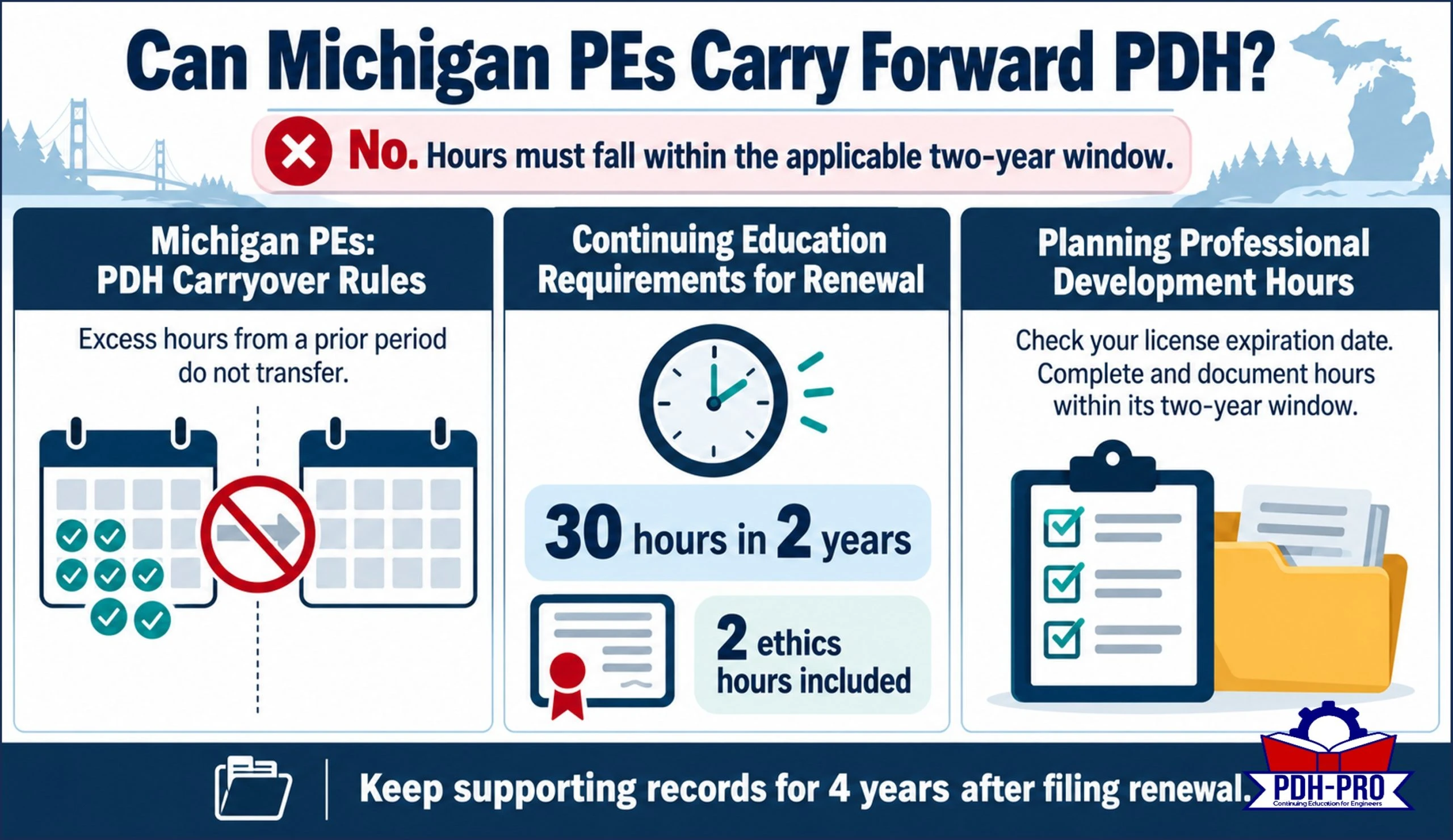
 No, Michigan PEs cannot apply excess PDH earned for one license renewal toward a later renewal if those hours fall outside the later license’s required two-year window. For a standard renewal, you need 30 qualifying continuing education hours completed during the two years immediately before your license expires, including two hours focused on professional ethics related to engineering. If you earn 35 hours in that period, the extra five do not become a bank of hours for a future Michigan renewal. This follows from the time period specified in Michigan Administrative Rule R 339.16040; the rule provides no general exception for transferring excess hours to a later period.
Michigan PE continuing education requirements were verified by the author who reviewed the Michigan administrative rules and the Board’s rules.
Michigan PEs: PDH Carryover Rules
Table of Contents
Michigan’s rule is framed around when you earn the hours. Rule R 339.16040 requires an applicant covered by its standard renewal provision to obtain 30 qualifying hours during the two-year period immediately before the license expiration date. It contains no provision allowing hours from before that period to satisfy the current obligation. The practical result is no general PDH carryover between Michigan renewal periods.
Think of each renewal as having its own education window. A completed course belongs to the window in which its completion date falls. Completing more than the minimum can still be worthwhile for your work, your employer, or another license. It simply does not alter the dates Michigan uses for a later renewal.
For example, suppose a license expires on a date in 2027 and you complete 34 qualifying hours during the two years immediately preceding that expiration. You may use 30 of those hours to satisfy the applicable total, provided two address engineering ethics. The additional four do not count toward a later Michigan renewal merely because they exceeded the minimum. The example dates are illustrative; check your actual expiration date in Michigan’s licensing system.
“Keep your extra certificates” and “carry your extra hours forward” are different advice. You should retain the certificates because they may support another license, document professional development for your employer, or help explain your completed activities during an audit. Retaining a record does not change when its hours were earned.
This distinction is especially useful if you hold licenses in multiple states. An activity might fit two jurisdictions’ subject-matter rules, but each jurisdiction may have a different renewal date, ethics requirement, permitted format, or carryover rule. Claim the activity in another state only after checking that state’s requirements and applicable reporting period. A course accepted for one license is not automatically accepted for every license.
Keep documentation for the hours you claim in the current cycle, and review the Michigan PE continuing education audit process so you know what records you may need to provide.
When Do Completed Hours Count?
For a standard Michigan PE renewal, start with the expiration date on your license and look back two years. The qualifying education must have been obtained during that period. The state’s Professional Engineer Licensing Guide says to complete the hours before submitting the online renewal application. By submitting that application, you certify that you have met the requirements.
Use the completion date shown by the provider or activity record. For a live event, that may be the date you attended. For an online course with an assessment, check when the provider considers the course completed and awards credit. If you begin a course before the window closes but do not finish it until after your license expires, do not assume the earlier start date makes its hours eligible for that renewal.
The rule also prevents counting an activity twice during the same renewal period when it has substantially the same content as one for which you already earned credit. Taking the same lesson again, or taking a nearly identical version under a new title, should not be used to increase your total. Michigan additionally limits credit to 12 hours in a 24-hour period. Both limits matter when you are trying to close a shortfall near expiration.
The ordinary renewal window differs from relicensure after a license has lapsed. Michigan’s current rules describe a separate application and education lookback measured from the filing of a relicensure application, with additional conditions depending on how long the license has been lapsed. If you are restoring an expired license, follow the relicensure provisions rather than assuming that the standard renewal example above controls your situation.
Continuing Education Requirements for Renewal
For a standard renewal, Michigan requires 30 qualifying hours during the two years immediately preceding expiration. Two of those hours must focus on professional ethics related to engineering. The ethics hours are included in the 30-hour total; they are not an additional two hours. The ethics instruction does not have to focus specifically on Michigan statutes or administrative rules.
| Item | Michigan requirement or practical effect |
| Renewal period | Two years |
| Education total | 30 qualifying hours in the applicable two-year window |
| Engineering ethics | Two of the 30 hours |
| Excess hours | No general provision to apply older excess hours to a later window |
| Online education | May earn credit when it satisfies an activity category in R 339.16041 |
| Daily credit limit | No more than 12 hours in a 24-hour period |
| Records | Maintain required documentation for four years after filing the renewal application |
| Audit | Provide the activity-specific proof if the department requests it |
The requirements and limits above come from Michigan Rules R 339.16040 and R 339.16041. The “excess hours” row explains the effect of the rule’s two-year timing requirement rather than quoting a separate carryover prohibition.
Michigan’s regulation calls these continuing education credit hours. Providers commonly describe engineering education using PDH, or professional development hours. When planning renewal, pay attention to the hours the applicable Michigan rule grants for an activity; do not assume that every unit appearing on a certificate converts identically. For example, an eligible seminar under R 339.16041(c) earns one continuing education hour for every 50 minutes of attendance. Qualifying academic courses have a different conversion.
Rule R 339.16041 lists acceptable activities and the proof required if you are audited. These include certain programs offered or approved for credit by named engineering organizations, qualifying academic courses, seminars, in-house instruction, professional presentations, and company-sponsored training. Other activities, such as teaching or publication, have their own credit amounts and limits. An activity’s category affects both the credit you can claim and the documentation you need to keep.
The rule permits in-person and online activities that satisfy its criteria. An online course does not need to be rejected simply because it is remote. Equally, a course does not qualify simply because it is online and advertises PDH. Check the relevant activity category, the engineering subject, the hours awarded, and the completion evidence. For an unusual self-paced format, ask the provider how the specific course fits R 339.16041 rather than assuming all written courses are treated like live seminars.
Michigan requires you to maintain documentation for four years after the date you file your renewal application. The rule allows the department to audit a licensee and request the evidence described for the activities claimed. Depending on the category, this may be a certificate identifying the sponsor and completion date, an attendance notice, a transcript, or another specified record. A personal spreadsheet helps you track totals but does not replace the underlying proof.
Michigan’s licensing guide says the online renewal application may be submitted no sooner than 90 days before your license expires. It directs engineers to finish their education before completing the application and accepting the renewal attestation. Check your own license record for its expiration date instead of assuming that every engineer has the date printed on an older third-party summary.
What If You Earn More Than 30 Hours?
You can take more education than the minimum. If the added instruction helps your practice, you need it for another credential, or you want to develop a new technical skill, the time can still be well spent. For Michigan renewal purposes, however, excess hours do not automatically move into the next two-year window.
Consider an engineer who has completed 28 technical hours and two ethics hours, then enrolls in another eight-hour technical program before expiration. If the activities qualify, the engineer has exceeded Michigan’s 30-hour minimum for that renewal. The extra eight hours remain part of the engineer’s professional record, but they cannot substitute for education that must be earned within the later renewal’s own two-year period.
There is one timing nuance worth checking carefully. If a course is completed after the earlier license expires and falls within the two-year period before the next expiration, its timing may place it in the later period. That is different from transferring hours earned in the earlier period. You would still need to ensure the activity qualifies, you have an accurate completion date, and you do not claim the same hours in a way that conflicts with a jurisdiction’s rules.
Avoid trying to solve an approaching deficit with an unrealistic one-day schedule. Even if a provider issues certificates for more than 12 hours of work, Michigan’s rule does not grant more than 12 continuing education hours in a 24-hour period. Space activities appropriately and verify that their actual completion dates fall before the relevant expiration.
Planning Professional Development Hours
A simple calendar and recordkeeping routine is more reliable than trying to bank an unusually large number of hours in one period. At the start of a renewal period, record your license expiration date and mark the preceding two-year window. Then plan the 30 hours within that window, including the two-hour ethics component. Michigan’s official engineer licensing page links to its current guide and administrative rules.
Before you submit renewal, work through these steps:
- Confirm the date. Use the expiration shown on your Michigan license to establish the applicable two-year period.
- Reconcile your hours. List each completed activity, its date, its qualifying category, and the hours you intend to claim. Do not add older excess hours merely because you retained their certificates.
- Check ethics separately. Identify at least two qualifying hours focused on professional ethics related to engineering within the 30-hour total.
- Check limits and repeated content. Apply any category-specific cap, the 12-hour limit for a 24-hour period, and the restriction on substantially duplicate content.
- Review your evidence. Save the certificate, attendance proof, transcript, or other documentation required for each activity category. Keep the records for four years after filing.
- Submit an accurate attestation. Complete the education first, then renew through Michigan’s system. If your circumstances are unusual, contact the Bureau of Professional Licensing before claiming an uncertain activity.
This is a planning checklist, not an additional state form. It is particularly helpful if several course platforms, an employer training program, and outside conferences all contribute to your total.
You may also use the period to select instruction that serves a real engineering need. A structural engineer might choose updated analysis methods; an environmental engineer might study treatment systems or emerging contaminants. Those are examples of professional-development goals, not assurances that a particular offering qualifies. Confirm the Michigan activity category and keep the required proof for whichever course you take.
If you need courses for an upcoming Michigan renewal, PDH Pro’s Michigan PE renewal packages offer discipline-based 30-hour selections that include ethics. Compare a package with your existing records before buying so you select only the hours you need within your current window. PDH Pro’s live webinar schedule is another option if you prefer scheduled instruction. Verify the course details and completion evidence for any activity you intend to claim.
Frequently Asked Questions
How many PDH credits does a Michigan PE need?
For a standard two-year renewal, Michigan requires 30 qualifying continuing education hours, including two hours focused on engineering ethics. Complete them during the two years immediately before your license expires.
How many CEUs can you do in a day in Michigan?
For Michigan PE renewal, the relevant rule limits credit to 12 continuing education hours in a 24-hour period. The POP question uses “CEUs,” but R 339.16041 states its limit in continuing education credit hours. Do not treat 12 CEUs as equivalent to 12 hours without checking the unit being used.
Can I use last period’s extra ethics hours this time?
Do not rely on ethics hours earned outside the current two-year window. The two ethics hours required for a standard renewal must be among the qualifying hours earned during the applicable period.
Can a course count for Michigan and another PE license?
It may count for both if it independently meets each jurisdiction’s rules and falls within each applicable reporting period. Michigan’s rules do not establish the requirements of another state. Check that state’s subject, ethics, provider, format, and record rules before claiming the activity there.
Can I finish the missing hours after my license expires?
Do not assume that late completion qualifies for an ordinary renewal. Michigan’s licensing guide directs engineers to finish the required education before expiration and says an engineer who has not met it by then will need to apply for relicensure. The guide separately describes a 60-day late-renewal grace period, which should not be interpreted as an automatic extension of the education window. Contact the bureau for the procedure that applies to your license.
How long should I keep course certificates?
Maintain the documentation supporting your claimed activities for four years after the date you file your Michigan renewal application. Retain the activity-specific evidence required by R 339.16041, not just a list of course titles.