
 Contributor: Jordan Ellis
Written: Sep 28, 2026
Yes, college courses can count toward an engineer’s continuing education requirement, but enrollment alone is not enough. Your licensing board determines which academic courses qualify, how to convert academic credit into renewal hours, and what proof you need. For example, Michigan awards credit for passing a qualifying engineering-related academic course at an eligible college or university. Its rule awards 15 continuing education hours per semester credit or 10 per quarter credit. Engineers applying that example should also review PDH Pro’s Michigan PE continuing education requirements alongside the current state rule. Michigan’s conversion is not a universal rule for CEUs or other state licenses.
When College Credit Qualifies for Continuing Education Requirements
Table of Contents
A university course can serve two different purposes. It may earn academic credit toward a degree, and it may also satisfy a professional renewal requirement. The first does not guarantee the second. The licensing authority decides whether the course subject, institution, completion date, and documentation meet its rules.
In practical terms, continuing education classes count only when the course fits the activity category recognized by the state licensing authority and the engineer can document the completed learning activity.
For an engineer, subject matter is usually the first question. A course in structural analysis might relate directly to structural engineering practice. A course taken for personal interest might award valid academic credit yet fall outside a board’s accepted professional activities. These are examples, not advance determinations about a particular course. Check the rule that applies to your license before relying on either one.
Next, distinguish a credit-bearing academic course from a continuing education class offered through a college’s extension or professional programs. Both can provide valuable instruction, but they may produce different records. A transcript showing semester or quarter credits is different from a certificate showing contact hours or CEUs. A state may place the two activities in separate categories and award different amounts of renewal credit.
Finally, check the outcome the rule requires. Some licensing rules recognize passing an academic course. Simply registering, attending part of a term, or auditing a class may not satisfy that condition. If you intend to use a course for renewal, identify the required outcome before the term begins.
What Does the State Board or Licensing Board Require?
Read the agency’s rule for academic study as a sequence of tests:
- Is the course an accepted activity? Look for the academic-course category rather than assuming all college study qualifies.
- Does its subject fit your profession or practice? Review the course description and learning objectives.
- Does the institution or program meet any stated condition? A rule may specify the type of university, degree program, or accreditation.
- Must you pass the course? Determine whether attendance or an audit grade is insufficient.
- How is credit calculated? Find the board’s conversion for semester or quarter credits.
- What evidence must you retain? Confirm whether the licensing authority requires a transcript, completion certificate, syllabus, or other proof.
- Was it completed during the applicable period? An otherwise eligible course may be too old for the renewal you are preparing.
These are practical questions to ask of the applicable rule. They are not a single national standard. NCEES provides continuing professional competency tracking, but its standard and tracking service do not replace the requirements of each agency that issues a license.
If you hold several PE licenses, apply this review separately to each. One course may meet more than one jurisdiction’s subject requirements, yet fall outside another jurisdiction’s reporting period or receive a different number of credits. Satisfying one state’s education rules does not automatically satisfy the others. Engineers who need to maintain licensure should confirm whether the academic course supports their career, professional development goals, and the requirements for each registration they hold.
How Academic Courses Convert to CEU Credits
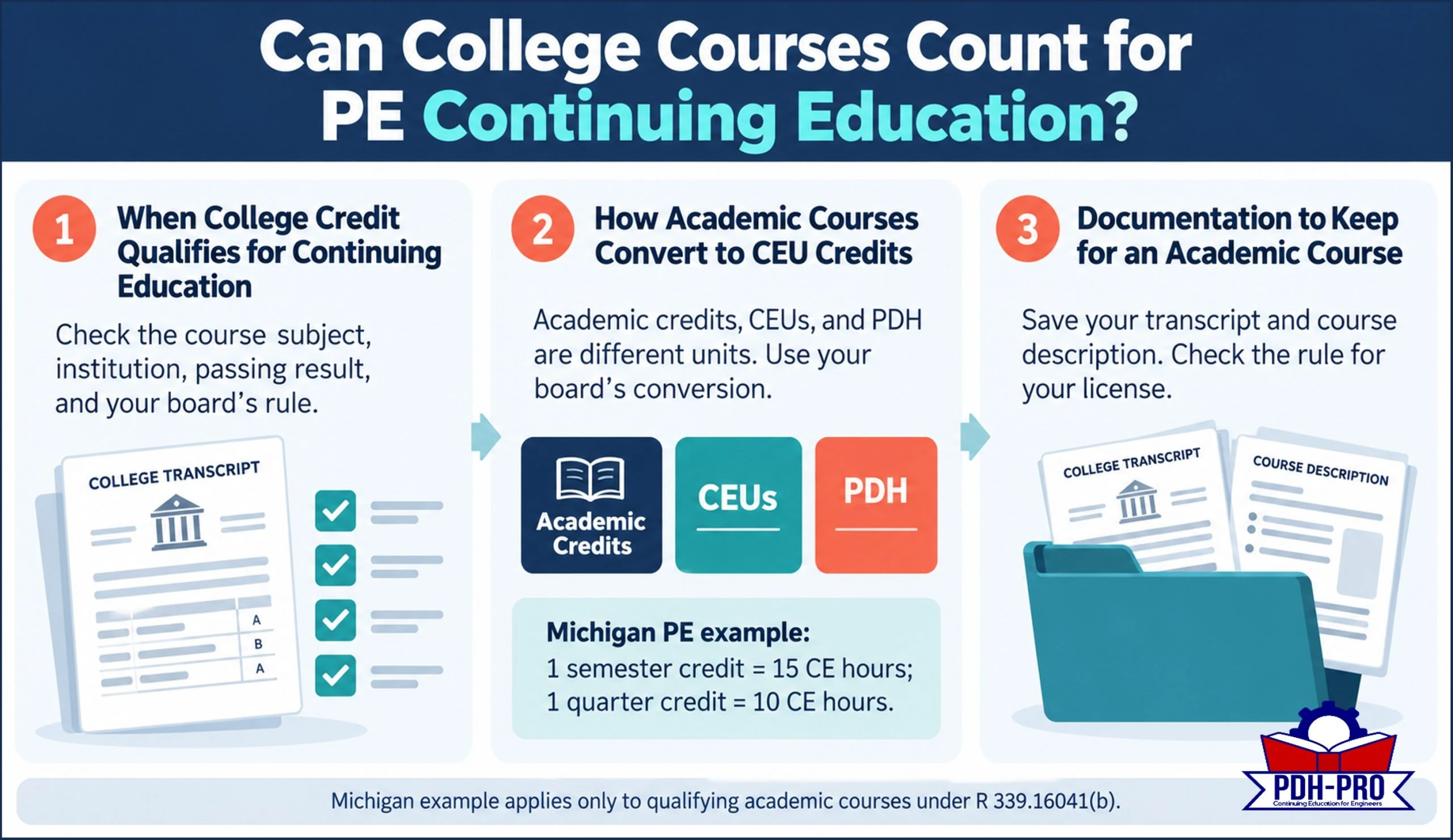 Academic credits, CEUs, and professional development hours describe different measures. A semester credit or quarter credit is assigned to an academic course by the college. The International Accreditors for Continuing Education and Training (IACET) defines one continuing education unit, or CEU, as ten contact hours of participation in an organized learning experience. Engineering boards often express renewal requirements in hours or PDH and may publish their own conversion for academic study. Do not treat these units as interchangeable without an applicable rule.
CE credits, continuing education units, academic credit, and contact hours can describe different systems, so credit validation should always come from the applicable board rule rather than a general conversion chart.
The conversion also depends on what you are converting for. A provider’s certificate might report CEUs for a noncredit training program. A school transcript might report semester credits for a completed academic course. Your engineering board may award a specified number of continuing education credits for each academic credit regardless of how the university describes instructional contact time.
Here is the distinction in compact form:
| Measure | What it generally describes | What an engineer should check |
| Semester or quarter credit | Academic credit assigned by an institution | The agency’s academic-course conversion |
| CEU | A continuing education unit; under IACET’s definition, one CEU equals ten contact hours | Whether the licensing authority recognizes the activity and that unit |
| PDH or continuing education hour | A measure commonly used for PE renewal | The jurisdiction’s activity and hour rules |
The table explains terminology, not a universal conversion formula. In particular, a three-credit academic class is not automatically “three CEUs.” Nor does a certificate bearing 0.3 CEU automatically establish that a state engineering board will award three PDH. Its activity and documentation must qualify under that board’s rule.
Why Academic Credit and Continuing Education Units Differ
They measure participation under different systems. An academic credit is part of a school’s curriculum and transcript. A CEU is a unit used for structured continuing education outside that academic-credit framework. Engineers often use “CEU” casually to mean any renewal credit, which can obscure the conversion the licensing authority actually requires.
Consider a certificate marked “0.3 CEU.” Under IACET’s ten-contact-hour definition, that represents three contact credits. It does not mean three college semester credits. Whether it also yields three hours toward a PE renewal depends on the jurisdiction’s rules and the activity offered.
Likewise, a transcript showing three semester credits identifies academic credit. To determine its PE renewal value, use the specific agency’s academic-course conversion. Do not first convert it to CEUs using a general contact-hour assumption and then convert it again to PDH. That extra step can produce the wrong number.
This is also why CEUs differ from university credits: one measures structured continuing learning, while the other appears on a transcript as part of an academic program.
Documentation to Keep for College Courses
A transcript is usually the clearest evidence that you completed and passed a credit-bearing course. The entry should identify the institution, course, term, grade or completion result, and number of semester or quarter credits. Michigan’s academic-course rule specifically calls for a transcript if the licensee is audited. Other jurisdictions may ask for different or additional evidence.
Keep a copy of the course description or syllabus as a practical supplement, especially if the title alone does not show its connection to engineering practice. “Special Topics,” for example, gives a future reviewer little information about the technical material you studied. The description can help explain relevance, while the transcript establishes completion and academic credit. Once you have your transcript, check how long must Michigan PEs retain continuing education records so you know how long to keep it with your renewal documentation.
A sensible course record contains:
- The transcript or official completion record.
- The course description and dates.
- The name of the school and relevant degree program.
- Your calculation of the renewal PDH claimed, with the governing rule noted.
- A copy of any agency correspondence resolving an unusual eligibility question.
The last four items are practical recordkeeping suggestions, not a claim that every licensing authority demands each document. Store the materials with the other records for the same renewal period so that you can retrieve them if audited.
If you are considering a noncredit class offered by a university, ask what documentation the provider will issue. A completion certificate might report contact hours, CEUs, or another unit. Determine the appropriate noncredit activity category under your authority’s rules instead of applying its semester-credit conversion to a course that awards no academic credits.
Some providers issue a certificate that lists contact hours or education units, while others provide only a transcript or completion record.
A Michigan PE Example of Education Credits
Michigan provides a concrete example of how an engineering board handles academic study. Rule R 339.16041(b) grants credit for passing a course related to professional engineering at a school or university that offers a bachelor’s degree or higher in an engineering program accredited by EAC/ABET or CEAB. It grants 15 continuing education credit hours for each semester credit or 10 for each quarter credit. If audited, the engineer must provide a transcript showing the academic-course credits.
As an arithmetic example, a qualifying two-semester-credit course would calculate to 30 Michigan continuing education hours. That does not mean every two-credit course satisfies the entire renewal requirement. The course must meet the academic-category conditions, fall within the applicable period, and leave the engineer able to satisfy any separate subject requirement. Michigan currently requires two of the standard 30 renewal hours to focus on professional ethics related to engineering. A technical academic course would not automatically satisfy that ethics component.
If you plan to earn the remaining renewal credits through other types of learning, review what activities count for Michigan PE PDH before selecting them.
The distinction between an accredited program and a school name matters here. Michigan’s rule specifies an eligible college or university offering an EAC/ABET- or CEAB-accredited engineering program. ABET accredits individual programs and provides an accredited-program search. Check the institution and program against the rule when eligibility is uncertain.
Michigan’s standard renewal rule places the 30 qualifying hours in the two years immediately before the engineer’s license expiration date. It requires documentation to be kept for four years after filing the renewal application, and the department may request activity-specific proof in an audit. Those dates and record requirements matter even when the course itself qualifies academically.
Professionals should keep the transcript, course description, and calculation notes together so the renewal file clearly shows how the accredited program and completed course support the claimed credit.
If you hold a Michigan PE registration and want to use a course taken at an unusual institution, in a new engineering discipline, or on a noncredit basis, compare its facts with the rule before claiming it. For a question the rule does not resolve clearly, ask the Michigan Bureau of Professional Licensing about your specific circumstances.
Frequently Asked Questions About CEUs and College Courses
Do college classes count as CEU?
They can count toward professional continuing education when the applicable licensing board accepts the academic course. The agency may award renewal hours under its own conversion rather than issuing CEUs for the class. Check the subject, institution, completion result, dates, and required evidence.
What counts as CEU credits?
A CEU measures participation in qualifying structured continuing education. Under IACET’s definition, one CEU equals ten contact hours. Acceptance toward an engineering license still depends on that agency’s rules for the particular activity.
Does 0.3 CEU mean three college credits?
No. Under IACET’s definition, 0.3 CEU corresponds to three contact hours, not three academic semester credits. Do not use the two units as substitutes when documenting a course.
How many credit hours are four college classes?
The number of classes alone does not tell you. Add the semester or quarter credits assigned to each completed class on your transcript, then apply your board’s academic-course rule. Four classes might have different credit values.
Can an online college course qualify?
Possibly. The delivery method does not, by itself, settle the question. Michigan’s rule allows in-person or online continuing education that meets an accepted category, and its academic-course category sets additional conditions for the institution, subject, passing result, and transcript. Check the rules of the state where you hold the license.
Before counting a college course, obtain its transcript and description, identify your board’s academic-course provision, and calculate the allowed renewal hours from that provision. If you need additional engineering instruction after reviewing your academic credit, PDH Pro’s course categories can help you select a relevant next activity. Verify that any course you select meets the requirements of each PE registration you intend to renew.