
How Many Ethics PDH Hours Do Engineers Need?
Engineers usually need ethics PDH hours as part of license renewal, but the exact number depends on the state where the license is held. Some state boards require one ethics hour during each renewal cycle, while others require different totals or place ethics under broader continuing education rules. For Florida professional engineers, the requirement is clear: one hour must relate to professional ethics during each biennial renewal period.
A common question is how many ethics PDH hours do engineers need when they hold licenses in one or multiple states. The safest answer is to check each state licensing board, confirm the current renewal requirements, and choose courses that match the board’s definition of ethics. A course that works in one state may not automatically satisfy another state’s rules.
PDH-Pro helps engineers manage these requirements with online ethics courses, state-specific packages, and completion certificates that support renewal records. With the right professional development plan, engineers can meet ethics requirements, stay organized for audits, and avoid last-minute stress before renewal.
Ethics PDH Requirements for Engineers
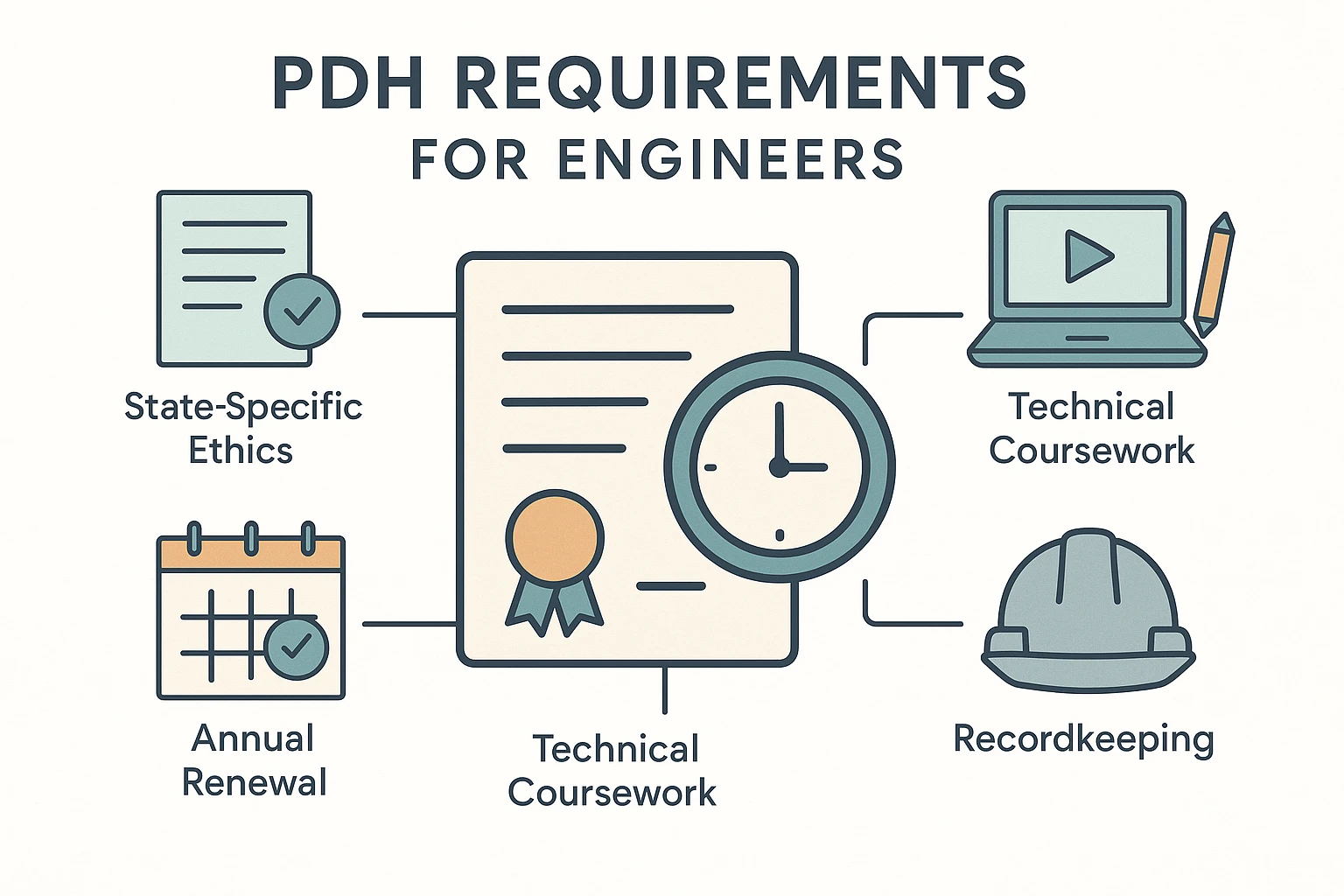
Ethics training is included in many engineering continuing education requirements because professional engineers make decisions that affect public safety, property, infrastructure, budgets, and public trust. Technical knowledge matters, but sound judgment and ethical responsibility matter as well.
A professional development hour, often called a PDH, is a common unit used by licensing boards to measure continuing education. Engineers earn PDH credits by completing approved education activities such as online courses, webinars, live seminars, technical presentations, and other board-accepted learning formats.
Ethics PDH requirements are not the same in every state. One board may require one ethics hour during each renewal period. Another may require ethics as part of a larger professional development total. Another may require specific subject matter, such as engineering ethics, state laws, public welfare, conflicts of interest, or professional responsibility.
Florida professional engineers must complete 18 continuing education hours during each two-year renewal cycle. Within those hours, one hour must relate to professional ethics. Florida also requires one hour related to Florida Laws and Rules, four hours related to the engineer’s area of practice, and the remaining hours related to engineering practice.
Because the rules vary, engineers should never assume that one course will apply everywhere. Multi-state licensees should review each board rule before selecting ethics PDHs. This is especially true for engineers licensed in states with different renewal dates, carryover limits, reporting systems, or provider requirements.
Engineering PDH Credits and State Licensing Rules
State licensing boards use PDH requirements to help keep engineers current. Continuing education may include ethics, technical practice, laws and rules, safety, project management, code updates, design topics, and other subjects tied to professional engineering work.
The ethics component helps engineers stay aware of responsibilities that go beyond calculations and drawings. Ethical decisions may involve public safety, honest communication, responsible charge, conflicts of interest, client pressure, confidentiality, documentation, and the proper use of professional judgment.
Engineers should start with the board that issued the license. The state board’s website usually explains the renewal cycle, required hours, ethics PDH requirements, reporting process, recordkeeping rules, and accepted course types. Some boards also explain whether self-paced online courses, live webinars, in-person seminars, or employer training may count.
For Florida engineers, ethics is one part of the broader 18-hour renewal requirement. Engineers should plan the full renewal cycle instead of treating ethics as a separate task. A licensee who completes one ethics hour still needs the other required hours, including Florida Laws and Rules, area-of-practice education, and other engineering-related hours.
Engineers licensed in multiple states should compare requirements side by side. A single course may satisfy more than one board if the content, provider, date, and documentation match each state’s rules. A clear tracking process can prevent duplicate work and help ensure that no state requirement is missed.
Here is a simple way to compare state requirements before selecting ethics training:
- List every state where you hold an active license.
- Write down each renewal deadline and reporting period.
- Confirm the total PDH hours required for each state.
- Note the required number of ethics hours.
- Check whether the ethics course must be live, online, board-approved, or provider-specific.
- Save each certificate with the state, course title, date, and hours.
- Review your records at least several months before renewal.
This approach saves time and helps engineers choose courses with fewer surprises. PDH-Pro’s state-specific course options can also help engineers match coursework to renewal requirements without sorting through unrelated training.
What Counts as an Ethics PDH Hour
An ethics PDH hour should focus on professional responsibility in engineering. Course topics may include public welfare, professional conduct, conflicts of interest, truthful reporting, competence, responsible charge, disciplinary cases, engineering decisions, state board expectations, and ethical problem-solving.
Not every course that mentions ethics will count. Boards may look for content that clearly addresses ethics as applied to professional engineering. A general business conduct course, workplace behavior module, or leadership class may not satisfy an engineering ethics requirement unless the board accepts it and the course content matches the state’s rule.
Engineers should review the course description before enrolling. The description should identify ethics content clearly, list the number of PDH hours, and provide documentation after completion. If the course is designed for professional engineers, it should explain how the content connects to engineering practice.
The course format also matters. Many boards accept online ethics PDH courses, live webinars, recorded webinars, and in-person seminars. Some boards may have restrictions on self-study or may require an exam or quiz for certain formats. Engineers should confirm the rules for their state before assuming a course will count.
PDH-Pro offers online ethics training built for licensed engineers. Courses are structured to support renewal planning, provide completion records, and help engineers satisfy PDH requirements while working around project schedules. Engineers can choose self-paced courses for flexibility or live options when they want instructor interaction.
A good ethics course should help engineers think through real situations, not only memorize rules. The value comes from applying ethical standards to decisions that involve client pressure, safety concerns, incomplete information, design responsibility, and communication with public agencies or project teams.
License Renewal, CPC Tracking, and Documentation
Completing ethics PDH hours is only part of compliance. Engineers also need to keep records and report education as required by the licensing board. A course may be completed on time, but poor documentation can still create problems during renewal or an audit.
Documentation often includes the completion certificate, course title, provider name, completion date, number of PDH hours, course description, and proof that the provider or course is acceptable. Engineers should save these records immediately after completing each course.
Florida professional engineers must report continuing education through NCEES CPC Tracking. This system is separate from the state licensing account. Engineers use it to enter course information, upload documentation, and track continuing education hours for Florida and other states.
The Florida Laws and Rules course is handled differently because the CE provider reports that course directly. Engineers should still confirm that the course appears correctly in the licensing account before renewal. Ethics and other qualifying courses should be tracked through the required reporting process.
Recordkeeping should not wait until renewal week. Engineers should create a folder for each renewal period and save certificates as soon as each course is completed. A clear file name can make audit response easier, such as “Ethics-PDH-Provider-Date-1-Hour.pdf.”
The table below outlines a practical recordkeeping structure.
| Record Type | What to Save | Why It Matters |
| Completion certificate | Course title, provider, date, PDH hours | Shows that the course was completed |
| Course description | Ethics topic, learning goals, format | Helps show the course matches board requirements |
| Provider details | Provider name and approval information when applicable | Supports course acceptability |
| Renewal period folder | All certificates for the current cycle | Keeps documents organized by deadline |
| CPC or reporting record | Submitted course entries and confirmations | Helps verify reported hours |
| Audit backup | Copies of course materials or transcripts when available | Provides extra support if the board asks for proof |
PDH-Pro supports this process by providing completion certificates that engineers can save for renewal files and reporting systems. Having documents ready reduces stress and makes it easier to respond if a board requests proof.
Choosing PDH Courses and Providers
The best ethics PDH course meets the board requirement, fits the engineer’s schedule, and provides clear documentation. Engineers should avoid choosing courses based only on price or speed. A course that does not count can create bigger problems during renewal.
A reliable provider should make course details easy to review. Engineers should be able to see the subject, PDH value, format, completion rules, certificate process, and state relevance before enrolling. For ethics courses, the content should clearly relate to professional engineering conduct.
PDH-Pro offers ethics PDH courses and broader professional development options for engineers who want a direct path to renewal. Engineers can select state-specific packages or individual courses, complete training online, and download certificates after completion. This is useful for busy professionals who need to meet requirements without interrupting project work.
Online courses are often the most flexible choice. They allow engineers to complete training from home, the office, or the field. Live webinars can be helpful when engineers prefer interaction or want to ask questions during instruction. Both formats can support professional development when they meet board requirements.
Before selecting a course, engineers should confirm:
- The course is suitable for professional engineers.
- The course content clearly focuses on ethics or professional conduct.
- The PDH hour value matches the state requirement.
- The provider supplies a completion certificate.
- The course date falls within the correct renewal period.
- The format is allowed by the state board.
- The course record can be saved for audit support.
PDH-Pro helps simplify this process by organizing courses around professional engineering needs. Engineers can use the catalog to select ethics, technical, laws and rules, and other continuing education courses that support license renewal.
Common Mistakes with Ethics PDH Compliance
Ethics PDH compliance problems usually come from timing, documentation, or assumptions about state rules. Even experienced engineers can run into issues when they hold multiple licenses, switch providers, or wait too long to review renewal requirements.
One common mistake is assuming every state requires the same number of ethics hours. Requirements vary. A licensee who meets one state’s ethics rule may still be short in another state. Engineers should review each board’s rule during every renewal period.
Another mistake is taking a course that does not match the board’s definition of ethics. A course may be useful for professional development, but it may not satisfy the ethics requirement unless it addresses the right content and is accepted by the board.
Documentation mistakes can also create problems. Engineers may complete a course but lose the certificate, forget the completion date, or fail to save proof of provider approval. If an audit occurs, missing records can be stressful and time-consuming.
Late planning is another risk. Waiting until the deadline limits course choices and leaves little time to correct reporting errors. Engineers should complete ethics PDHs early in the renewal period when possible.
Engineers can avoid most problems by building simple habits. Keep records in one place, review state rules regularly, confirm course content before enrolling, and enter completed courses into the right tracking system soon after completion. PDH-Pro’s certificate access and online course structure support those habits.
Plan Your Ethics PDH Hours Before Renewal
Ethics PDH hours help engineers maintain professional judgment, meet state licensing requirements, and keep their licenses in good standing. The number of ethics hours depends on the state, but Florida professional engineers need one ethics hour during each biennial renewal cycle as part of the 18-hour continuing education requirement.
Engineers should confirm the rules for every state where they are licensed, choose courses that clearly count, and save documentation for renewal and audit purposes. A few minutes of planning can prevent missed requirements, rejected hours, or deadline stress.
PDH-Pro helps engineers meet ethics PDH requirements with online courses, live options, state-specific packages, and completion certificates that support organized renewal records. Review your current licensing requirements, choose the ethics course that fits your state, and complete your PDH hours before renewal pressure builds.