
Ethics continuing education is required for many licensed professional engineers because state boards expect PEs to stay current on professional conduct, public safety duties, conflicts of interest, responsible charge, reporting obligations, and license renewal rules. The exact requirement depends on the state where the engineer is licensed, the renewal cycle, and the board rules that apply to that license.
A common question is which engineers need ethics continuing education when engineering licenses, disciplines, and state rules vary. In most cases, licensed professional engineers should assume they need to review their board requirements before each renewal cycle. Civil, mechanical, electrical, structural, environmental, and other engineering professionals may all need ethics training if their state licensing board includes it in continuing education requirements.
PDH-Pro helps engineers meet these obligations with online ethics courses, live and recorded webinars, state-focused PDH options, and completion certificates that support renewal records. For busy engineers, the goal is simple: choose courses that count, complete them before the deadline, and keep proof ready for reporting or audit.
Professional Engineers and State Board Ethics Requirements
Ethics requirements are created and enforced by state engineering boards. These boards regulate professional licensure and set rules for continuing education, license renewal, documentation, and acceptable training formats. Because each state can define its own PDH requirements, engineers should not assume one rule applies everywhere.
Professional engineers licensed in one state should check that state’s renewal rules. Engineers licensed in multiple states need to review every board where they hold an active license. A course accepted in one state may not automatically count in another, especially if a board requires specific topics, live instruction, approved providers, or a set number of ethics PDH hours.
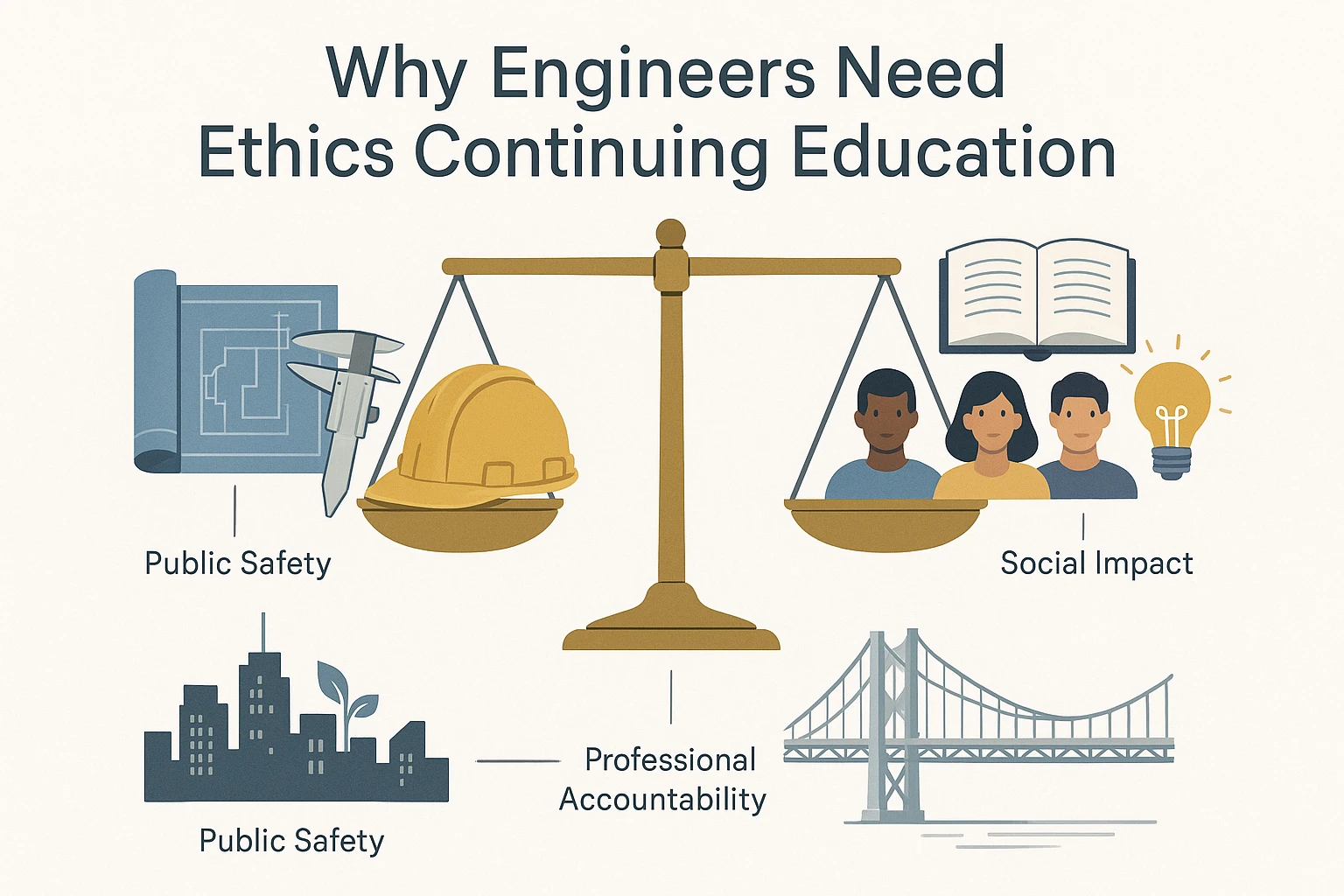
Ethics training is usually tied to the responsibilities that come with a PE license. A professional engineer may sign and seal documents, supervise engineering work, communicate project risks, or make decisions that affect public safety. State boards use ethics education to keep these responsibilities visible throughout a career.
Many boards require ethics courses because engineering practice changes over time. New technology, delivery methods, environmental concerns, client expectations, and regulatory updates can raise new ethical questions. Ongoing training gives licensees a structured way to revisit professional conduct and apply it to current practice.
Engineers who should check ethics continuing education requirements include:
- Licensed professional engineers preparing for renewal.
- PEs licensed in multiple states.
- Engineers who sign and seal documents.
- Engineers supervising technical staff or interns.
- Firm owners or managers are responsible for compliance.
- Engineers returning from inactive or retired status.
- Licensees selected for audit or board review.
The safest approach is to verify requirements early in the renewal period, choose courses that clearly match the board’s rules, and save all completion records. PDH-Pro supports this process with courses built for professional engineers and documentation that can be stored with renewal files.
Florida Ethics Requirements for Professional Engineers
Florida has a specific continuing education structure for professional engineers. Florida PEs must complete 18 hours of continuing education during each biennial renewal period. Within those hours, one hour must relate to professional ethics. Florida also requires one hour in Florida Laws and Rules, four hours related to the licensee’s area of practice, and the remaining hours on topics related to engineering practice.
This means all Florida professional engineers who are renewing an active PE license need ethics continuing education as part of the renewal process. The requirement applies across engineering disciplines because it is tied to professional licensure, not only to one technical field.
The Florida Board of Professional Engineers also requires PEs to report continuing education using NCEES CPC Tracking. The Florida Laws and Rules course is reported by the provider, but engineers still need to keep records and confirm that their renewal requirements are complete before the deadline.
Florida engineers should pay attention to both course content and documentation. The ethics course should be related to professional ethics, engineering judgment, public welfare, professional conduct, or similar topics that fit board expectations. The completion certificate should show the course title, provider, date, and number of hours.
PDH-Pro offers Florida PE continuing education options, including ethics courses and Florida-specific renewal packages. Engineers can complete online coursework, download certificates, and keep records ready for renewal or review. This helps reduce last-minute stress, especially when the renewal deadline is approaching.
For Florida firms, ethics training also supports internal quality. When licensed staff understand professional obligations, firms are better prepared to manage document control, supervision, conflict concerns, client communication, and project accountability.
Which Engineering Disciplines Usually Need Ethics Courses?
Ethics continuing education is not limited to one type of engineer. Civil, mechanical, electrical, structural, environmental, chemical, industrial, and other licensed engineers may need ethics training depending on the rules of the state where they practice.
The reason is that ethics applies to the professional role, not only to the discipline. A civil engineer may face public safety decisions on infrastructure projects. A mechanical engineer may need to evaluate equipment safety, energy systems, or industrial process risks. An electrical engineer may work with power systems, controls, cybersecurity, or life safety systems. A structural engineer may be responsible for designs where failure could place the public at risk.
Each discipline faces different scenarios, but the ethical foundation is similar. Engineers must be truthful, competent, accountable, and focused on public welfare. They must also understand when to disclose conflicts, when to refuse work outside their competence, and when a design concern should be elevated.
| Engineer Type or Status | Why Ethics Training May Apply | Common Ethics Topics |
| Civil engineers | Public infrastructure and permitting often affect communities | Public safety, transparency, and environmental impact |
| Mechanical engineers | Systems may affect safety, reliability, and energy performance | Competence, testing, product responsibility |
| Electrical engineers | Work may involve power, controls, communications, and safety systems | Risk disclosure, code compliance, system reliability |
| Structural engineers | Designs are tied closely to life safety and property protection | Responsible charge, sealing, and review standards |
| Environmental engineers | Decisions may affect water, air, land, and public resources | Public welfare, reporting, and regulatory compliance |
| Firm principals | Leadership affects staff conduct and project procedures | Supervision, conflicts, documentation |
| Multi-state licensees | Requirements vary by board and renewal cycle | State-specific ethics, reporting, and audit readiness |
Some states also require ethics training for engineers regardless of discipline. Others include ethics within a broader continuing education total. Because requirements differ, engineers should always check the current board rule before selecting a course.
PDH-Pro makes course selection easier by offering ethics courses for professional engineers in multiple formats. Engineers can choose self-paced courses for flexibility or webinar options when they prefer scheduled training.
What Ethics Training Covers and Why It Matters
Engineering ethics courses help licensees connect professional standards to real decisions. A good course not only defines ethical conduct. It helps engineers recognize issues they may face on projects, in firms, and during license renewal.
Common topics include professional responsibility, public safety, conflicts of interest, confidentiality, truthful reporting, responsible charge, sealing practices, disciplinary cases, and communication with clients or agencies. Some courses also review professional codes or board rules that guide ethical behavior.
Ethics training is useful because difficult situations are not always obvious. An engineer may face pressure to approve a drawing quickly, overlook a concern, reduce review time, or accept work outside their area of competence. Training helps engineers identify those risks before they become larger problems.
Ethics also affects communication. Many project problems become worse when warnings are not documented, assumptions are not explained, or decision-makers do not receive clear information. Professional ethics encourages engineers to communicate honestly, document concerns, and put public welfare ahead of convenience.
A strong ethics course should help engineers:
- Recognize conflicts of interest early.
- Understand duties related to public safety.
- Apply professional codes to project situations.
- Make better decisions under schedule or budget pressure.
- Know when to seek guidance or decline work.
- Improve documentation and communication habits.
- Maintain stronger professional credibility.
PDH-Pro’s ethics courses are designed to support both compliance and real-world judgment. Engineers can complete required training while refreshing skills that affect daily practice, client relationships, and firm standards.
Choosing Courses and Tracking PDH for Renewal
Selecting the right ethics course starts with the state board. Engineers should review the renewal rules, confirm the required number of ethics hours, check whether the course format is accepted, and confirm any provider requirements. This is especially important for engineers licensed in multiple states.
A course should clearly identify the PDH value and subject matter. If the ethics requirement is one hour, the course should state that it provides one PDH or equivalent credit. If the board requires professional ethics, the course description should clearly focus on ethical practice for engineers.
Documentation matters as much as course selection. Engineers should keep certificates, course descriptions, provider details, and reporting confirmations. These records may be needed during renewal or if the licensing board audits the licensee.
A practical renewal process includes checking requirements early, choosing qualifying courses, completing training well before the deadline, downloading certificates, and storing records in a renewal folder. Engineers using NCEES CPC Tracking or another reporting system should enter course details soon after completion rather than waiting until the end of the cycle.
PDH-Pro helps simplify this process by providing online access, course details, and completion certificates. Engineers can use the platform to select ethics courses, complete training on a practical schedule, and keep proof of completion ready.
For firms, a shared PDH tracking plan can help multiple engineers stay compliant. Managers can remind licensed staff of renewal dates, encourage early course completion, and keep training resources available. Each engineer remains responsible for their own license, but firm-wide planning reduces avoidable stress.
Plan Ethics Training Before the Renewal Deadline
Ethics continuing education applies to many licensed professional engineers, including Florida PEs and engineers in other states where boards require ethics coursework for renewal. The requirement may vary, but the purpose is consistent: help engineers maintain professional judgment, protect the public, and meet board expectations.
Engineers should not wait until renewal week to check ethics requirements. Review your state board rules early, confirm the required number of hours, choose courses that count, and keep documentation organised. If you hold licenses in multiple states, compare each board’s requirements before selecting training.
PDH-Pro gives engineers a convenient way to complete ethics continuing education through online courses and webinar options built for professional license renewal. Select the course that fits your board requirements, complete your PDH, and save your certificate before the deadline creates pressure.