
 A Michigan PE renewal course package can simplify planning for a professional engineer. Start with current state requirements from the licensing board and department, not a generic checklist. Michigan engineers need continuing education that fits their work, meets education requirements, and supports professional engineering practice.
During each renewal period, compare online courses by provider, credit hours, and PDH value. Include engineering ethics to meet the ethics requirement and keep clear records of hours for the renewal application. For a Michigan professional, the right ethics courses included in renewal packages can make renewal education more useful on the job.
Key takeaways
Table of Contents
- Michigan PEs generally need 30 PDH every two-year renewal cycle; verify current LARA requirements before filing.
- Include required ethics or professional-conduct education and choose courses relevant to your engineering practice.
- Select packages with clear PDH values, learning objectives, completion rules, and prompt certificate access.
- Complete courses within the applicable renewal period; do not assume unused credits automatically carry forward.
- Store certificates, course outlines, attendance records, and receipts in case LARA audits your renewal.
- Start early to resolve eligibility, assessment, certificate, or online-account issues before the deadline.
To explore available options, browse PDH Pro’s Michigan PE renewal packages and compare the included courses with your remaining continuing education needs.
Michigan PE renewal requirements: Start with verified state guidance
Michigan professional engineering renewal is simpler when you start with current state guidance, not an old checklist or a colleague’s experience. The Michigan Department of Licensing and Regulatory Affairs (LARA) oversees licensure for engineers. The engineering board sets and interprets the requirements for each professional engineer license.
For each renewal period, you will typically complete an online renewal application, pay the required fee, and attest to your continuing education. Michigan’s education requirements generally include 30 professional development hours, or PDH, during the two-year cycle. This may include engineering ethics, professional conduct, and applicable statutes and rules. Confirm the current ethics requirement, accepted credit hours, and filing deadline with the department before you submit.
Choose relevant courses and keep clear documentation. Certificates, attendance records, transcripts, and program descriptions can support your reported hours if the department audits your renewal. Ask how each provider packages ethics training, and verify that the activity qualifies as engineering PDH. Search terms such as “Michigan professional engineering” and “Michigan PE renewal course package” may help you compare options, but always confirm eligibility with state requirements.
Timing matters as much as coursework. Check your license expiration date, confirm which activities count, and submit the renewal application before the deadline. Do not assume that late courses apply to the correct renewal period or that unused hours carry forward. New licensees, inactive-status applicants, and engineers returning to practice may have different requirements, so review the current board guidance before filing.
Michigan PE Renewal Quick Reference
| Renewal item | What to verify or complete | Documentation or action |
|---|---|---|
| Renewal timing | Review the license expiration date in the Michigan licensing account and submit the renewal before the deadline. | Confirm the current deadline through the LARA renewal notice and board guidance. |
| Online renewal application | Submit the renewal application through the state’s online licensing system. | Review the application carefully before filing. |
| Renewal fee | Pay the required renewal fee. | Verify the current fee amount with LARA before submitting payment. |
| Continuing education | Complete the professional development hours required for the two-year renewal cycle; the section states this is generally 30 hours. | Verify eligible activities and applicable renewal-period rules with current state guidance. |
| Ethics and professional conduct training | Include training related to ethics, professional conduct, or applicable statutes and rules. | Confirm the current content requirement and retain evidence of completion. |
| Activity eligibility | Make sure continuing education is relevant to professional engineering practice and counts for the applicable renewal period. | Review whether coursework completed near a deadline or credits from a prior cycle are eligible. |
| Continuing education records | Keep support for reported professional development hours in case of an audit. | Retain course certificates, attendance records, transcripts, program descriptions, and similar materials. |
| Record retention | Keep renewal and education records for the retention period specified by the state. | Verify the current retention period rather than discarding records after application acceptance. |
| Special license circumstances | Review requirements directly if newly licensed, seeking inactive status, or returning to practice. | Consult the applicable LARA and Michigan Board of Professional Engineers requirements. |
| Final review | Confirm current rules, forms, fees, deadlines, and requirements before filing. | Use the current LARA renewal notice and board guidance. |
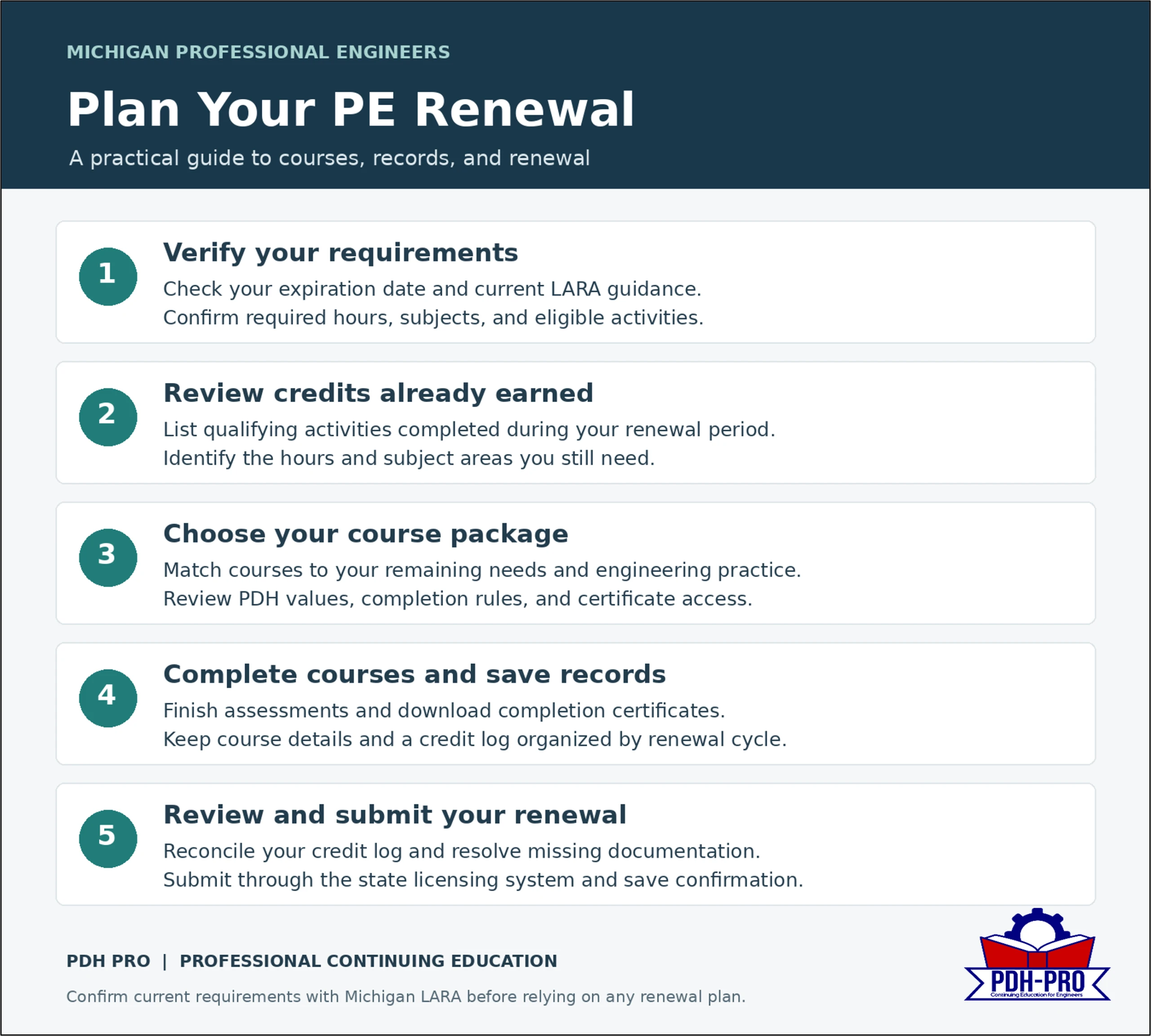
Choosing a Michigan PE Renewal Course Package and Engineering PDH Mix
A strong Michigan PE renewal course package does more than meet the required credit hours. It helps a Michigan professional engineer build a clear, defensible record of continuing education. Before beginning your renewal application, review guidance from the department, board, and engineering board. Confirm the state requirements, education requirements, renewal deadline, ethics requirement, and any engineering ethics expectations.
A balanced mix of courses is often more useful than a single-topic bundle. Choose engineering PDH courses that strengthen technical judgment, address updates to codes and standards, and support the direction of your work. Civil engineers may focus on transportation, water, geotechnical work, or construction management. An electrical or mechanical engineer may prioritize systems, controls, energy, equipment, or risk management. The goal is professional engineering education that remains useful long after the required hours are complete.
Online courses can make renewal easier to manage around project deadlines. Still, convenience should not be the only consideration. Review each provider’s course descriptions, learning objectives, completion records, and policies before enrolling. A reliable provider clearly states the PDH value of each course, delivers documentation promptly, and offers education designed for professional engineers rather than generic workplace training.
Keep your renewal records organized in one place. Save certificates, course outlines, completion dates, and proof of participation. Confirm that every course falls within the applicable renewal period, and avoid duplicate material with little new value. A thoughtful plan packages ethics guidance with technical study, creating a credible professional portfolio for your next design review, field decision, or client conversation.
Michigan PE Course Checklist
- Confirm current Michigan renewal requirements, deadline, total PDH hours, and any ethics obligations before selecting a package.
- Choose a balanced course mix that strengthens core technical judgment and supports your current engineering discipline.
- Prioritize updates on applicable codes, standards, materials, safety practices, project delivery, or emerging technical responsibilities.
- Review provider course descriptions, learning objectives, PDH values, documentation practices, and policies before enrolling.
- Use online options for flexibility, but ensure content is designed for licensed engineers rather than generic workplace training.
- Avoid duplicate subjects; select distinct courses that provide meaningful new knowledge and a credible professional-development record.
- Store certificates, course outlines, completion dates, and participation records together for potential renewal review.
Engineering ethics and courses that strengthen professional practice
Technical ability is only part of what makes an effective engineer. Decisions made in design reviews, site meetings, procurement discussions and project handovers can shape public safety, environmental outcomes, privacy, cost and community trust. That is why engineering ethics should be more than a brief compliance exercise. Strong courses help engineers recognize competing obligations, explain their reasoning and act responsibly when there is no simple answer.
An ethics requirement may be tied to registration, accreditation, continuing education or renewal. For a professional engineer, it can also support a stronger renewal application and help meet state requirements set by an engineering board or licensing board. In Michigan, education requirements may include specific credit hours, PDH or engineering PDH during a renewal period. A trusted provider can help a michigan professional understand current requirements and select appropriate online education.
The best courses connect ethics to everyday professional engineering work. Look for practical discussion of duty of care, conflicts of interest, informed consent, sustainability, risk communication, whistleblowing and accountability across multidisciplinary teams. Case-based learning is especially useful. It gives engineers space to weigh evidence, identify affected parties and consider the consequences of action, or inaction, before deciding how to respond.
For those comparing options, packages ethics modules with technical or management learning can be a practical choice. A Michigan PE renewal course package may combine ethics with project leadership, workplace health and safety, environmental management or quality assurance. These courses can make required hours more relevant to the work of a department or project team. The goal is not one approved answer to every dilemma. It is to build sound habits: ask better questions, seek independent advice when needed, communicate honestly and keep the public interest at the center of engineering practice.
Complete online courses and keep renewal documentation organized
For many licensed professionals, renewal is straightforward; proving that every requirement has been met takes more work. Online continuing education makes the process easier when courses fit around a full schedule. For a Michigan professional engineer, planning ahead helps keep professional engineering renewal on track.
Start with your licensing board’s current education requirements. Confirm the required credit hours, renewal period, reporting deadlines, and any state requirements set by the engineering board or department. Check whether an ethics requirement, engineering ethics, safety, law, or cultural competency course is required. Some boards accept fully online education, while others limit distance-learning hours or require live instruction.
Before enrolling, verify that the provider is approved by the relevant board or recognized accrediting organization. Review each course description, PDH value, completion rules, assessments, and certificate process. A Michigan PE renewal course package may simplify planning but confirm that its engineering PDH and packages that include ethics courses meet your specific requirements. Useful education does not always count toward renewal, so approval matters as much as the topic.
Keep a dedicated digital folder for each renewal cycle. Save enrollment confirmations, syllabi, completion certificates, receipts, and messages confirming eligibility. Use clear filenames with the course title, completion date, provider, and hours. A simple spreadsheet can help engineers compare completed continuing education with outstanding requirements and prepare a renewal application if documentation is requested.
Try not to leave courses until the final weeks of the renewal period. Completing them in stages gives every engineer time to resolve technical issues, replace a missing certificate, or select another course if one does not apply as expected. With approved online courses and organized records, renewal becomes a routine professional responsibility rather than a last-minute scramble.
Renewal Documentation Checklist
- Review your licensing board’s current hour requirements, reporting period, mandatory subjects, and any limits on online learning.
- Verify provider approval before enrolling; professionally useful coursework may not qualify for license renewal credit.
- Confirm each course’s credit hours, completion rules, assessment requirements, and certificate availability before making payment.
- Create a dedicated digital folder for each renewal cycle and save all supporting materials immediately.
- Keep enrollment confirmations, receipts, syllabi, certificates, and eligibility correspondence in one searchable location.
- Use consistent filenames with course title, provider, completion date, and credited hours for faster audit retrieval.
- Track completed and remaining hours in a spreadsheet, including required subject categories and renewal deadlines.
- Finish courses well before the deadline to resolve technical problems, missing certificates, or ineligible coursework.
Michigan PE renewal course package FAQs
A Michigan PE renewal course package can make continuing education planning easier while helping you meet current state requirements. Before you enroll, confirm that the package fits your practice area, renewal period, and education requirements.
Michigan generally requires each licensed professional engineer to complete 30 credit hours of qualifying engineering PDH during a two-year renewal period. A complete package may cover all required hours in one place. However, engineers should review course descriptions, credit totals, and completion dates first. If you already have qualifying hours from conferences, employer training, teaching, or professional society activity, a smaller option may be a better fit.
Give engineering ethics and professional conduct special attention. Michigan’s requirements include an ethics requirement, so look for packages ethics details that clearly identify the applicable credit. Do not assume a technical course meets this requirement. Eligible courses should support engineering practice, technical knowledge, professional responsibility, or public health, safety, and welfare.
For most renewals, you do not submit every certificate with your renewal application. Instead, keep completion records, including certificates, course outlines, provider details, and attendance or completion dates. The engineering board may audit licensees, and organized records make the process much easier. Retain documentation for the required period, and confirm that the name on each certificate matches your license records with the department and board.
Online professional engineering courses can be a practical choice for busy professionals. Choose courses with meaningful instructional content and dependable participation records. As a Michigan professional, avoid waiting until the last days before renewal. Leave time to complete assessments, download certificates, and address account questions. If a topic, credit calculation, or carryover issue is unusual, check current guidance from the state requirements before relying on it for renewal.
Frequently asked questions
How many PDH are required for Michigan PE renewal?
Michigan professional engineers generally need 30 professional development hours during each two-year renewal cycle. Confirm the current total, renewal dates, and any exceptions through Michigan LARA and the Board of Professional Engineers before submitting your renewal.
Is ethics training required for Michigan PE renewal?
Michigan renewal requirements generally include education related to ethics, professional conduct, or applicable laws and rules. Choose a course that clearly identifies its ethics content and retain documentation showing the completion date and PDH awarded.
Are online courses accepted for Michigan engineering PDH?
Online courses can be a practical way to earn engineering PDH when they provide relevant instructional content and reliable completion records. Before enrolling, verify that the course format, provider, subject matter, and credit calculation meet current Michigan requirements.
What records should I keep after renewing my Michigan PE license?
Keep completion certificates, course descriptions or outlines, attendance records, provider details, dates completed, and receipts when available. Store records by renewal cycle and retain them for the state-required period in case LARA audits your continuing education.
Can I use a Michigan PE renewal course package for all 30 PDH?
A course package may cover the full 30-PDH requirement if every course is qualifying, completed within the applicable renewal period, and includes any required ethics content. Review individual course descriptions rather than relying only on the package total.
Can unused PDH carry over to the next Michigan renewal period?
Do not assume excess hours can carry forward. Carryover rules can be limited or may change, so check current LARA and board guidance before counting prior-cycle education toward a future Michigan PE renewal.
When should I complete my Michigan PE continuing education?
Complete courses well before your license expiration date. Early completion gives you time to finish assessments, obtain certificates, confirm that hours apply to the correct cycle, and correct any missing documentation before filing.