Contributor: Jordan Ellis
Written: Oct 14. 2026
 Licensed professional engineers can buy engineering continuing education courses online to complete PDH requirements, satisfy state renewal rules, and document professional development before their PE license renewal deadline. PDH Pro offers a full catalog of online engineering courses here: buy engineering continuing education courses online.
Online continuing education is one of the most practical ways for engineers to maintain licensure because it allows you to choose courses by discipline, topic, credit value, and renewal need. Instead of waiting for an in-person seminar or adjusting your schedule around a conference, you can complete PDH courses at your own pace and keep records for your renewal file.
Most state engineering boards require professional engineers to complete continuing education, commonly measured in professional development hours, or PDH. The exact number of hours, renewal cycle, carryover rules, ethics requirements, and accepted course formats vary by state. That is why engineers should select online courses that are relevant to their practice area, clearly documented, and appropriate for their licensing board’s rules.
Online PDH courses are especially useful for busy engineers who manage project deadlines, client needs, travel, field work, or multiple state licenses. A good online course provider makes it easier to find courses that support both compliance and real professional growth.
How Online Continuing Education Helps Engineers Meet PDH Requirements
Table of Contents
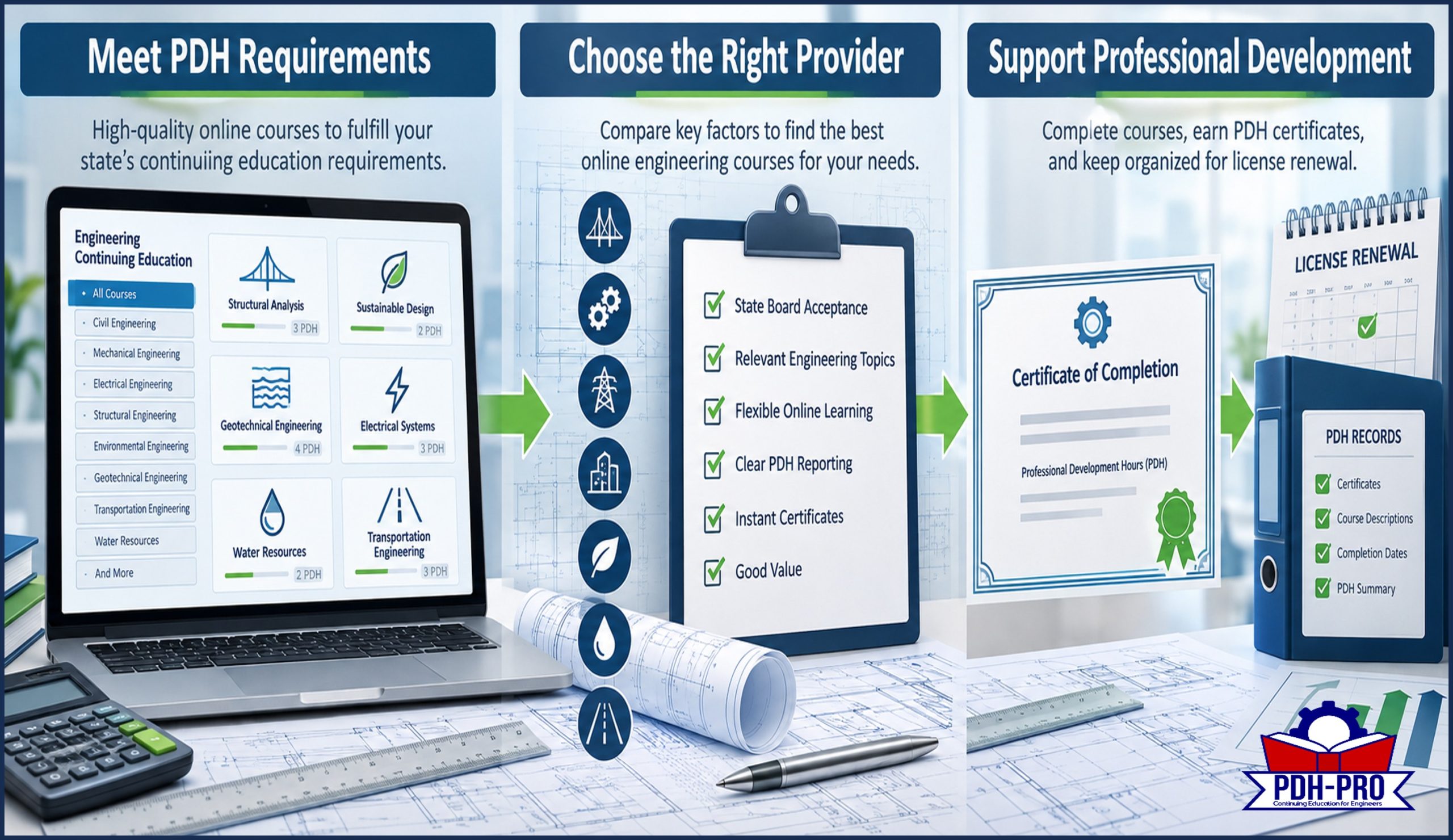 Online continuing education helps engineers complete required PDH credits without needing to attend a live classroom event. For many PEs, this is the most efficient way to manage license renewal while still choosing technical topics that are useful in practice.
Continuing education requirements are intended to help licensed engineers maintain competency, stay current with technical developments, and protect the public. NCEES describes continuing professional competency programs as a way to support consistent standards for earning and reporting continuing education credits during license renewal. NCEES also notes that its CPC standard includes annual PDH expectations and ethics-focused learning, although each licensing jurisdiction sets its own rules for renewal compliance (NCEES CPC Tracking).
Online PDH courses can help engineers meet these requirements by providing:
- Flexible access from home, office, or the field
- Discipline-specific engineering topics
- Self-paced course completion
- Immediate or convenient documentation of completion
- Options for ethics, laws, rules, safety, design, and technical subjects
- A practical way to complete education credits before a renewal deadline
For engineers licensed in more than one state, online learning can also make it easier to organize courses around different renewal cycles. One state may require an ethics course, another may limit carryover, and another may require courses from an approved provider. Online course selection allows engineers to plan around those differences instead of scrambling near the end of a renewal period.
The most important point is that engineers should not treat PDH as a simple checkbox. The best courses support professional judgment, technical competence, and better engineering decisions. NSPE has long emphasized that lifelong learning and continuing education for licensed professional engineers are important to protecting the public (NSPE Continuing Professional Competency).
Practical example: A civil engineer may choose courses on stormwater design, construction safety, engineering ethics, and project documentation. A mechanical engineer may choose courses on HVAC systems, energy efficiency, pressure vessels, or equipment reliability. In both cases, the engineer can satisfy renewal needs while selecting topics that match actual work responsibilities.
Online continuing education is also helpful because it gives engineers more control over timing. Some PEs complete courses throughout the renewal cycle. Others complete a group of courses shortly before renewal. Either approach can work, but spreading courses across the renewal period often makes recordkeeping and learning more manageable.
What to Look for in an Engineering Continuing Education Provider
When choosing an engineering continuing education provider, engineers should look beyond the course title. A good provider should offer relevant course topics, clear PDH values, completion certificates, accessible records, and course formats that match state licensing requirements.
Before purchasing a course, check whether the provider offers the type of documentation your board expects. Most engineers should keep a certificate of completion, course title, course date, number of PDH credits, provider name, and a description of the course content. Some boards may ask for this information during an audit, even if it is not required at the time of renewal.
A strong online provider should make it easy to answer these questions:
| Question | Why It Matters |
| Does the course list the number of PDH credits? | Engineers need accurate credit values for renewal reporting. |
| Is the course relevant to engineering practice? | Many boards require continuing education to maintain or improve professional competence. |
| Is a completion certificate provided? | Certificates are commonly needed for renewal records or audits. |
| Are ethics or laws and rules courses available? | Some states require specific topics during each renewal cycle. |
| Are courses available by engineering discipline? | Engineers should choose learning that fits their work and license responsibilities. |
| Is the provider experienced with PE continuing education? | Engineering licensure education has different expectations than general training. |
Engineers should also pay attention to whether the course is self-paced, live webinar, recorded webinar, or another format. Some states accept several formats. Others may place limits on certain course types or require specific provider approval. Because rules vary by jurisdiction, engineers should always confirm requirements with their state licensing board.
A provider’s course catalog should also be broad enough to support different engineering disciplines. Useful topics may include structural design, electrical systems, civil engineering, environmental compliance, mechanical systems, project management, construction, safety, ethics, and business practice. This allows engineers to select education that is both compliant and professionally meaningful.
Some engineers also look for free PDH opportunities or low-cost courses. Cost matters, especially when an engineer must complete many credits, but price should not be the only factor. A course that is poorly documented, irrelevant, or not accepted by a licensing board can create problems during renewal or audit. The better approach is to balance cost, quality, relevance, and documentation.
For many PEs, the right provider is one that supports both immediate renewal needs and long-term professional development. That means the courses should be easy to access, technically useful, clearly organized, and backed by completion records that can be saved for future reference.
Choosing PDH Courses That Support Professional Development
The best PDH courses do more than help an engineer reach a required number of hours. They also strengthen technical knowledge, improve professional judgment, and support better decisions in engineering practice.
When selecting courses, start with your license renewal requirements. Identify how many PDH credits you need, whether your state requires engineering ethics, whether online or self-paced courses are accepted, and whether any provider approval rules apply. Then choose courses that match both your board’s rules and your professional responsibilities.
A simple selection process can help:
- Confirm your state’s PDH or continuing education requirement.
- Identify any required topics, such as engineering ethics, laws, rules, or professional practice.
- Review your current work responsibilities and technical gaps.
- Choose courses related to your discipline or project work.
- Save course certificates and completion records in one renewal folder.
- Review your records before submitting your license renewal.
Engineers should also consider career goals when selecting courses. A project engineer moving into management may benefit from courses in communication, risk management, contracts, or leadership. A design engineer may prefer technical courses on codes, calculations, safety factors, or system performance. An engineer working in environmental, civil, mechanical, electrical, or structural practice can use continuing education to stay current in the areas that matter most to clients and the public.
The best online learning plan is usually a mix of compliance and usefulness. For example, an engineer might complete one ethics course, several discipline-specific technical courses, and one course related to project management or business practice. This type of balanced plan helps satisfy renewal requirements while supporting broader professional growth.
Engineering ethics deserves special attention. Even when a state does not require a separate ethics course, ethics education can be valuable because professional engineers are responsible for decisions that affect public health, safety, and welfare. Ethics courses can help engineers think through conflicts of interest, responsible charge, public communication, competence, and duty to clients, employers, regulators, and the public.
Online courses can also support lifelong learning by making it easier to revisit topics over time. Engineers can take courses when a project need arises, when a code changes, when they move into a new role, or when renewal deadlines approach. This flexibility is one reason online PDH has become such a practical option for licensed professionals.
Before buying any course, engineers should remember that the licensing board has the final authority over continuing education compliance. Course providers can help organize and document learning, but each licensee is responsible for understanding the rules that apply to their own license.
Frequently Asked Questions
Do engineers need CEUs or PDH credits?
Many licensed professional engineers need continuing education to renew their licenses, but the terminology varies by state. Some boards refer to professional development hours, or PDH. Others may use terms such as continuing education, continuing professional competency, CPC, or continuing education units, commonly called CEUs.
For PE license renewal, PDH is the most common unit used by engineering boards. The number of required hours, renewal period, acceptable activities, and documentation rules depend on the state where the engineer is licensed. Engineers with multiple licenses should check each board’s requirements because one state’s rules may not match another’s.
Where can I find online engineering classes?
Engineers can find online engineering classes through continuing education providers, professional associations, universities, technical organizations, and training platforms that offer PDH-eligible courses. For license renewal, the key is to choose courses that are relevant to engineering practice and acceptable under your state board’s rules.
PDH Pro provides online engineering continuing education courses across a wide range of technical and professional topics. Engineers can select courses by subject area, credit value, and renewal need, then save completion documentation for their records.
What is the best online course format for learning engineering?
The best online course format depends on the engineer’s schedule, learning preference, and state requirements. Self-paced online courses work well for engineers who want flexibility and the ability to complete training on their own schedule. Live webinars may be better for engineers who prefer scheduled instruction or interactive learning. Recorded webinars can be useful when engineers want presentation-style instruction with more flexibility than a live event.
For license renewal, the best format is the one that is accepted by your state board, provides clear documentation, and helps you learn something relevant to your engineering practice.