
Contributor: Jordan Ellis
Written: Oct 8, 2026
 Before applying conference or seminar hours toward renewal, engineers should understand the broader Virginia PE Continuing Education Requirements that govern PDH completion and documentation. Conferences can be useful for professional development, but Virginia engineers should confirm that each session meets the state’s continuing education standards before counting it toward license renewal.
Virginia’s continuing education rule does not limit engineers to one course format. Instead, it focuses on whether the activity relates to professional practice, has a clear purpose and objective, supports relevant skills or knowledge, and results in documentation verifying successful completion. The rule also explains how credit hours are computed and what records must be kept.
For professional engineers, the education requirement is tied to the professional license rather than the name of the event. A seminar, workshop, or conference session should support the licensee’s practice and satisfy the board’s standards for acceptable development activities.
What Counts as a Qualifying Conference Session for Virginia PE Renewal?
Table of Contents
Conference credit may count for Virginia PE renewal when the activity satisfies the state’s continuing education criteria. The most important question is not whether the event is called a conference, meeting, seminar, or workshop. The key question is whether the specific session qualifies as a continuing education activity under Virginia’s regulations.
A qualifying conference session should generally:
- Relate to the practice of professional engineering
- Have a clear purpose and objective
- Maintain, improve, or expand skills and knowledge relevant to the engineer’s practice
- Be taught by a competent instructor when instructor interaction is involved
- Provide documentation verifying successful completion
This means a technical presentation on structural design, water resources, environmental compliance, transportation safety, project risk management, engineering ethics, or public health and welfare may be more defensible than a general networking session, exhibit hall visit, meal program, or vendor sales presentation.
Virginia Regulations for Continuing Education Activities
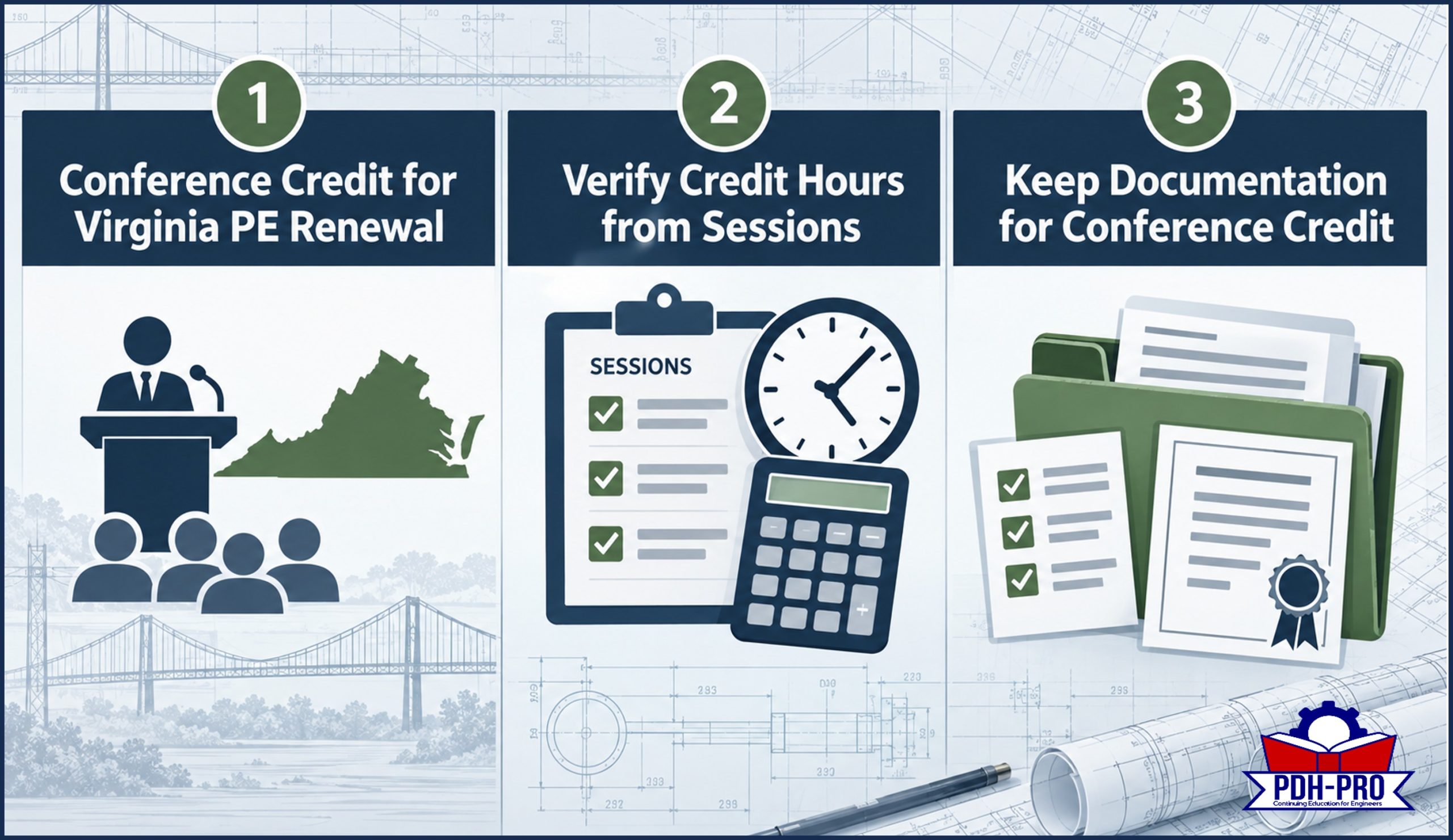 Virginia’s rule requires licensees to complete continuing education for renewal or reinstatement under Section 54.1-404.2 of the Code of Virginia. For renewal, CE must be completed during the two-year license period immediately before the license expiration date, and the CE is valid only for that renewal. Additional hours are not valid for later renewal periods.
The regulation provides several criteria for acceptable CE activities. The activity must consist of content and subject matter related to the practice of the profession. It must also have a clear purpose and objective that will maintain, improve, or expand skills and knowledge relevant to the licensee’s area of practice. Virginia specifically recognizes that business practices may qualify when they have demonstrated relevance to the licensee’s area of practice, including project management, risk management, ethics, and public health, safety, and welfare.
The same framework applies to mandatory continuing education completed through a live event, online course, university program, or other structured educational activity.
For conference credit, this means the engineer should evaluate each session separately. A conference may include both qualifying and non-qualifying activities. The technical sessions may qualify, while receptions, product demonstrations, award lunches, and general networking events may not.
Standards for Professional Development, Learning, and Instruction
Virginia’s continuing education standards focus on professional relevance, learning value, and verifiable completion. The activity should not merely be interesting. It should support professional practice and be tied to the engineer’s knowledge, skills, or responsibilities.
For activities involving interaction with an instructor, Virginia requires the instructors to be competent in the subject matter by education or experience. For self-directed activities, the sponsor must include an assessment at the conclusion of the activity to verify that the licensee successfully achieved the purpose and objective of the activity. Good instruction should leave the attendee with a clearer understanding of technical standards, professional responsibilities, or applied science relevant to the licensee’s work.
At a conference, engineers should look for sessions with:
- A technical or professional-practice topic
- A published agenda or course description
- Identified presenters or instructors
- Defined learning objectives
- Attendance tracking or sign-in records
- A certificate or transcript showing credit awarded
The stronger the documentation, the easier it is to justify the credit if the board requests records later.
How to Verify Contact Time from Conferences and Seminars
Virginia calculates CE credit based on contact time. The regulation states that 50 contact minutes equals one hour of CE. If an activity consists of segments shorter than 50 minutes, those segments are totaled for computing CE for that activity.
Engineers should not assume that a full-day conference automatically equals a full day of credit. Meals, breaks, exhibit hall time, social events, and nontechnical sessions should be excluded unless the sponsor clearly identifies them as qualifying CE activities.
| Conference Activity | Likely Treatment |
| Technical engineering presentation | May qualify if documented and relevant |
| Ethics seminar | May qualify if related to professional practice |
| Project management or risk management session | May qualify if relevant to engineering practice |
| Exhibit hall visit | Usually weak unless structured as qualifying instruction |
| Networking reception | Generally not a CE activity |
| Meal or awards program | Usually not counted unless it includes qualifying instruction |
| Vendor sales presentation | Risky unless it has clear educational value and documentation |
If a conference provides more PDH than needed for the current renewal cycle, engineers should confirm whether Virginia PE credits carry over before relying on extra hours for a future renewal.
Records Engineers Should Keep for Conference Sessions
Virginia requires licensees to maintain records of CE completion used to renew a license for three years from the date of expiration of the license. Licensees must provide those records to the board or its authorized agents upon request. The board may conduct random audits, and licensees selected for audit must provide documentation of all CE activities used for renewal within 21 calendar days of the audit notice.
A record file should also identify the sponsor, the development activity, the topic, the date completed, and the reason the session relates to the licensee’s professional practice.
For conference credit, engineers should keep:
- Conference agenda or program
- Session titles and descriptions
- Presenter names and credentials, if available
- Attendance records or sign-in confirmations
- Certificate of completion or conference transcript
- Number of credit hours awarded
- Date and location of the event
- Notes explaining relevance to engineering practice, if needed
Strong documentation is especially important when only part of a conference qualifies. If the conference sponsor issues one certificate for the whole event, keep the agenda and highlight the specific technical sessions attended.
College Courses, Semester Hours, and Accredited Education Programs
Virginia’s regulation also explains how college credit is converted. One semester hour of college credit equals 15 hours of CE, and one quarter hour of college credit equals 10 hours of CE.
This is different from conference credit, which is typically based on contact minutes or sponsor-awarded hours. If a conference is connected to a university, regionally accredited college, or formal education program, engineers should still verify how the sponsor identifies the credit. The record should make clear whether the engineer is claiming contact-hour CE, PDH, semester hours, or quarter hours.
When a program is offered with an accredited college or regionally accredited college, the record should distinguish academic coursework from conference attendance so the correct conversion method is used.
Ethics, Public Safety, and Technical Topics That May Qualify
Virginia’s rule allows continuing education activities that maintain, improve, or expand skills and knowledge relevant to the licensee’s area of practice. It also recognizes business practices when relevant, including project management, risk management, ethics, and public health, safety, and welfare.
Examples of conference topics that may qualify include:
- Engineering ethics and professional responsibility
- Public safety and risk reduction
- Civil, structural, environmental, electrical, mechanical, or other technical engineering topics
- Codes, standards, and regulatory compliance
- Project management for engineering projects
- Risk management in professional practice
- Design methods, science, applied sciences, or technical research
- Health, safety, and welfare topics tied to engineering decisions
The safest approach is to connect each session to the engineer’s professional practice. A topic does not need to match the engineer’s exact discipline perfectly, but the relevance should be reasonable and documentable.
Common Mistakes When Claiming Conference Sessions
The most common mistake is claiming the entire conference without separating qualifying instruction from non-credit activities. A three-day conference may include many valuable experiences, but not every hour is necessarily continuing education.
Other common mistakes include:
- Counting meals, receptions, or exhibit hall time as CE
- Claiming more hours than the sponsor awarded
- Keeping only a registration receipt instead of a completion certificate
- Losing the agenda or session descriptions
- Counting the same content more than once in the same renewal period
- Assuming extra hours carry forward to the next renewal
- Claiming sessions that are interesting but not related to professional engineering practice
Virginia’s rule states that a licensee must not claim more credit for any CE activity than the number of hours predetermined by the sponsor at the time the activity was completed. It also states that a licensee applying for renewal will not receive credit for completing a CE activity with the same content more than once during the two years before license expiration.
Practical Checklist Before Using Conference Sessions for Renewal
Before using conference credit for Virginia PE license renewal, review the following checklist:
- Confirm the session occurred during the correct two-year license period.
- Confirm the topic relates to professional engineering practice.
- Confirm the activity had a clear purpose and objective.
- Confirm the presenter or instructor was competent in the subject matter.
- Confirm the sponsor assigned a specific credit value.
- Exclude meals, breaks, exhibit time, and networking events unless they are documented as qualifying instruction.
- Save the certificate, transcript, agenda, and session descriptions.
- Calculate hours using Virginia’s credit rules.
- Keep the records for three years from the license expiration date.
- Do not rely on extra hours for the next renewal cycle.
PDH Pro offers written self-paced courses, live webinars, and on-demand recorded webinars that can help Virginia engineers complete continuing education in a documented format. Conferences can be a useful part of a renewal plan, but they work best when paired with organized records and a clear understanding of Virginia’s rules. The board’s public guidance and forms are available through Virginia.gov, and licensees should use those official resources when confirming the current regulations for licensure renewal.
Frequently Asked Questions
Can Virginia PEs count conference sessions for continuing education credit?
Yes, conference sessions may count if they meet Virginia’s continuing education criteria. The session should relate to professional practice, have a clear educational purpose, support relevant skills or knowledge, and result in documentation verifying completion.
What are the requirements to get a VA PE license?
Initial PE licensure is separate from continuing education for renewal. Engineers seeking initial Virginia licensure should review the Virginia Board’s application, education, experience, examination, and comity requirements. This article focuses on using conference credit after licensure for renewal compliance.
Do conference credits need certificates or proof of attendance?
Yes. Virginia requires CE activities to result in documentation verifying successful completion. Engineers should keep certificates, attendance records, agendas, session descriptions, and credit-hour documentation.
Can extra conference credit hours carry over to the next Virginia PE renewal?
No. Virginia CE for renewal is valid only for the renewal period in which it is completed. Additional hours are not valid for a later renewal period.
How many hours can a Virginia PE claim from a conference?
An engineer should claim only the hours assigned by the sponsor for qualifying CE activities. Virginia uses 50 contact minutes as one hour of CE, and shorter qualifying segments may be totaled for computing CE for that activity.