
 Contributor: Jordan Ellis
Written: Sep 25, 2026
Michigan counts more than courses toward a professional engineer’s continuing education: qualifying activities include technical seminars, teaching, peer-reviewed publications, certain committee work, mentoring, and other activities listed in Rule R 339.16041. For a standard two-year renewal, you need 30 credit hours, including two focused on professional ethics related to engineering. Each activity has its own conditions and, in some cases, a credit limit. Start with the broader Continuing Education Requirements for Michigan Engineers if you also need an overview of renewal.
Eligible Education Activities for Michigan Engineers
Table of Contents
Michigan’s rule lists eleven ways to earn credit. The connection to professional engineering matters: an activity must meet the description and proof requirements for its particular category. A useful conference, for example, does not automatically earn credit for every hour you spend at the venue. Identify the qualifying sessions, the applicable rule category, and the documentation you can retain before adding them to your renewal total.
The rule accepts qualifying education taken in person or online. It also recognizes certain programs offered or approved for credit by another state’s engineering board, a professional engineering association, NCEES, or ABET. That is one route to credit, but it is not the only route: the rule separately covers seminars, company training, academic study, and several professional contributions. Michigan does not give every course a blanket approval simply because its provider sells PE education.
Courses, Conferences, Teaching, and Published Work
The table summarizes Rule R 339.16041. “Per renewal period” limits apply to the named activity, not to your overall 30-hour requirement. Review the rule’s proof requirements as well as its credit calculation before relying on any entry.
| Qualifying activity | Michigan credit and key condition |
| Eligible program offered or approved for credit by an organization named in the rule | Credit approved by the sponsor or approving entity |
| Passing a qualifying engineering academic course | 15 credit hours per semester credit, or 10 per quarter credit |
| Attending an engineering seminar, in-house course, workshop, or professional or technical presentation | 1 credit hour per 50 minutes attended |
| Teaching, instructing, or presenting on an engineering subject | 2 credit hours per 50 minutes; maximum 12 per renewal period |
| Publishing a peer-reviewed engineering paper, article, or book | 6 credit hours; maximum 18 per renewal period; no additional credit for publishing the same work again |
| Serving as a voting member of a qualifying state or national engineering committee, board, council, or association | 3 credit hours for a year of service; maximum 6 per renewal period; attendance at least 50% of regularly scheduled meetings |
| Attending a complete Michigan Board of Professional Engineers meeting | 1 credit hour per meeting; maximum 6 per renewal period; obtain the required signed form at the meeting |
| Serving as a school-sponsored mentor to an engineering student | 4 credit hours; maximum 8 per renewal period; mentoring cannot be part of your regular job description |
| Participating in qualifying company-sponsored or hosted training | 1 credit hour per 50 minutes |
| Studying an eligible engineering article in a peer-reviewed, professional, or scientific journal | 2 credit hours per article; maximum 4 per renewal period |
| Obtaining an engineering-related patent | 10 credit hours per patent; maximum 20 per renewal period |
If you are taking a college course, see do college courses count as CEU for an explanation of how academic credit is evaluated.
A conference can supply qualifying seminars, workshops, or technical presentations, but “attended the conference” is too broad a record on its own. Keep evidence identifying the particular presentation, date, organization, and your attendance. For an in-house technical session, keep the company’s completion record showing your name, the subject, and the date. These details become important if the department asks how you calculated the credit.
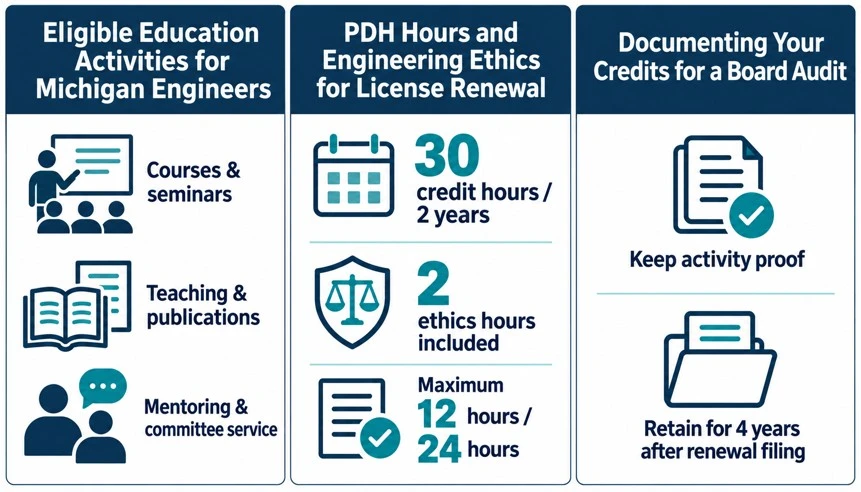 Teaching and publication have different rules from attendance. Michigan awards teaching credit at twice the attendance rate, subject to its 12-hour limit. A publication must be peer-reviewed and related to professional engineering; publishing the same work multiple times does not generate additional credit. If your plan depends heavily on these categories, calculate the category maximum before scheduling the rest of your education.
The less familiar categories can be useful, but their conditions are specific. Committee service requires voting membership and attendance at no fewer than half the regularly scheduled meetings. Board-meeting credit requires attendance from start to finish and a department employee’s completed form. School-sponsored mentoring qualifies only when it falls outside your regular job description. Ordinary participation in a committee meeting or informal mentoring should not be claimed under those categories without meeting the rule’s conditions.
Online Continuing Education and Course Conditions
Online delivery is permitted when the underlying activity satisfies Rule R 339.16041. A live webinar might fit the seminar or presentation category; a documented company training session might fit the company-training category. For a written self-paced course or recorded webinar, check the applicable rule category and the completion documentation rather than assuming its format alone determines acceptance. The rule’s activity descriptions, credit calculations, and audit proof remain the deciding factors.
Before enrolling, ask what the provider will issue when you finish. For a program offered or approved for credit by an organization named in Rule 41(a), the audit documentation must show your name, credit earned, sponsor name and contact information, program title, and completion date. For other categories, the rule specifies different proof, such as a transcript, presentation notice, company record, publication, or official letter. Save supporting material when you complete the activity; reconstructing attendance years later is difficult.
For engineers with licenses in several states, one course may be useful for more than one renewal, but Michigan’s acceptance does not establish acceptance elsewhere. Check each board’s subject, format, timing, and documentation rules separately.
PDH Hours and Engineering Ethics for License Renewal
Michigan’s operative rules call these continuing education credit hours. Engineers and course providers often use “PDH” when discussing the same planning task, but you should use Michigan’s rule to determine the credit actually available for each activity. A standard renewal requires 30 qualifying credit hours earned during the two years immediately before the license expires. Two of those 30 must focus on professional ethics related to engineering; they are included in the 30, rather than added to it. The ethics subject does not have to focus specifically on Michigan statutes or rules.
Michigan’s licensing guide directs engineers to finish the education before completing the online renewal application. Submitting that application certifies compliance. The guide says you may begin the online renewal no sooner than 90 days before your license expires. Check your own expiration date in MiPLUS rather than assuming that all Michigan PEs share a calendar deadline.
Consider this example: an engineer completes 26 qualifying technical credit hours and a two-credit-hour ethics course. The total is 28, so the engineer still needs two qualifying hours. Conversely, 30 technical hours without the required ethics component do not satisfy the rule. This is why a running total should track ethics separately from overall credit.
Credit Limits and Exclusions
Michigan allows no more than 12 continuing education credit hours in a 24-hour period. That limit applies even if you finish multiple eligible activities that day. The rule also denies credit for a program or activity with substantially the same content as one for which you already earned credit in the same renewal period. Repeating a familiar course may refresh your knowledge, but do not count it twice toward that renewal.
Several categories have their own caps, shown in the table above. For example, reading eligible journal articles can contribute at most four credit hours per renewal period, while eligible mentoring can contribute at most eight. If you build a 30-hour plan around these activities, add the capped credit, not every hour you spent participating.
Because renewal credit must be earned in the two-year period immediately before expiration, do not plan to apply excess hours from an earlier period to the next standard renewal. The published rule provides the timing requirement and does not establish a carryover allowance. Engineers with unusual circumstances should confirm their individual situation with the department before relying on older education.
A waiver is a separate process, not an automatic exemption. Rule R 339.16040 requires the request to reach the department for board consideration at least 30 days before the last regularly scheduled board meeting before expiration. If you may need one, contact the department early enough to identify that meeting and assemble your request.
Documenting Your Credits for a Board Audit
Keep proof for four years after filing your renewal application. Michigan can audit your compliance and ask for the documentation specified for each activity in Rule R 339.16041. A personal spreadsheet helps you track your progress, but it does not replace the certificate, transcript, letter, publication record, or other evidence required for the activity you claim.
Keep proof of each activity you claim so you are prepared for the Michigan PE continuing education audit process.
A practical pre-renewal check is:
- Confirm your license expiration date and the preceding two-year education window.
- Total eligible credit using Michigan’s rate for each activity, including category caps and the 12-hour limit per 24 hours.
- Confirm that at least two of your 30 hours address professional ethics related to engineering.
- Remove duplicate-content claims and activities completed outside the applicable period.
- Match every claimed activity to the proof required by Rule 41, then retain that proof for four years after filing.
- Complete the requirements before you submit the renewal attestation.
Michigan’s Bureau of Professional Licensing offers CE Broker information for tracking education. Using it to track credits is optional, but the bureau says an engineer selected for a continuing education audit must upload documentation there. Keep your own accessible copies as well.
If you need to fill a gap, choose an activity whose subject and documentation fit Michigan’s rule. PDH Pro offers written self-paced courses, recorded webinars, and live webinars on its schedule. Check the specific course’s credit and completion record against your remaining requirement before enrolling.
Frequently Asked Questions
How many PDH credits does a Michigan PE need? For a standard two-year renewal, Michigan requires 30 continuing education credit hours, including two in professional ethics related to engineering. All 30 must come from qualifying activities within the applicable two-year period.
How many CEUs can you complete in a day in Michigan? Michigan’s PE rule states a limit in credit hours rather than answering the question as “CEUs”: no more than 12 continuing education credit hours may be earned in any 24-hour period. Check the credit value of each activity; do not treat a provider’s CEU label as permission to exceed that limit.
Does attending a conference count? Qualifying engineering seminars, workshops, and technical presentations can count at one credit hour for every 50 minutes attended. Keep records for the particular sessions you claim; registration for the event alone does not document each session.
Can I claim the same course twice? No, not for substantially the same content within one renewal period. Michigan’s rule expressly excludes repeat credit for such a program or activity.
What if I reach expiration without finishing the required education? The licensing guide says an engineer who has not met the requirement before expiration will need to apply for relicensure. It also describes a 60-day renewal grace period, but that grace period should not be treated as extra time to earn education required before expiration. Contact the department about your circumstances before filing an inaccurate renewal attestation.