
Written by: Jordan Ellis
Published: Mar 9, 2021 | Updated: May 18, 2026
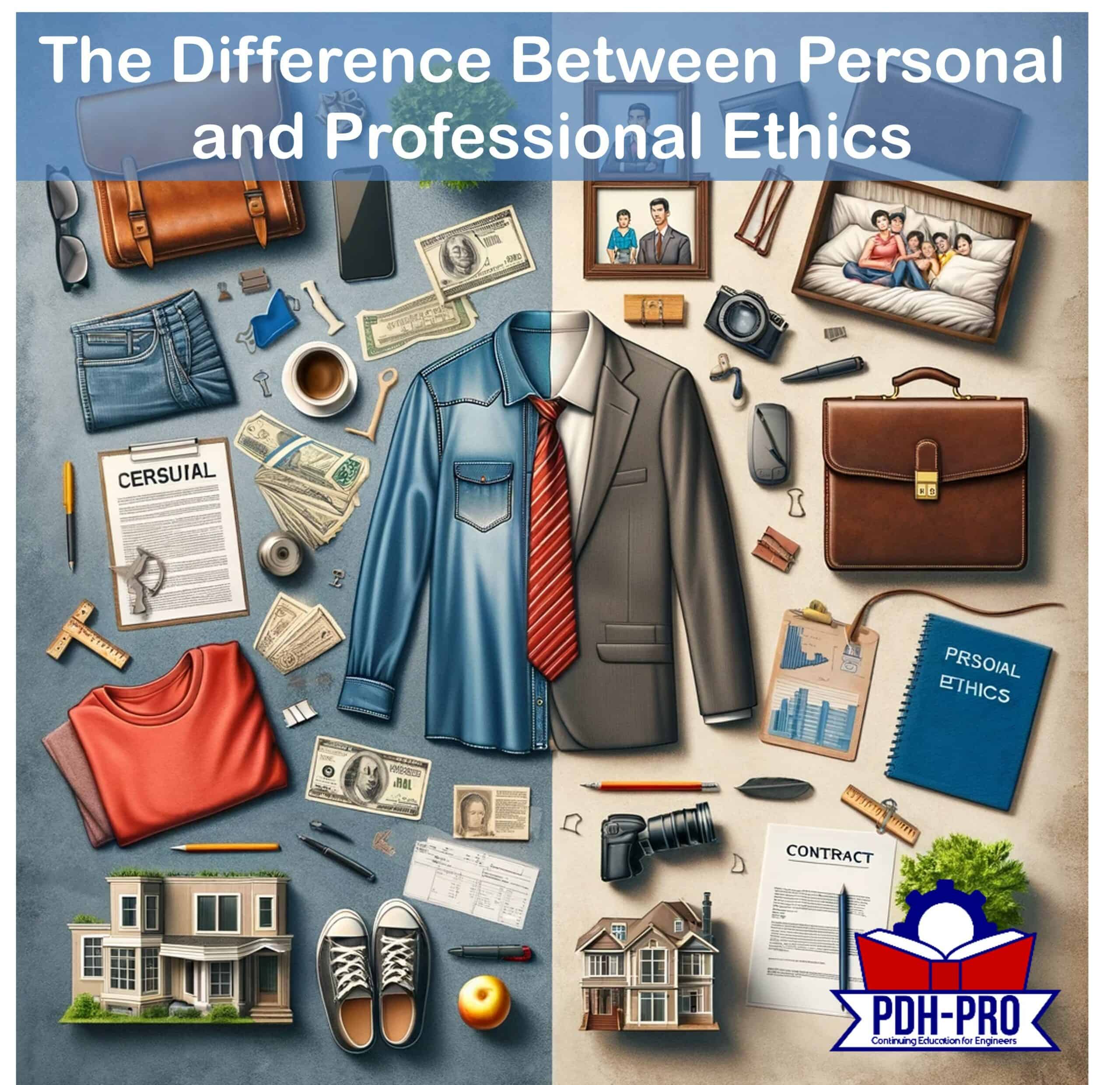 Most engineers can describe their personal values without much hesitation. Articulating the difference between personal ethics and professional ethics, and understanding how the two interact when they pull in different directions, is harder. For Professional Engineers, that distinction is not abstract. It shapes daily decisions, defines legal obligations, and, when the line between the two blurs, can affect a license.
What Is the Difference Between Personal Ethics and Professional Ethics?
Table of Contents
Personal ethics are the moral principles an individual develops through upbringing, experience, and values. They are self-defined and vary from person to person. Professional ethics are a codified set of standards established by an industry, enforced by licensing boards and professional societies, and applied uniformly across all practitioners regardless of individual belief.
The core distinction: personal ethics guide what you believe is right; professional ethics define what you are obligated to do. For Professional Engineers, professional ethics carry legal weight. Violating them can result in disciplinary action, license suspension, or revocation. Those are consequences that personal ethics alone do not impose.
Defining Personal and Professional Ethics
Personal ethics reflect an individual’s internal moral compass. They develop over time through family, culture, education, and personal experience, and they govern how a person makes decisions when no external rule applies.
Common personal ethics include:
- Honesty
- Loyalty
- Empathy
- Integrity
- Respect
These values are not imposed from outside; they are chosen, often without formal articulation.
Professional ethics are externally defined and codified. They represent the standards a person agrees to uphold upon entering a licensed profession. For engineers, those standards are set at the national level through the NSPE Code of Ethics, which is organized into three tiers: the Fundamental Canons, the Rules of Practice, and the Professional Obligations.
State licensing boards apply and enforce these standards locally. Common professional ethics in engineering include:
- Honesty
- Impartiality
- Fairness
- Equity
All of these are part of a larger, unwavering commitment to the protection of public safety, health, and welfare.
The overlap between personal and professional ethics is real. Most people drawn to engineering already hold values that align with its professional standards, but alignment is not the same as equivalence. Professional ethics apply even when personal ethics would point elsewhere, and they provide a consistent standard when individual judgment varies.
The following YouTube video offers a good explanation of the difference between personal and professional ethics.
Personal and Professional Ethics Examples
Understanding personal and professional ethics examples in concrete terms makes the distinction easier to apply in practice.
Personal ethics scenario. Consider finding $50 on the floor of a coffee shop with no one nearby. Whether to keep it or ask around is a personal ethical question. There is no law requiring action either way, no professional standard to consult. The decision reflects individual values: what you would want someone to do if the money were yours, and how you define honesty and fairness in your own life.
Professional ethics scenarios. Now consider two situations a PE encounters regularly. First: a project client asks an engineer to seal drawings prepared by an unlicensed contractor without direct PE supervision. The engineer’s personal ethics might make this feel uncomfortable, but the professional obligation is explicit. Applying a PE seal is a formal declaration that the engineer has either prepared the work or directly supervised its preparation. Sealing work that does not meet that standard is a professional ethics violation and a disciplinable offense in every state.
Second: a PE holds a financial interest in a subcontractor and is also serving as the design lead for the same project. Personally, the engineer may feel confident that their judgment is unaffected. Professionally, the NSPE Code requires disclosure and, in many cases, recusal from decisions involving that subcontractor. The civil engineering code of ethics and equivalent discipline-specific codes make no exception for good intentions.
Where the two can conflict. In 2003, researchers at the Boyce Thompson Institute published findings that could not be replicated, prompting the scientific community to question the validity of the original study. The lead author, Dr. Chandok, sued for defamation when her results were publicly challenged, as misconduct had never been proven.
The case was ultimately dismissed in favor of continued scientific scrutiny, illustrating how professional ethics, specifically the obligation to validate and reproduce results, can come into direct conflict with an individual’s sense of personal fairness. The professional standard held. That is the point of having one.
Why the Distinction Matters for Engineers
Engineering decisions affect public safety in ways that most professions do not. A bridge, a water treatment system, a structural design: each carries consequences that extend far beyond the client relationship. Because of this, the engineering profession operates under a formal ethical framework that sets a floor below which personal judgment alone cannot take a practitioner.
This is why personal ethics, however strong, are not a substitute for professional ones. An engineer who personally values honesty but has not studied the specific obligations of the NSPE Code or their state’s rules of practice may act in good faith and still commit a professional ethics violation.
Understanding professional ethics in engineering means knowing not just the values but the rules, and knowing when the rules apply regardless of what personal conviction might suggest.
Resolving Conflicts Between Personal and Professional Ethics
When personal and professional ethics point in the same direction, decision-making is straightforward. Conflicts arise when they diverge: when a client’s request, an employer’s pressure, or a financial interest pulls against what the professional code requires.
The engineering profession’s answer to these situations is the codified standard itself. When personal judgment is clouded by relationships, financial stakes, or competing loyalties, the professional ethics framework provides a fixed reference point that is not subject to individual interpretation.
An engineer uncertain whether a situation requires disclosure, recusal, or refusal can consult the NSPE Code, their state board’s rules, or seek guidance from their professional society, rather than relying on instinct alone.
This is also why professional ethics are not static. The Dr. Chandok case and others like it demonstrate that formal ethical standards are tested, debated, and refined over time as new situations arise. Participation in that process, through continuing education and engagement with professional organizations, keeps engineers current on how standards are being interpreted and applied.
Ethics in Engineering Practice and Licensure
For licensed Professional Engineers, personal and professional ethics are not separate concerns that occasionally intersect; they are continuously intertwined in practice. Every sealed document, every client disclosure decision, and every instance where public safety is weighed against cost or schedule is a moment where both sets of ethics are in play simultaneously.
State licensing boards reinforce this through continuing education requirements. Most states mandate ethics PDH hours as part of biennial license renewal. Requirements vary by state, but the underlying purpose is consistent: to ensure that PEs engage regularly with formal ethical standards rather than relying solely on personal judgment developed at the time of initial licensure.
PDH Pro’s ethics and law courses are built specifically for Professional Engineers and designed to satisfy state board ethics PDH requirements. Courses cover the NSPE Code, real disciplinary cases, conflicts of interest, and the engineer’s duty to the public, giving engineers a structured framework for the situations where personal conviction alone is not enough.
FAQs
Which states require ethics PDH hours for PE renewal?
The majority of states with mandatory continuing education for PE license renewal include an ethics component, though the specific hour requirement varies. Some states mandate as little as one hour per cycle; others require two or more. A handful require ethics courses from state-specific providers or covering state-specific rules of practice. For a full breakdown by state, see which states require ethics PDH courses.
How many PDH hours does an ethics course typically satisfy?
Most ethics courses offered for PE continuing education are one to three PDH hours in length. A two-hour ethics course is the most common format and satisfies the ethics mandate in the majority of states that require it. Engineers should confirm their state’s specific requirement before selecting a course, as some states have minimum hour thresholds or content restrictions that affect which courses qualify.
What topics does a qualifying engineering ethics course cover?
A qualifying professional engineering ethics course typically addresses the NSPE Code of Ethics, an engineer’s duty to protect public health and safety, conflicts of interest, professional liability, client and employer obligations, and the rules of practice established by state licensing boards. Courses that focus on general business ethics or workplace conduct without anchoring content to the specific obligations of licensed engineers generally do not satisfy the ethics PDH requirement. PDH Pro’s ethics and law courses are built around these qualifying topics and accepted by state boards across the country.